Pray
Read
Ecc 2:1-11.
Meditation
So there was no answer in drink.
But surely, Solomon, his critics say, you just need to do something more meaningful. Drinking is such a base desire. You just need to look for pleasure in something more meaningful.
“Alright,” says Solomon, “try me. Let’s go with projects and industry, with development and achievement. Let’s pursue something more noble. I will build great houses, plant spectacular gardens with fruit trees, and design an irrigation system that the world has never seen. Our technology will take leaps and bounds.”
And indeed, we see here that Solomon was a man of industry. You can read more about it in the book of Kings. He assembled a workforce of eighty thousand stonecutters and seventy thousand labourers. He spent thirteen years building a palace for himself. He built other palaces, administrative buildings, and courts. He built the temple of God itself, a magnificent construction. This wasn’t just a house project—Solomon made monuments and buildings that would be the envy and wonder of the world.
And there’s no doubt about it: there is a certain satisfaction to be found in projects like these, in advancing technology, and in achievements at work. Even a humble, well-kept garden can bring immense satisfaction—a model ship completed, the interior of a house freshly painted. And as technology advances, our new phones continue to amaze us, opening up opportunities that people could not even have imagined four decades ago.
Well, Solomon tried it all. He planned, he built, he labored. He achieved astounding things and amazed the world. And when he had finished it all—when his heart surveyed his achievements—he came to the end and realized: it is all vanity.
Probably our children’s children will be doing things with their equivalent of a smartphone, things we cannot even imagine right now. They will be amazed to live in the early twenty-second century. But we won’t be there. We won’t benefit from it. Even the things we do now—our jobs, our projects, the advancements of technology that we enjoy—when we are dying in just a few short years, these things will not bring lasting contentment. We will not be able to take them with us. We will hold our phones in our hands and say: it is vanity. It is all a breath.
“Then I considered all that my hands had done and the toil I had expended in doing it,” Solomon writes, “and behold, all was vanity and a striving after wind, and there was nothing to be gained under the sun.”
You can build the grandest of designs, you can achieve great things, but there is no lasting satisfaction to be found there. We cannot take these things to the grave with us.
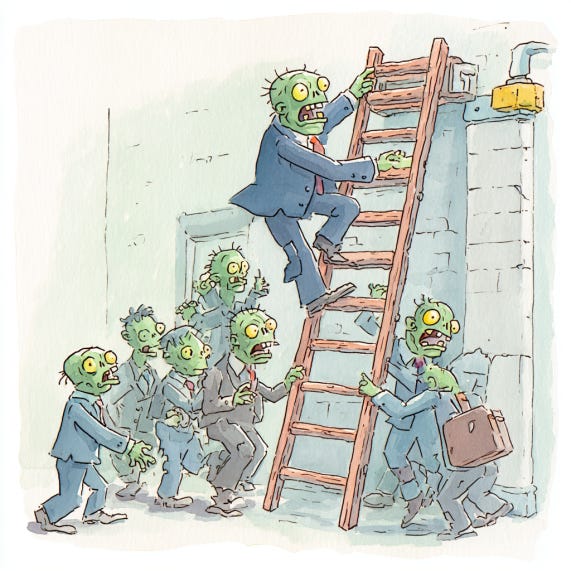
And in a culture of busyness, where being a workaholic is an easy temptation, we should take note of this. Our jobs will be satisfying to an extent; we can achieve and complete projects; but the working lifestyle can easily draw us in. The working world will take everything it can from you. I watched it happen in Canberra. Work will take as much as it can—if you give a little, it will ask for more, and then more. And soon you see executives with broken marriages, working long hours. And for what?
Don’t follow the path of obsession with labour, Solomon says. There is no lasting happiness there. You won’t find what you’re looking for.
We need a building project that’s larger than we are. Larger than anything this world has to offer. That project exists, it’s called “The Kingdom of God.” As we come to Christ for cleansing from our sins, he calls us into his agenda for history: the establishment of the Kingdom of God. As we labour in service to our Saviour, we find that our work is not in vain. Let go of the idols of workaholics, embrace the full satisfaction that is found in Christ alone. SDG.