In 1941, a man who had just escaped Nazi Germany sat down at Columbia University and tried to answer the most important question of the twentieth century.
It was not “how did Hitler take power?” Historians had already begun documenting that. The question Erich Fromm needed to answer was different. It was worse.
Why did the people let him?
Not the inner circle. Not the military leaders or the party functionaries or the industrialists who funded the operation. The ordinary people. The shopkeepers and teachers and factory workers and farmers who watched a democratic republic dismantle itself and did not just allow it to happen but cheered while it did.
Fromm published his answer in a book called Escape from Freedom. The book argued that fascism is not imposed on a population from the outside. It is chosen from the inside. By people who are free. Who have the ability to think for themselves. And who voluntarily surrender that ability because the weight of freedom has become more than they can carry.
Eighty-four years later, the book reads like a field manual for understanding the United States of America.
The Core of Fromm’s Argument
Fromm identified a paradox at the center of modern life that most political theorists had missed entirely.
The modern era liberated human beings from the constraints that had organized their lives for centuries. Feudalism collapsed. The authority of the church weakened. Rigid class systems loosened. People gained the freedom to choose their own beliefs, their own careers, their own identities. For the first time in history, the individual was free.
But Fromm saw what that freedom actually produced in millions of people. Not confidence. Not creativity. Not self-determination. Anxiety. Isolation. A paralyzing sense of insignificance.
He called this the burden of freedom. The distinction he made was between two types of freedom. Freedom from is liberation from external constraints. You are free from the king, from the church, from the rigid hierarchy that told you who you were and what your life meant. Freedom to is the capacity to use that liberation productively. To create meaning. To build relationships. To construct a life that matters on your own terms.
The modern world delivered freedom from. It did not deliver freedom to. Millions of people were liberated from the structures that had oppressed them and left standing in an open field with no direction, no community, no framework for meaning, and no one to tell them what to do next.
For psychologically strong individuals, this is an opportunity. For everyone else, it is a crisis.
Fromm argued that when the anxiety of freedom becomes unbearable, people do not fight to preserve it. They run from it. They seek out any structure, any leader, any movement that promises to take the burden away. They surrender their autonomy in exchange for certainty. They trade self-determination for belonging. They hand their freedom to someone else and feel relief, not loss.
He called this the escape from freedom. And he identified three mechanisms through which it happens.
The first is authoritarianism. The person submits to a leader and allows the leader to do their thinking for them. The submission feels like strength because the leader projects power and the follower absorbs it by association.
The second is destructiveness. The person attempts to destroy the world that makes them feel small. If the institutions, the experts, the systems, the cultural changes are what make freedom feel unbearable, then destroying those things feels like liberation.
The third is automaton conformity. The person abandons individual thought entirely and thinks whatever the group thinks. They adopt the opinions, the language, the values, and the emotional reactions of the crowd. They experience this as thinking for themselves because the group’s thoughts have replaced their own so completely that the substitution is invisible.
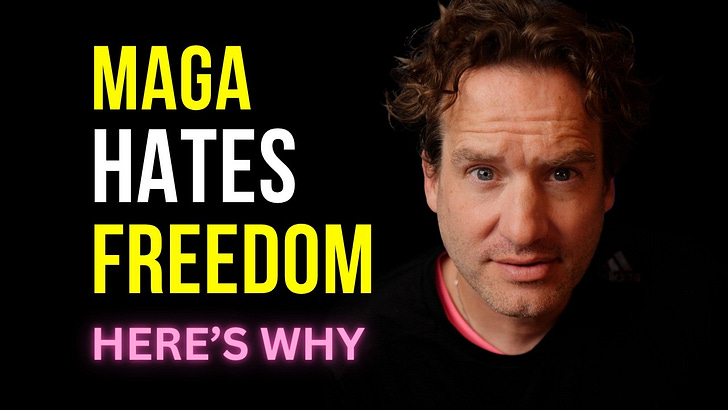
MAGA does all three simultaneously. And six decades of psychological research have confirmed the mechanisms underneath each stage of the escape.
Why They Were Primed Before Trump Arrived
Fromm argued that the escape from freedom begins when people lose the belief that their actions can change their circumstances. Modern psychology has a precise term for this state and a body of experimental evidence showing exactly how it works.
In 1967, psychologist Martin Seligman at the University of Pennsylvania published research showing that repeated exposure to uncontrollable negative events teaches the brain to stop trying. The brain learns, through experience, that effort does not produce results. Once that lesson is internalized, the person stops generating action plans even when the situation changes and escape becomes possible.
Seligman called it learned helplessness. The research has been replicated hundreds of times across multiple species and multiple contexts. The finding is consistent: when the brain concludes that nothing you do matters, it shuts down the motivational system that would otherwise drive you to act.
The communities where MAGA support runs deepest are communities where learned helplessness is not a laboratory finding. It is a lived experience spanning decades. Wages that did not rise. Jobs that disappeared and were not replaced. Towns that hollowed out. Schools that were defunded. Infrastructure that crumbled. Promises from politicians of both parties that were made and broken and made and broken until the brain learned the obvious lesson: nothing you do will change anything.
Seligman’s research showed that learned helplessness produces a specific vulnerability. The person who has given up on their own agency becomes dependent on external sources of control. They stop generating their own plans and look for someone else to generate plans for them.
Trump said “I alone can fix it.” That sentence is not a policy statement. It is the precise message that a brain trapped in learned helplessness is waiting to hear. Someone else will handle it. Someone else has the plan. You don’t have to try anymore. Just follow.
Fromm predicted this exact dynamic in 1941. The person escaping freedom does not evaluate the leader’s competence. They evaluate the leader’s certainty. In a brain that has concluded effort is pointless, absolute certainty feels like the opposite of everything that has ever failed them. It does not matter whether the certainty is justified. It matters that it exists.
Why They Cannot Leave the Group
Fromm argued that the escape from freedom is not just about the leader. It is about the group. The movement provides something the modern world stripped away: a tribe. A community. A structure that tells you who you are, what you believe, and where you belong.
In 1995, psychologists Roy Baumeister and Mark Leary published what became one of the most cited papers in social psychology. They reviewed decades of research on human connection and concluded that the need to belong is among the most powerful drives in the human brain. It is not a preference. It is a biological imperative. People will tolerate extraordinary costs, including abuse, deception, and the destruction of their own material interests, to maintain the feeling of belonging to a group.
The research showed that the brain processes social exclusion using the same neural pathways it uses to process physical pain. Being cut off from a group does not just produce sadness. It produces a neurological response indistinguishable from a physical injury.
Now consider what MAGA has replaced in the lives of its members. As they went deeper into the movement, they lost people. Friends who could not tolerate the politics stopped calling. Family members pulled away. Coworkers avoided them. Holiday dinners became arguments that ended relationships.
And every one of those people was replaced by another MAGA supporter. Their entire social architecture was rebuilt inside the movement. Their friends, their news, their entertainment, their social media feeds, their daily vocabulary, their sense of humor, their rituals, their heroes, their enemies are all organized around one identity.
Baumeister and Leary’s research predicts exactly what this means for the possibility of leaving. A person whose entire social world exists inside one group cannot leave that group without triggering a neurological event the brain processes as equivalent to a physical attack. The cost of leaving is not just loneliness. It is pain.
Fromm described this in 1941 without the neuroscience. He wrote that the person who escapes into a group does not experience the group as a cage. They experience it as a home. The walls are invisible because the alternative, standing alone in the open field of freedom, is more terrifying than anything the group can do to them.
How the System Disables Morality
Fromm’s most disturbing observation was that people who escape into authoritarianism become capable of cruelty they would never have committed as free individuals. The group does not just provide belonging. It provides permission.
In 1999, psychologist Albert Bandura at Stanford University published research that provided the mechanism Fromm had described but could not yet explain neurologically. Bandura showed that the human brain has a set of internal mechanisms that allow a person to selectively deactivate their own moral standards. The deactivation is temporary. It is targeted. And it is invisible to the person doing it.
Bandura called it moral disengagement. He identified eight mechanisms and they map onto MAGA’s behavior with clinical precision.
Moral justification reframes cruelty as service to a higher cause. Deporting families is not cruelty. It is protecting America. Euphemistic labeling changes the language so the cruelty does not sound like cruelty. Families are not destroyed. They are processed. Workers are not fired. They are part of efficiency gains. Dehumanization strips the victim of their humanity so the brain’s moral standards no longer apply to them. They are not people. They are illegals, vermin, animals, poison in the blood.
Each mechanism does the same thing: it creates a gap between the act and the person’s self-concept just large enough for the cruelty to pass through without triggering guilt. And each successful act of moral disengagement makes the next one easier. The threshold moves. What was unthinkable six months ago becomes normal. What was normal becomes mild.
Fromm observed this same escalation in Germany. Bandura proved how it works in the brain. And MAGA demonstrates it on live television every day.
The Machine That Keeps It Running
Fromm wrote Escape from Freedom in 1941. The primary delivery systems for the escape were radio broadcasts and party rallies. He could not have imagined the machine that now exists to maintain the escape at industrial scale.
In 2017, psychologists William Brady and Jay Van Bavel at New York University published research in the Proceedings of the National Academy of Sciences analyzing over half a million social media posts. They found that every moral-emotional word in a political post increased its sharing rate by approximately 20 percent. The angrier and more morally charged the language, the faster and further it spread. The effect was bounded by group membership, meaning the outrage circulated inside the echo chamber, intensifying the group’s existing beliefs with every share.
Brady and Van Bavel called it moral contagion. The algorithm does not reward accuracy. It rewards emotional intensity. It surfaces the most extreme version of whatever the group already believes and pushes it to the top of every feed. Every time you share it, the system feeds you more.
This machine keeps every mechanism in the escape operational simultaneously. It keeps the learned helplessness active by telling the audience every day that the world is dangerous and getting worse. It keeps the belonging rewarded by flooding the feed with in-group validation. It keeps the moral disengagement running by providing a fresh supply of dehumanized enemies every news cycle. And it does all of this automatically, without a propaganda minister, without a centralized command, without any human being making a deliberate decision.
The algorithm is the most efficient fascism delivery system ever built. Not because it was designed to produce fascism. Because it was designed to maximize engagement. And fascism is engaging.
Why They Will Not Stop
Fromm observed that people who have escaped into authoritarianism do not return on their own. The escape is self-reinforcing. Every day inside the movement makes leaving more costly and staying more automatic.
In the 1970s, psychologist Barry Staw at UC Berkeley published research on what happens when people have invested heavily in a course of action that is clearly failing. The rational response would be to cut losses and change direction. Staw found that people do the opposite. They escalate. They invest more. They commit harder. Because stopping would mean the original investment was wasted. And the psychological cost of admitting waste is so high that the brain would rather keep losing than face it.
Staw called it escalation of commitment. Applied to MAGA, the mechanism is devastating. Every act of loyalty a Trump supporter has performed is an investment they cannot write off without confronting what it cost.
Every argument they started at a family dinner. Every friend they lost. Every relationship they destroyed. Every conspiracy theory they repeated to someone they loved. Every dollar they donated to a man who would not let them into his living room. Every time they defended something they knew was indefensible.
Admitting Trump was a fraud does not mean changing a vote. It means admitting the last ten years were wrong. It means every family member they cut off was cut off for a lie. It means every person who tried to warn them was right.
The brain will not allow that. It will protect the investment at any cost, including the cost of reality. So they keep going. Not because they believe. Because the alternative is looking back at what they have done and facing it without the story that made it all make sense.
What Fromm Tried to Tell Us
Erich Fromm spent the rest of his career refining and extending the argument he made in 1941. He wrote book after book warning that the escape from freedom is not a historical anomaly. It is a permanent vulnerability in the human psyche. It can be activated any time a population is isolated enough, helpless enough, and afraid enough to prefer a cage to an open field.
The people deepest inside MAGA do not feel trapped. They feel free. They feel like fighters, like patriots, like rebels. That is how the escape works. It does not feel like surrender. It feels like purpose. It does not feel like giving up your freedom. It feels like finally using it.
And that is what makes it so hard to break. The cage does not look like a cage from the inside. From the inside it looks like the only place in the world that makes sense.
Fromm wrote this warning in 1941. Nobody listened. And the country that defeated fascism the first time is becoming one.
Sources
Fromm, E. (1941). Escape from Freedom. Farrar & Rinehart.
Fromm, E. (1955). The Sane Society. Rinehart & Company.
Seligman, M. E. P., & Maier, S. F. (1967). Failure to Escape Traumatic Shock. Journal of Experimental Psychology, 74(1), 1-9.
Maier, S. F., & Seligman, M. E. P. (2016). Learned Helplessness at Fifty: Insights from Neuroscience. Psychological Review, 123(4), 349-367.
Baumeister, R. F., & Leary, M. R. (1995). The Need to Belong: Desire for Interpersonal Attachments as a Fundamental Human Motivation. Psychological Bulletin, 117(3), 497-529.
Bandura, A. (1999). Moral Disengagement in the Perpetration of Inhumanities. Personality and Social Psychology Review, 3(3), 193-209.
Bandura, A. (2016). Moral Disengagement: How People Do Harm and Live with Themselves. Worth Publishers.
Brady, W. J., Wills, J. A., Jost, J. T., Tucker, J. A., & Van Bavel, J. J. (2017). Emotion Shapes the Diffusion of Moralized Content in Social Networks. Proceedings of the National Academy of Sciences, 114(28), 7313-7318.
Staw, B. M. (1976). Knee-Deep in the Big Muddy: A Study of Escalating Commitment to a Chosen Course of Action. Organizational Behavior and Human Performance, 16(1), 27-44.