🎉 A version of this article appeared earlier today in Business Insider. Check it out here 🎉
INTERESTING ON THE WEB
* 💪 Awesome upcoming Data & Democracy Workshop series taking place August 2024 is focused on empowering election officials, policy professionals, and researchers to undertake data-driven projects that bolster free and fair elections - LINK
* 👰♀️ Child marriages run rampant in the US: 300,000 child marriages in the last 25 years, largely in Nevada, Idaho, Arkansas, and Kentucky - LINK
* 🛑 States including Texas and South Dakota are pushing new bans on guaranteed income programs - LINK
* 🤔 Did the 401K drive greater inequality? - LINK
* 🥷 How scammers are stealing food stamps from millions (thanks to the folks at Georgetown for highlighting this one) - LINK
Sleep is critical, but a full third of Americans do not get enough of it, and the trend has been getting worse. We all need at least seven hours each day in order to function properly. That critical time allows our bodies to start repairing cells, store memories, and balance our emotions.
When you don’t get enough sleep, it can impact everything from how much money you make to your mental health to your likelihood of getting dementia, heart disease, and diabetes.
American Inequality is a reader-supported publication. To receive new posts and support my work, consider becoming a free or paid subscriber.
Hustle culture success stories often make it seem like you can get more out of life on less sleep. Successful CEOs like Apple’s Tim Cook and Robinhood’s Vlad Tenev tout their limited sleep schedules. Gordon Ramsay barely sleeps during the week, and loves to yell at his line cooks about how that has helped him get to where he is today.
While different people tend to feel more alert at different times of day — aka night owls or early birds — everyone needs at least seven to nine hours of sleep each night. Teenagers need a full eight to 10 hours. And there is emerging evidence that women, who historically haven’t been included in sleep studies, need more rest than men.
The internet is littered with advice on how to get enough sleep: keep your phone in a different room, don’t drink alcohol before bed, turn the thermostat down. There’s even specialized advice for couples: maybe separate bedrooms will help. Those with extra cash can take things a step further — beyond putting their penthouses far above the fray. Drake, for instance, bought a $395,000 horse-hair mattress that supposedly improves circulation. Michael Phelps sleeps in a hyperbaric chamber that simulates being at 9,000 feet. And expensive products like Oura’s smart ring and Whoop’s smart band promise to use data to improve your sleep.
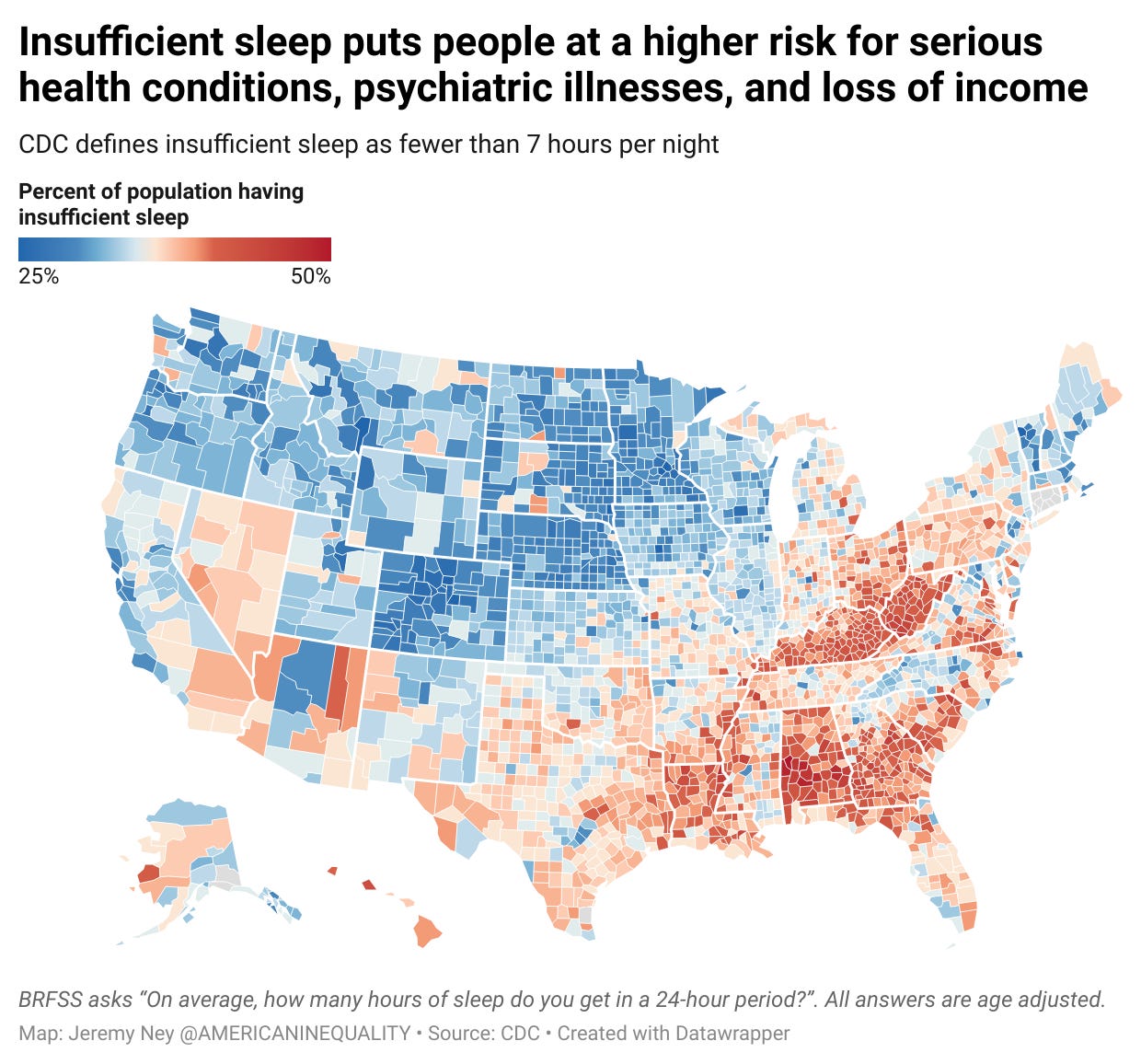
The messaging implies that proper “sleep hygiene” (and expensive products) can fix chronic sleep depravity. This idea led researchers to believe that people in cities — where sleep impediments like noise pollution, bright lights, cramped conditions, and poor airflow are common — got the worst sleep. But research by my team at American Inequality has found that the most underslept people actually live in low-income, rural areas, primarily in the South. Residents of West Virginia, Kentucky, and Alabama regularly get the least amount of sleep — and it’s not because they don’t have horse-hair mattresses.
What causes bad sleep?
There are 4 main reasons the South and the Appalachian counties have the worst sleep in America.
* Stress: Stress is one of the strongest indicators of poor sleep. People who have financial, physical, or emotional stress tend to have worse sleep. In the counties seen in the map above in red, we observe some of the highest unemployment rates and lowest incomes as people are deeply stressed about their futures and livelihoods.
* Poor physical health: People who are struggling with chronic health issues tend to have far worse sleep as well since those illnesses tend to keep them awake or in hospitals.
* Bad sleep habits: Areas where people tend to drink more, eat more fast food, or exercise less tend to get worse sleep.
* Physical factors: Noise and light pollution, crowded rooms, lack of air conditioning in high temp areas, and crime, all cause sleep disturbances and tend to cluster within low income areas, leading to further inequalities.
The data comes from the CDC’s Behavioral Risk Factor Surveillance Survey, which asked 432,000 people the following question: “During the past thirty days, for about how many days have you felt you did not get enough rest or sleep?”
Stress about finances and health is the strongest contributor to bad sleep
Researchers have found that stress — financial, physical, or emotional — is one of the strongest indicators of poor sleep. Economic stress, in particular: People in poverty in the US report getting the least amount of sleep. A 2022 survey found that 87% of Americans lose sleep worrying about their finances. And a 2020 study found that 13% of newly unemployed people get four hours of sleep or less a night, half of what a regularly employed person gets on average. In counties where about half the population is underslept, many of which are in Alabama, unemployment rates are twice as high as the US average and median household incomes teeter at $35,000.
Mingo County, tucked in the southwestern corner of West Virginia, is the most sleep-deprived county in the most sleep-deprived state. One in four Mingo residents lives in poverty — double the national average. On top of that, the county struggles with poor health — another major contributor to poor sleep. Nearly half of Mingo residents are obese — 10% above the national average — and one in three smoke cigarettes — triple the national average. Mingo residents also have the highest rates of hypertension, cardiovascular disease, and being uninsured in the state.
On the other end of the spectrum is Boulder County, Colorado, which gets the best sleep in America with 8 in 10 people getting a good night of rest. In Boulder, the unemployment rate is one of the lowest in the state and median household income falls at $92,000. In major cities like Manhattan and San Francisco, where median incomes fall at $90,000 and $126,000 respectively, seven in 10 people report getting sufficient sleep. Money may not buy happiness, but it does seem to buy better sleep.
Of course money isn’t everything. Mental and physical health are also factors. In our analysis, we found a 79% correlation between mental health and poor sleep. A 2022 study by Columbia researchers confirmed these mental health findings on a global scale. 75% of people with depression say they struggle to fall asleep or stay asleep and 50% of people with chronic pain report getting insufficient sleep. As many as half of people with cancer don’t get enough sleep.
The effects of poor sleep on incomes, health, employers, and the community
“Sleep is linked to health, but it’s also linked to wealth. Sleep is a pillar of health and well-being. Unfortunately, the opportunity for a good night’s sleep is not evenly distributed across populations, with many of those who need sleep most facing more barriers than the rest of us.“
Aric Prather told us the above when we asked him about sleep habits. Aric is the author of The Sleep Prescription and knows how important this can be for changing outcomes.
The worst part is how sleep depravity can spiral out of control: Poor income, depression, and physical pain make it harder to sleep, and the lack of sleep makes all of these situations more difficult to manage. Americans with sleep disorders earn an average of $2,500 less each year. Sleep-deprived workers are more likely to have to leave their jobs and their workplace mistakes cost employers up to $3,100 a year. One worker at a Boston accounting firm was so sleep deprived he accidentally deleted a project that took 1,000 hours to comp…