In this emergency episode of the Political Junkie podcast, I am joined by Michael Kazin, a prize-winning scholar and Professor of History at Georgetown University. Michael is an expert in American social movements and politics; his most recent book is What It Took to Win: A History of the Democratic Party (Farrar, Straus and Giroux, 2022), but he has also written extensively about the American peace movement, the Progressive and populist movements, and the New Left. You can see all of his work here.
The episode begins with a clip from a press conference on Sunday, January 25, 2026, in which Minnesota Senator Amy Klobuchar demands that ICE leave the state.
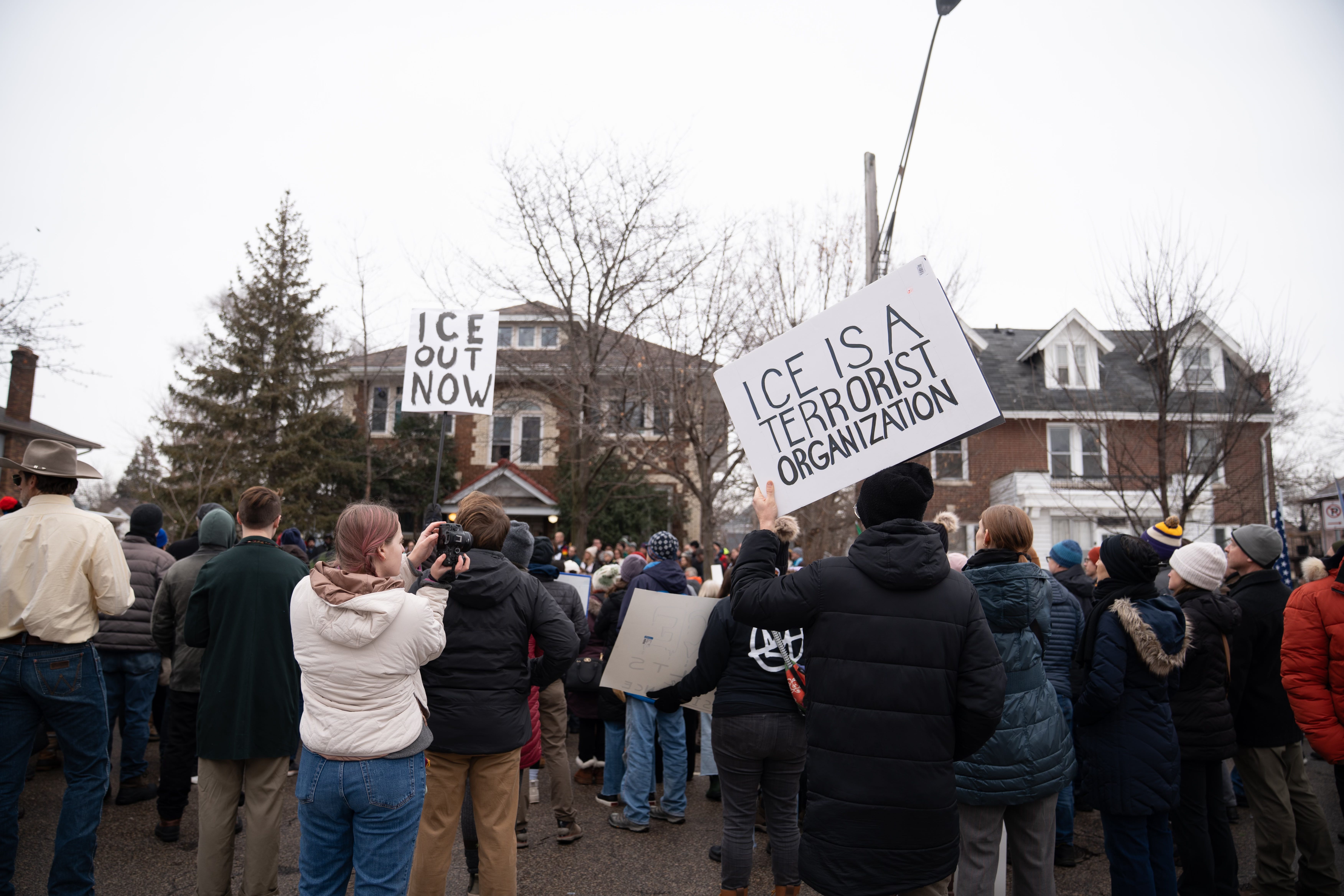
A protest on January 7, 2026, in Minneapolis, Minnesota, immediately following the murder of Renee Good by ICE officer Jonathan Ross. Photo credit: Alejandro Diaz Manrique/Shutterstock
Your host:
Claire Potter is a historian of politics and media, a writer, a podcaster, and the sole author and editor of the Political Junkie Substack. Her most recent book is Political Junkies: From Talk Radio to Twitter, How Alternative Media Hooked Us on Politics and Broke Our Democracy (Basic Books, 2020), and she is currently writing a biography of feminist journalist Susan Brownmiller.
The topics Michael and I touched on in today’s podcast included:
* The murders of two Twin Cities residents: Alex Pretti, a 38 year-old White man, and an ICU nurse, and Renee Good, a 37 year-old White woman and mother of three. Good was shot in the face, and then twice more, as she attempted to leave the scene of a protest, while Pretti was shot in the back multiple times as he was being held on the ground by officers.
* The roots of the Minnesota’s resistance in its long progressive past, and the networks established during the George Floyd protests in 2020. The organizations involved in the anti-ICE protests were clearly prepared--and some of the violence we are seeing from federal officers may be evidence that the activists are effective.
* A recent poll shows that almost 20% of registered Republicans now want to abolish ICE: will this brutal crackdown will be a decisive factor in moving the electorate away from MAGA policies?
* We mention the “credibility gap,” an old phrase from the Vietnam War years, a phrase that speaks to the out of control falsehoods coming out of Washington and the MAGA media. The Trump administration has responded to the crisis by flipping the narrative--claiming that ICE officers are really the victims, stating that they will not investigate the officers involved--and their media allies are pushing the same story. Is this fundamentally different from other Trump lies on some level, or should we expect many Americans to accept this as the “new normal?”
* What Democrats should do right now, and what should those of us who are bracing for ICE in our own communities be doing.
You can also get all audio content by subscribing for free on Apple iTunes, YouTube, or Spotify.
Short takes:
* Meredith Lee Hill reports at POLITICO that the White House may be pivoting: ICE chief Tom Homan is headed to the Twin Cities in what may be a move to displace the Border Patrol’s Gregory Bovino. “A growing number of Hill Republicans have been pushing publicly and privately for a lowering of the temperature, including from the federal government, after DHS agents shot and killed 37-year-old Alex Pretti in Minneapolis on Saturday,” Hill writes. “GOP lawmakers largely view Homan as a more practical enforcer of Trump’s mass deportation plans as some grow increasingly wary of how Homeland Security Secretary Kristi Noem and Border Patrol commander Gregory Bovino are handling the campaign, according to six GOP lawmakers granted anonymity to discuss internal conversations.” (January 26, 2026)
* “It’s not clear why the Trump regime chose to invade Minneapolis,” Jonathan V. Last writes at The Bulwark, speculating that the Trump administration could be having its Gettysburg moment. “But when the regime’s forces occupied the city they were surprised by the resistance they encountered. Not from Democratic politicians, or institutions, or the legal establishment. From ordinary people. The people of Minneapolis organized to protect their neighbors and provide oversight of the regime’s forces that the local government either could not, or would not, perform.” (January 26, 2026)
* “Again and again, I heard people say they were not protesters but protectors—of their communities, of their values, of the Constitution,” Robert F. Worth writes in The Atlantic about what he observed in the Twin Cities. “As in Cairo’s Tahrir Square, Minneapolis has seen a layered civic uprising where a vanguard of protesters has gained strength as many others who don’t share progressive convictions joined in feeling, if not always in person. I heard the same tones of outrage from parents, ministers, school teachers, and elderly residents of an affluent suburb. Some of the quarrels that divided Minneapolis city leaders only a few weeks ago, over policing or Gaza or the budget, have faded as people have come together to oppose ICE.” (January 25, 2026)
Items left at the site where Alex Pretti was murdered on Sunday. Photo credit: Darth Stabro/Wikimedia Commons
Political Junkie is a reader-supported publication. Can you support our work for $5/month?