A Poetic Invitation to Face Our S**t
Marie Ida Sequence: Writing Prompts to Love Our Mothers
Hello Wonderful Reader,
The mother-daughter bond is just about the last thing I wanted to share about this week. I only wanted to give you a taste of Elsa von Freytag-Loringhoven because next week we’ll be working with another poem by her in a “Fantasy”-themed Intimacy Writing Workshop (which I’m very excited to teach!)
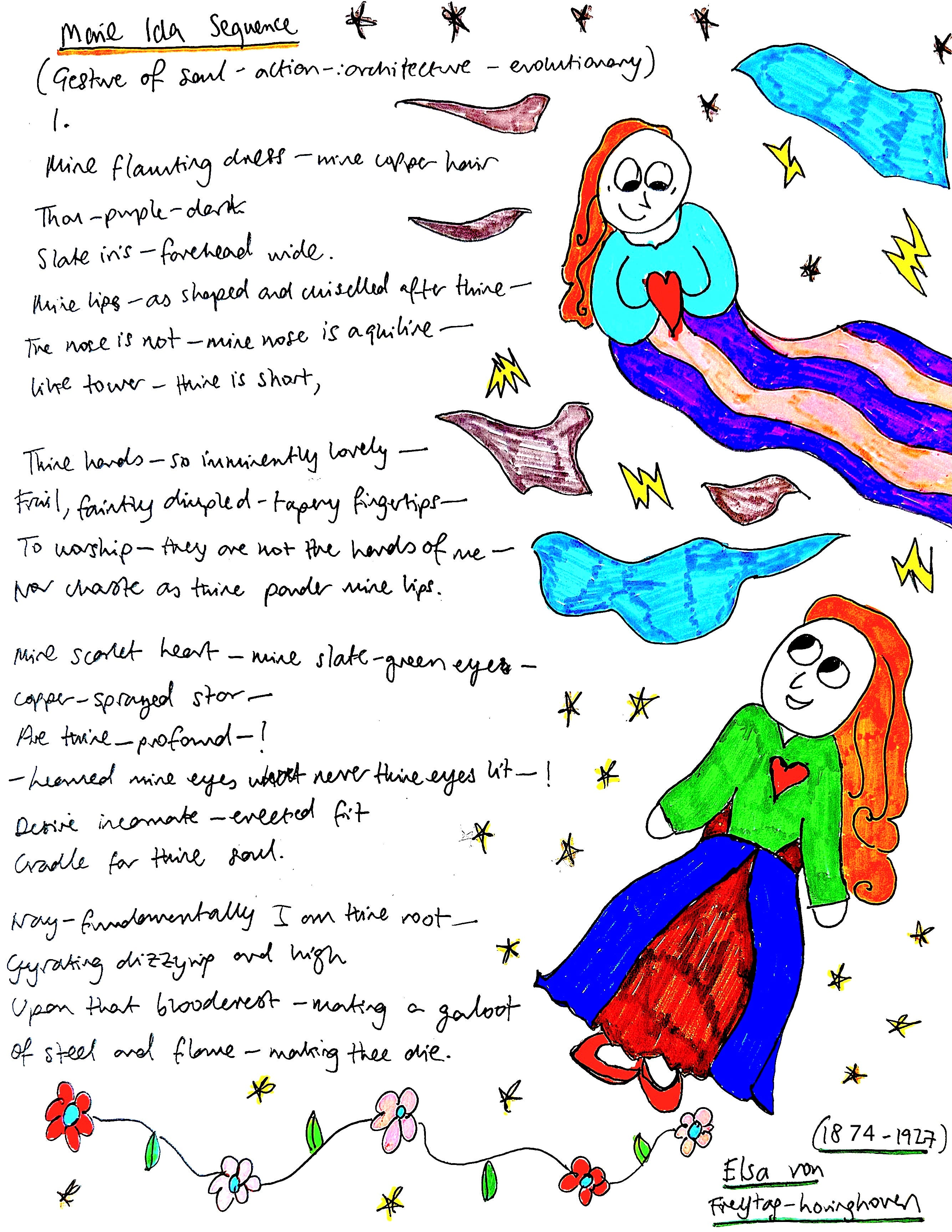
I found her poem “Marie Ida Sequence,” and I liked it. But once I sat down to illustrate, I got the message: she’s talking about her mother, their resemblance, and her love for her. Her mother, Ida-Marie, who died of uterine cancer when Elsa was only 19 years old. Her mother, who had suffered from mental illness and spent time in a sanatorium in Stettin, Germany (theartstory.org). Her mother, who had been stuck in an abusive, violent relationship with her father, and contracted syphilis because of him (Elsa blamed her father for her mother’s death).
I’m not going to lie, the complexity of it makes me feel a bit better about myself. I’m going through a difficult time with my own mother. I am trying to accept her for who she is, while she cannot do the same for me. My boundaries are met by her silence. I’m still an afterthought in her web of family gatherings, always wanting everyone to be close while still not really knowing what closeness means. It’s f*****g complicated, and not fun to think about.
Still, the clear images in the poem captivated me. The slate-green eyes, the copper hair. Maybe that’s what writing is about sometimes. Facing the dark s**t. Processing the stuff we’d rather not look at. In fact, in the research from UT Austin that I base my workshops on, they say that there are more mental and physical health benefits from writing about your most traumatic and difficult experiences than from writing about neutral topics.
So, here’s to facing our s**t.
Love,
Tash
💌 ✍️
Join my next Intimacy Writing Workshop!
Theme: Fantasy 🧚✨
Next week on Thursday, March 12th, I’ll be collaborating with the wonderful sex-positive podcast, Honeydew Me, for an evening of writing about our intimate fantasies. We will be using a poem by Elsa von Freytag-Loringhoven. Join us!
Marie Ida Sequence
By Elsa von Freytag-Loringhoven (1874-1927)
(Gesture of soul—action-:architecture —evolutionary)
I.
Mine flaunting dress—mine copper hair—
Thou—purple—dark— —
Slate iris— forehead wide.
Mine lips—as shaped and chiselled after thine—
The nose is not—mine nose is aquiline—
like tower—thine is short,
Thine hands—so imminently lovely—
Frail—faintly dimpled—tapery fingertips—
To worship—they are not the hands of me—
Nor chaste as thine ponder mine lips.
Mine scarlet heart—mine slate-green eye—
copper-sprayed star—
Are thine—profound—!
—Learned mine eyes what never thine eyes lit— !
Desire incarnate—erected fit
Cradle for thine soul.
Nay—fundamentally I am thine root—
Gyrating dizzying and high
Upon that bloodcrest—mating a galoot
Of steel and flame—making thee die.
Source: The Little Review, 1920. This poem is in the public domain. 🩵
The edition of The Little Review where “Marie Ida Sequence” was published.
Send this to a friend who should have been born 100 years ago 🕰️
Four Prompts To Go Deeper ✍️
For 20 minutes, write a memory, a reflection, a letter, or whatever comes:
Explore the physical similarities you have with your mother, and what they say about you.
Inspired by: “Mine lips—as shaped and chiselled after thine—”
Write about your most vivid memory of your mother.
Inspired by: “Cradle for thine soul.”
Write about the ways in which you and your mother will always be interconnected.
Inspired by: “fundamentally I am thine root—“
Write about what you wish you could say to your mother but can’t for whatever reason.
Inspired by: “(Gesture of soul—action-:architecture —evolutionary)”
Elsa herself! Image courtesy of ArtCurious
Elsa von Freytag-Loringhoven herself was an exceptionally interesting woman. I don’t have time to go into it too much here, but give her Wikipedia page a read. Her “elaborate costumes both critiqued and challenged the bourgeois notions of feminine beauty and economic worth. She adorned herself with utilitarian objects like spoons, tin cans, and curtain rings, as well as street debris that she came across.” (Wikipedia) Yes, spoons are jewelry, friends.
I hope this invitation stirred something deep within you and inspired you to process it, as hard as that may be. Which writing prompt resonated with you the most? Let me know. I read and respond to every DM I get!
Sending love,
Tash
p.s. I’m sharing more updates on Instagram, TikTok, or LinkedIn. Follow me!
💌 ✍️
Can we have a second date? 📅 🫦