If you only followed the headlines, you’d think regenerative innovation is stalling. But here’s what’s actually happening: the gap between idea and impact is closing. Not because the work got easier. Because the infrastructure to support execution is finally being built.
Three things happened recently that show the difference between the narrative and the reality:
How to Use External Pressure as Internal Permission
Last weekend, I wrote a LinkedIn post about local opposition to data centers and the execution gap it highlights—a post that went viral for a variety of reasons based on the comments. But the main point I was trying to make is: those communities just handed innovators inside tech companies the business justification they’ve been waiting for.
When breakthrough designs sit unshipped inside organizations, it’s rarely because the solution doesn’t work. It’s because of internal inertia. Everyone from leadership to legal to finance want proof that the market demands it.
External pressure creates that proof.
Communities blocking datacenter projects unless they include regenerative design aren’t just protecting their interests—they’re changing the business case for internal teams who’ve been trying to ship those designs for years. Suddenly, regenerative design isn’t a “nice to have.” It’s a market requirement for project approval.
This is a transferable pattern. When you’re trying to deliver breakthrough work, asking “who outside our organization has leverage over our success?” can reveal unexpected allies. Regulators. Communities. Customers. Investors. Employees.
The innovation move isn’t fighting external pressure. It’s translating it into internal permission.
And “external” can also be another group within your company. We demonstrated this at Microsoft with water foot-printing. When the sustainability team framed it as voluntary reporting, they couldn’t get funding. When we reframed the same work as operational waste solved through innovation, the money showed up. Same solution. Different leverage points.
Where’s the external pressure in your work? And how could you translate it into the business driver for the transformation that’s already sitting on your shelf?
The Opportune Moment
Earlier this week, I was in London at the Thinkers50 summit and gala. Dean and I were named to the 2025 Radar List earlier this year—30 people Thinkers50 identified as shaping the future of management thinking—and then shortlisted for the Innovation Award. Huge honors! But the real fun was that I got to spend two days in a room packed with the world’s leading management thinkers, academics, and coaches. And even though this was not a sustainability audience, everyone was talking about regenerative solutions.
Here are three reasons why that matters for all of you, not just the sustainability folks in this community:
* Most of the value created throughout history has come from business model innovation.
* Regenerative business is a business model innovation.
* Andrew Winston and Paul Polman’s taking the #1 spot on the Thinkers50 list for Net Positive: How Courageous Companies Thrive by Giving More Than They Take validates regeneration as the leading management practice of our time.
But as we talked about in the first section, validation isn’t enough. We need external pressure to create internal permission.
Generative AI is that pressure.
Think about what happened when smartphones arrived. Companies had to figure out mobile-first business models—not just add mobile features. The technology itself forced business model transformation.
GenAI is doing the same thing, only bigger. It’s forcing even the companies building it (like Microsoft) to rethink their business models. You can’t bolt GenAI onto an old business model and expect it to add value.
This is the opportune moment. Regenerative business models aren’t just good for people and planet. They’re the business model innovation that meets the transformation GenAI is demanding. Aiming for positive requires that we ask different questions, which the readers of The Insider’s Guide to Innovation at Microsoftknow is step one in finding innovative answers.
Innovating Out Loud: Where Leaders Say It Ugly and Build Better
This brings me to something new we’re launching through Regenerous Labs.
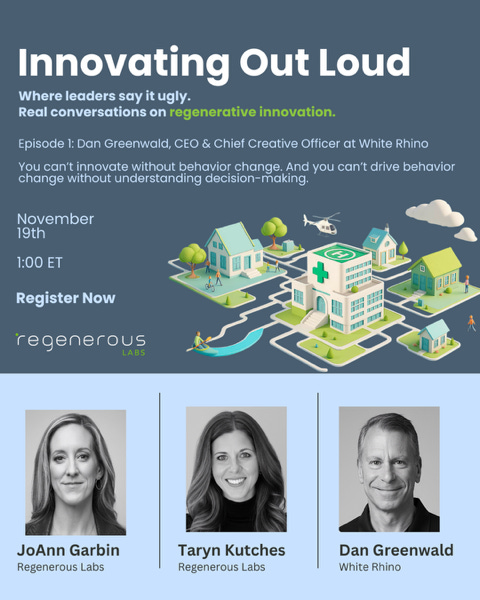
Taryn Kutches and I are starting Innovating Out Loud—a live monthly webinar series where leaders have real conversations about regenerative—scalable, repeatable, net positive—innovation. Not polished keynotes. Not safe corporate messaging. Real talk about what it actually takes to drive transformation.
If you read the Visual Studio Code chapter in the book, you know how effective their “develop in the open” method has been. That’s exactly why we’re adopting it in the Lab. Learning together, iterating in public, building better by being willing to say it ugly out loud, in conversation with our community. You!
Our first episode features Dan Greenwald, CEO & Chief Creative Officer at White Rhino—and the timing couldn’t be better. The datacenter story I just told you? It’s fundamentally about behavior change. You can’t innovate without behavior change. And you can’t drive behavior change without understanding decision-making.
Dan has spent his career translating behavioral science into business action. He’s going to help us understand why smart organizations keep announcing new programs instead of implementing existing solutions. Why innovation theater feels safer than execution. And what it takes to shift from “we should” to “we did.”
Episode 1 will be hosted live November 19th at 10:00 AM PT / 1:00 PM ET.Register Here
If you’ve ever wondered why your organization talks about innovation more than it does it—and want to learn how to change that—this conversation is for you.
Why This Matters Now
These three pieces—the external pressure pattern, the Regenerative-Generative AI transformation, and Innovating Out Loud—aren’t separate stories. They’re the same story told from different angles.
Transformational innovation starts with collaborations that ask different questions. The question right now isn’t “should we transform our business model?” GenAI already answered that. The question is: “what business model innovation do we build toward?”
Regeneration gives you direction. External pressure gives you permission. And this community, now open for live conversations via Innovating Out Loud, gives you the support to succeed at it.
See you November 19th.
Onward,JoAnn
Register for Innovating Out Loud - Episode 1 Here
Note: Article read by AI-JoAnn created with ElevenLabs