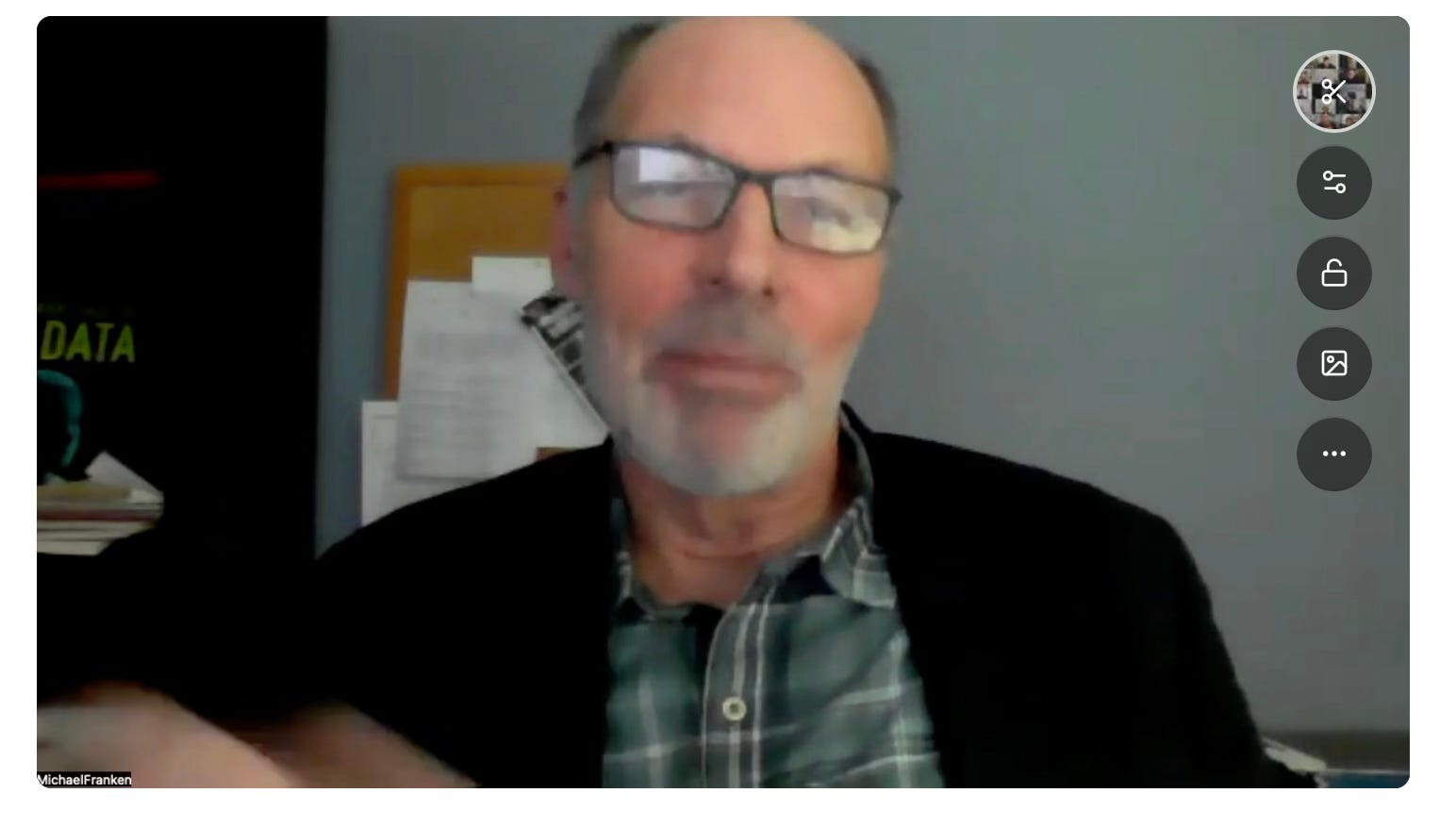
Our bonus podcast guest this week was Retired Vice Admiral Mike Franken, who oversaw maritime interdiction and joint operations across the globe.
In this recording, Admiral Franken joins a Zoom call where participants, including Vietnam veteran and former JAG officer Bill Fanter, first react to recent U.S. attacks on small boats in the Caribbean. Fanter recalls that in Vietnam, commanders were obsessed with preventing atrocities and protecting their commands, and he’s baffled that the U.S. would now choose “overkill” instead of disabling boats, taking prisoners, and exploiting valuable intelligence.
Franken then lays out, in detail, how maritime interdiction is supposed to work under international law and his own experience: he helped draft a maritime interdiction executive order under Rumsfeld and commanded a task force that conducted hundreds of boardings without killing anyone. Standard practice, he says, is to jam communications, disable engines, board, arrest, collect evidence and phones, sink the boat if appropriate, and then exploit the “warble” of follow-on communications to dismantle networks. By contrast, the current policy of sinking boats and killing survivors is, in his view, “sophomoric, primitive, cruel, and horrendously illegal,” amounting to “state-sanctioned murder” and putting the U.S. on par with Russia as a blatant violator of the law of armed conflict. He’s especially disturbed that senior uniformed JAGs and IG oversight have been cut out.
This is sophomoric, primitive, cruel, and horrendously illegal. There is no aspect of it that is lawful.
Participants then ask broader questions about national security strategy, the courts, and accountability. Franken criticizes the newly released national security strategy as a campaign document that abandons European allies and rolls back climate policy, predicting it will change but warning about the combination of an unbalanced Supreme Court and a compliant Congress. He suggests many current and former flag officers know in their “heart of hearts” that what’s happening is wrong, but notes that legal approvals are now coming from political civilian appointees rather than senior uniformed lawyers.
On potential accountability for Admiral Mitch Bradley, Franken predicts the president will likely pardon everyone involved, making court-martial discussions largely moot. He describes how a flag-officer court would normally work (a small panel of three admirals), but says flatly he sees “no thread” that could justify a not-guilty verdict based on what’s publicly known.
Stopping a boat at sea is not hard. The Coast Guard has over 90% certainty in disabling engines without harming anyone.
Comparing Libya strikes under Obama (and Trump), he stresses those were conducted under AUMF authority, with multilateral partners and rigorous legal vetting, and with great care to avoid noncombatant casualties—very different from machine-gunning survivors at sea. He also argues that in this Venezuela context, oil is secondary; he believes the real driver is domestic politics centered on Cuban and Venezuelan expat politics in Florida.
As the call widens to questions about morale, resignations, and the future of American democracy, Franken says he was initially convinced these operations must be outsourced to contractors or the CIA because he couldn’t imagine the U.S. military doing them. Learning that uniformed forces were directly involved deeply shook his trust—but he still believes the military ultimately understands that its “master” is the Constitution, not an individual. He’s worried, though, about the 2026 election and about an administration that, in his view, will try to neutralize any branch of government that becomes an obstacle.
Asked what ordinary citizens can do, he doesn’t offer a magic fix but urges people to stay engaged: write letters to the editor, use social media calmly and truthfully, avoid name-calling and exaggeration, and persist in making fact-based arguments that slowly “chip away.” He notes that some Trump-supporting friends have grown notably quieter over time. The conversation ends with Julie thanking him, emphasizing how rare this kind of detailed, unsiloed discussion is in today’s media environment, and Franken closing with the hope that Iowa will elect a Democratic senator and flip at least two House seats, saying, “Iowa owes this nation that.”
Zach Wahls
Our Monday Zoom Potluck guest is Zach Wahls, Iowa Democratic primary candidate for U.S. Senate. Join the conversation. Get to know the candidate, and ask questions.
Okoboji
Times up on December 15 to snag the best possible Early Bird deal for the Okoboji Writers’ and Songwriters’ Retreat. I’ve bundled the new online Okoboji Year Round Mastery Circle online classes, starting January 14, and running 10 months, with the Early Bird registration fee. All in one = $795. The regular price for the online series will be $497 and OWSR $895 when the early discounts are gone.
Watch Bob Leonard and I talk about this in a Live conversation on Substack:
Interested, but not ready to enroll? Sign up to receive updates: Read more
Iowa Writers’ Collaborative Holiday Party!
It’s not too late to RSVP.
The IWC Holiday Party will be Wednesday, December 17 at the Harkin Institute in Des Moines at 7pm. It’s FREE for any paid subscriber to any IWC writer column, including this one, or $35 the night of the event. The award-winning duo Weary Ramblers will be performing and IWC authors will be on hand for socialization and goodwill. Please RSVPhere.