Hello Friends,
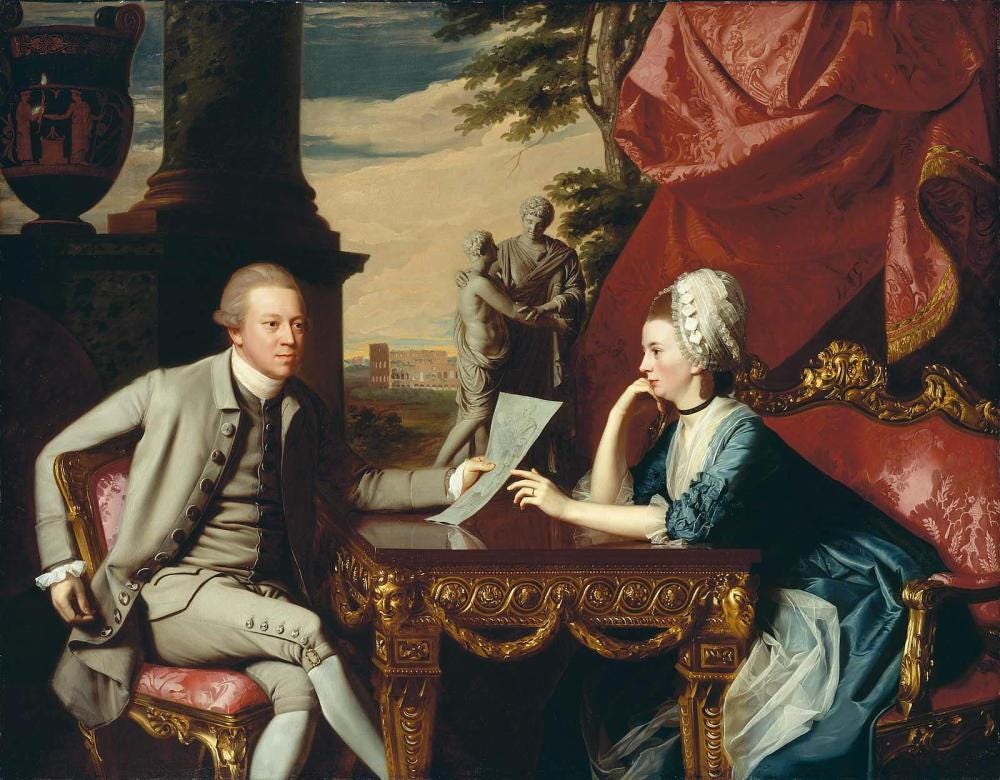
Today we walk to Boston to visit Mr. and Mrs. Ralph Izard, yes Ralph pronounced “Rafe,” in a portrait by Copley that could take a lifetime to examine and discern. We won’t take that long, it’s much too nice out to spend too much time, but a close look will be so rewarding, I promise.
First off, a bit about husbands and wives in colonial British portraits. Copley painted hundreds of people in Boston and vicinity, many of them pictures meant to hang side together in an entry hall or a parlor, so-called pendant portraits. He had only painted a husband and wife together in one picture twice before: Thomas and Sarah Morris Mifflin now hangs in the beautiful new galleries of the Philadelphia Museum of Art. The portrait of Isaac and Jemima Debuke Winslow is right nearby here, at the Museum of Fine Arts, Boston, the largest collection of Copley’s work anywhere. Both of these pictures he painted in 1773, the Izard portrait in 1775, maybe by this time in his career, he was about 35 years old--middle aged in those days--he had a premonition that in future his pendant husband and wife portraits were doomed to separation by family inheritance. You know, possessions get split up, just as people do too. For instance Hannah and John Winthrop would end up at The Met and Harvard, respectively, at least on the same coast; not so much for Thomas and Margaret Gage who got split up between Yale and San Diego; Epes Sargent II is in New York and his wife Catherine, is still in the family; Theodore Atkinson is at the Rhode Island School of Design and his wife, Frances, is at Crystal Bridges in Arkansas. Copley’s idea to put a couple on one canvas was a bold idea, with plenty of art historical precedents but none that he would have seen. He used big canvases, lots of room for stuff, vistas and draperies, all of the things that define individuals. To my eye now, they seem progressive, as Copley had to figure out how to portray not only two people, but also their relationship. My mind flashes to Rob and Laura Petrie in their single beds when we all knew, or hoped, that they kissed, touched, whispered. In each of his three couple portraits, Copley captured the nuances in exquisitely rendered hands, subtle gazes--to each other and to us--the effect of which is mesmerizing.
Copley’s portrait of Ralph and Alice DeLancey Izard has bewitched us since the time it was painted, in 1775 while the three of them were traveling in Italy. Just look at it—if you are listening and not walking or driving, please don’t trip or crash, find the image on the newsletter page. There is just so much. Picture like this make me a little anxious, so much to see, read, understand, interpret—if every single bit is meaningful then I have to know about it and how it all fits together. What if I miss one small detail because my eye is smitten with something else, and that is the key bit? Ralph, dressed in a perfectly tailored grey suit with silk thread covered buttons and a sharp white scarf around his next, no frills for this man, sits at ease, left arm draped around the back of his chair, legs crossed, and he holds a drawing, seems to be handing it across a gold leaf and porphyry table to Alice, who is simply fabulous. Forgive me from jumping to judgement, but come on now. Her gesture with her left hand across the table, bridging the marital divide is open and welcome. Her right hand rests on her lovely double chin, her flushed face so apparently real with tiny nose, direct gaze at Ralph. Ornate bonnet, a blue satin open robe gown with yards and yards of fabric. The sheer wrap around her neck wafts down and across her lap. She sits on an ornate settee, enough room for two people but just enough for her and that dress. Red figured silk satin, in a pattern of stylized foliage, covers her settee, the huge drapery hanging behind her, also his matching side chair. In the background, from left to right, a Greek vase with figures, a marble column, the easily recognizable Colosseum in Rome, a two-figure statue, and a tall tree.
How are the two of them so calm in the midst of all of this? Or perhaps that’s part of the point. They are not overwhelmed or overly excited by so much, they are dignified, curious, and obviously comfortable with the stuff. They came all the way to Italy after all. Here is what I know. First, let’s get it out of the way, the picture reeks of privilege. Just how grand can they be. The Izards are British colonists on the Grand Tour, the requisite journey through Italy for the very wealthy at the time. Fair warning, if any of you get more interested and search for Grand Tour online, you will come up with the major European cycling races or the very funny British tv program in which Jeremy Clarkson drives fancy cars on beautiful roads. The Izard’s Grand Tour was the pre-bicycle, pre-car, pre-train, pre-steamship version, a type of bespoke tour that lost its panache by about 1825 when mass tourism became possible and Thomas Cook started his first travel agent business. The Izards went to Italy when it was still very expensive, very special, and very important to the very rich. How could a rich British colonist burnish his status to an even greater luster? A trip to Italy.
The Izard’s journey all the more exceptional, more special than most, because Alice went along; the usual Grand Tour was a men-only adventure, in fact a sort of right of passage for young men sowing their wild oats before coming back to the colonies, all set to get married. The Izards were already married, back in 1767. So this is a good thing, he took her along, a bit of progress for women. Ralph hailed from Charleston, one of the richest men in the so-called Lowcountry, having inherited his family’s vast rice and indigo plantations with a huge workforce of enslaved labor. He had gone abroad for school as a youngster, graduated from Christ College, Cambridge, back in 1764. Back in the colonies, he met and married Alice, a prominent New Yorker, in 1767 and they moved to London in 1771, bought a house on Berners Street and filled it with everything fine: paintings, furniture, books, music, posh friends. It’s not clear if Izard had a role in politics of the day, he is sometimes called a political envoy or lobbyist for the American cause, but he was very careful in his correspondence, never wanting to lose his cache in London. But he still owned fields and fields in America, now run by his agents. Izard’s move to London strikes me today as interesting for at least two reasons: first, it proves what people said at the time about plantation owners, who grew so very rich with so little labor themselves that even back then they could travel and spend and decorate and entertain. Second, the move to London tells us that Ralph identified as both an Englishman and a South Carolinian, not so much a colonist as a man resident in both places. And with sympathies on both sides of the brewing revolution between England and America.
This would have given him a lot in common with Copley, not the part about being so rich, but the living life in the balance. While in Boston, Copley expertly played both sides of the political divide because to take one side or the other would have been professional suicide. Paint only Tories (the people who sided with England) or only Whigs (those who wanted American Independence) and his client base would have been cut in half. By the early 1770s, though, his ability to fence-sit grew more painful. He had married Susannah Clarke, the daughter of a British loyalist. When he got on the boat to London on June 10, 1774, he said it was because he couldn’t stand being treated so badly in Boston any more, famously complaining that no one cared about the arts, that his own status as a painter was severely limited by provincial minds who thought of painting as a service, “no more than any other usefull trade, as they sometimes term it, like that of a Carpenter tailor or shewmaker.” He said the situation was “not a little Mortifying to me” and he wanted to live in a place where he had a chance at “fortune or fame.” Hello London, where he studied paintings for a few months before setting off for Rome. Hello Ralph Izard. Remarkable that Copley went half way around the world to meet people from home.
Our happy trio travelled to Naples, Herculaneum, Pompeii, Paestum, and Rome during 1775, with Izard paying for everything. Copley wrote to his friend, the painter John Greenwood, on May 7, 1775: “There is a kind of luxury in seeing, as in eating and drinking, and the more we indulge our senses in either, the less they are to be restrained.” Copley wrote to his mother June 25, 1775 “has shown the greatest desire possible to render me every service in his power.” What a trip!! Izard wrote letters, too, but not a word about Copley or about the trip, his letters were all about politics, which have lead us to believe that the double portrait was also a political act. I’m sure Copley was a terrific companion, from what we know charismatic, clever, handsome, but also of great value for the Izards would be a portrait that captured them authentically and packed as much of the trip into the canvas as possible.
A quick reminder that the portrait would hang in London or Charleston as proof of the Izard’s travels and knowledge. Grand Tour portraits are common, part of the deal. A man on the Grand Tour would almost always come home with a portrait painted by an Italian artist, along with a lot of new clothing in the latest fashion. For the Izards, Copley did more. Alice is in the picture, making this a family affair. And the picture packs in so much of what he would have learned about them. For instance, they sit on modern furniture, the sort they might have bought on tour or back in England, they are situated in the present, a very lavish and comfortable present at that. The background is all about the past, antiquities and ruins, cleverly seating their present state in a historical context.
One of my great pleasures in writing each week, is that I re-engage with some fantastic thinking from great colleagues, bringing very good thoughts back to light. In this case, I was riveted, again, by the article Maurie McInnis wrote back in 1999, putting Izard and Copley both between a rock and a hard place, both with “continued loyalty to the mother country despite rising tyranny or a declaration of independence.” Maurie covers a lot of ground, I think I’ll read it again, but her clear focus is on the double statue, the one that looks like it is standing on the table between the Izards and that is depicted in the drawing that Ralph is holding. On the drawing, just for a moment, one of Copley’s greatest teases ever is what is going on here. Did she draw it and hand it to him for his feedback? Is she the student and he’s the teacher? Did she perhaps buy it and hand it to him, making her the shopper and he’s the connoisseur? Or is he holding it and she is reaching out, as if to say “let me have a look, please.” That the drawing is of the statue behind them, has convinced many lookers that it is Alice’s drawing. I’m going to say, I’m not so sure. She is truly in her own world on her side of the canvas, truly swathed in luxury, red fabric, again that dress. The sheer white fabric coming from around her lap and the table leg is powerful, sexy, she is dripping with sensuality and the way she leans into him shows confidence and come hither, my dear. He is aligned with a column, for goodness sake, relaxed but rigid, staring off into the distance, as if completely distracted by the troubles of the world, really pretty much oblivious to the stunning person leaning into him.
But back to the compelling interpretation that the picture not only celebrates an epic Grand Tour for the Izards and Copley, but embeds Ralph’s deep trauma about the relationship between America and England. The red-figure Greek vase behind Ralph to the left shows Leto with her twins, Apollo and Artemis, popularly known as the goddess of motherhood. The statue is Papirius and His Mother, about the clever youth who made up a story to honor his mother’s questions but keep his confidence to the Roman senate. Are we following? See that the pattern of antiquities that evoke mother and child, personal loyalties? Ralph Izard had great respect for what he called the “Mother Country” and equal respect for the colonies. And now the Colosseum makes sense, so easily it could be just a portrait set piece, a bit of 18th century clip art to indicate that the Izards had been to Rome on their holiday. But if we are more thoughtful, we see that the ruined amphitheater is code for a fallen empire, a warning of the cyclical patterns of civilization, a big shout out to mother England to quit while she’s ahead. Oh and way way in the distance—remember I said we would miss something—is the Flavian theatre, the one built for the future of Rome.
Maybe I’ve read too many self-help parenting books, but there is something deeply familiar about parent-child separation in the politics of this picture. Copley wrote to his wife in July 1775, just after the trip, that “years of sorry will not dry the orphans’ tears nor stop the widow’s lamentations.” He meant the tears of the colonist, orphans, and the lamentations of the mother, without children or husband. In the same year, the very young Alexander Hamilton wrote “If the mother country would desist from grasping at too much, and permit us to enjoy the privileges of freemen, interest would concur with duty, and lead us to the performance of it.” If mothers would stop helicoptering and fixing, the children would not only be free but would mature. As is ever thus, that the mother would allow freedom for her children but runs the risk of loss. And the children would run free except for the risk of loss.
Take a Walk
For those of you really in Boston, a very pleasant walk through the Back Bay Fens is in order. Just to the north of the Museum of Fine arts is a lovely garden, including the Fenway Garden Society plots, and paths along the Emerald necklace of ponds and green space that runs all the way to Brookline. That’s a very long walk, but worth it to clear the mind and keep thinking.
And onward,
Indulge me with one more Copley portrait, Margaret Kemble Gage hanging in the delightful Timken Museum of Art in San Diego. She’s a New Yorker, married to the British commander of forces in North America, quite possibly a spy for the colonies, and oh so thoughtful. More next week.
Until then, keep walking and looking, slowly and with courage and curiosity,
Carrie