Dear Friends,
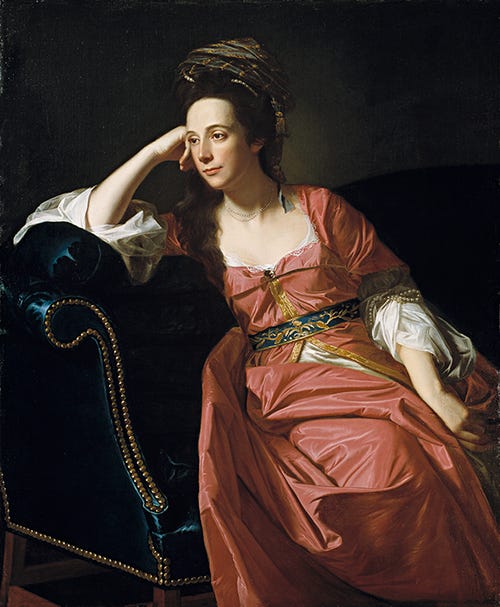
This week, a close look at the stunning portrait of Margaret Kemble Gage at the Timken Museum of Art in San Diego, this time with feeling. When he painted it in 1771, John Singleton Copley wrote to his brother: “It is I think, beyand Compare the best Lady’s portrait I ever Drew.”
Before we venture to San Diego, where the portrait hangs, I wanted to share some very exciting news. Just this week I learned that Crystal Bridges Museum of American Art has just named me as Distinguished Scholar for 2021, as I look backwards and forwards at my own past scholarship on early American art. The position feels like a validation of precisely what I’ve been doing on this newsletter--close looking, adding historical data, thinking again. As if I needed reinvigoration of my already high energy for exploring the past through pictures! I’m truly excited. The focal point of my appointment is the inaugural Tyson Think Tank, a one-month deep dive reexamining early American art with new eyes—works painted by white artists for white audiences and patrons and collected by museums and taught in schools as an exclusive canon. My favorite part is that the work requires looking at actual works of art. Theory and practice attached to specific paintings, anchors to ground our conversations. I’ll be focusing on Copley’s portrait of Frances Deering Atkinson of 1765. More on her situation later this year. I’ll be studying in a sort of lab format, with a group of fellows on the same project, each with a different work of art, and surrounded by museum staff members, community partners, and students and faculty from the University of Arkansas.
The work to create a more inclusive canon of American art is well underway as museums across the country expand their collections with Native and Latin art, more works by BIPOC artists, for instance just look at the new American galleries at the Philadelphia Museum of Art. I visited just last week, yes really in person. You know, I’ll pick a painting from that collection for next week so that we can visit virtually together.
In the meantime, my joy continues to be looking anew at works from the old canon, what used to be called the traditional storybook of American art. I feel a moral and social obligation to reckon with my old thoughts. Looking backwards, standing in the present moment, looking ahead. Art historical whiplash! Today, you can imagine me standing in front of the portrait of Margaret Kemble Gage with a sideways glance and squinty eyes, saying hello old friend, I thought I knew you, but I’m here to ask more questions, really get to know you.
So much has happened since we met, Margaret and I, back in 1992. At the time, I was curating John Singleton Copley in America, an exhibition that would be at The Met three years later in 1995. In 1992, I travelled around the country chasing a bucket list of pictures to best convey the artist’s work, a then new story of British colonial America in the immediate pre-revolutionary period, a tale of invention, fantasy, frustration, all along the political divide. And then I was pregnant, my first child and all of the joys and anxiety that being with child threw me into. Honestly, being in the throes of a very cool project took my mind off of my nausea and worries about childbirth, parenting, all of it. I kept saying to myself, “I’ll have a two-year-old at the opening of the exhibition,” imagining a future that looked like me holding a beautiful child in my wonderful show. In the present the show was complicated and the child inside of me was coaxing me to eat hot dogs and potato chips. And so I did, eat hot dogs I mean, and gave thanks that my baby was super portable and could easily travel with me.
Most of my travel was on the east coast; Copleys had landed in New England museum collections not far from the families that originally owned the pictures and some were still in private homes. Margaret, though, was in San Diego, at the Timken Museum of Art. She had only been there for a decade, having spent the past two centuries at the Gage family home, Firle Place in Lewes, East Sussex, England. The 15th century manor house is now better known as the home of Emma Woodhouse in Autumn de Wilde’s 2020 film adaptation of the Jane Austen novel. Yes Bill Nighy lived here, but long before he took residence, Margaret Kemble was lady of the manor with her husband, General Thomas Gage, a direct descendant and now head of the family. The house was filled with portraits and other pictures, one of the finest private collections in the land and in tact for over 350 years. Yet, as it happens, there are deaths and taxes. In 1977, the family sold Copley’s portrait of General Gage to Paul Mellon for the Yale Center of British Art. Margaret’s picture remained at home until 1984, when the Gage family consigned it to auction where it was purchased by the Putnam Foundation for the Timken Museum. Yet another husband and wife split on opposite sides of the country.
Margaret and Thomas had met in New York, where Gage was headquartered as Commander in Chief of British Forces in North America and Margaret was renowned for her charm, beauty, and social prominence. They married on December 8, 1758. Gage’s officers called her Duchess. The General sat for Copley ten years later, in 1768, on an extended work trip to Boston, for a portrait that hung in his stately home on Broad Street in New York.
Seems he wished for a companion portrait of his wife, but Copley wasn’t budging from Boston. Not until the summer of 1771, when Gage and his brother-in-law Stephen Kemble made the artist an offer he couldn’t refuse, a commission for several portraits with Margaret Kemble Gage at the top of the list. Copley arrived in New York on June 13, 1771, and had his first sitting with Mrs. Gage three days later, telling his brother in a letter that he barely had time to set up his studio, so eager to meet her.
We need to back up a bit, I’m carried away by my memories of meeting Margaret, my life at the time, so much. Let’s look at the portrait. Recently a friend asked me if I could answer “what is a masterpiece?” She gave me her own definition, which is that a masterpiece of painting keeps giving time and time again, after many viewings. This portrait does that. I would add that a masterpiece captivates on first glance, a big “wow” factor that makes it challenging to do the sort of bit by bit inventory that I’ve been making myself do each week for these essays. I feel myself standing back, taking the picture in all at once, mainly taken by the look on her face. I promised I would look askance and say hello in a newly quisical manner. And so yes, I am looking at the voluminous salmon-colored dress, trimmed with gold ribbon, the embroidered belt, pearls at her left elbow and collarbone and in her hair. A plaid silk scarf with tassels wrapped on her dark hair, a sort of turban that can’t keep her tresses from falling down her back and around her shoulder. Her right fingers support her head, a gesture that makes me think tired, but her face reads as thoughtful, perhaps sad. Calm countenance, faraway eyes, dark brown like her hair and eyebrows.
I want to know what she’s feeling, and my desire to know more about her emotions comes from a different place than back in 1992, when we first met, and the eager researcher in me wanted to find out what was going on in her life in 1771. Get the facts, ma’am. The difference is emotion vs. data. Back then, I fully admit to have stifled feelings--remember I was pregnant, worried and joyful all at once, hormonal, look a picture like this one brought me to tears, real tears. But instead of crying, feeling, I got down to the research of what was going on. I’ll get to the bottom of this.
I figured out that she lived with divided loyalties--married to an English general yet with strong sympathies and affiliations to the American cause, and may have been a spy, sharing her marital pillow talk with Joseph Warren, leader of the colonial militia. She wrote to a friend that she hoped her husband “would never be the instrument of sacrificing the lives of her countrymen” and that she felt like Blanche in King John by Shakespeare:
Which is the side that I must go withal?
I am with both: each army hath a hand
And in their rage, I having held both
They whirl asunder and dismember me.
And General Gage was not a happy camper either, writing to a friend that things were so strained between them that he was “ready to wish he had never known her.” He then precipitated the Battles of Lexington and Concord, was burned in effigy on the Boston Common, and King George III called him back to England after the disastrous--for England--Battle of Bunker Hill. Margaret went with him, portraits in tow. Have a look at the portraits again and they say it all: in his, he’s a staunch and amiable military figure, upright and competent, standing outdoors in the fresh air and blue sky, hopeful and strong. Her’s is dark, melancholic, brooding. And absolutely avant-garde in terms of fashion, the latest Turkish influence on English dress, a wrapped gown so loose it might fall right off, no corset, her hand pressed between her thighs, hair undone. He’s outdoors in the field and she is a sultana, either depressed or post-coital, too bad we can’t ask her.
The point remains, mea culpa, that I gathered abundant evidence of what was going on, why she was feeling, but I never asked her what she was feeling. I made an entire project, a separate exhibition, on the meaning of Turkish fashion in colonial portraits, extensive research, and never asked her what she was feeling. Sounds ridiculous now, the woman is in a portrait, or perhaps I’ve now read everything we all have read in this traumatic year about how important it is to name our feelings. So before you think I’ve gone off the deep end and am talking to portraits, I’ll say that an emotionally-rich portrait like this one asks us to feel. If we were together in a group looking, I would absolutely ask, how do you think she feels? More importantly, how does her expression and pose make you feel? Lonely, disappointed, unhappy, aggrieved, resigned, miserable? Depressed, sad, hopeless? Tough stuff, because none of us usually goes to a museum to be triggered into despair, but if art makes us feel, well, that’s when the solace comes. And helps us understand the past. Our past. Margaret Kemble Gage may have been many things that now smack of privilege, but somehow she got Copley, three days off the coach from Boston, to make her a picture that is rich in feeling. Copley’s friend, the painter Matthew Pratt, visited his New York studio while this canvas was still on his easel and, even unfinished, Pratt wrote that it would “be flesh and Blood these 200 years to come, that every Part and line in it is Butifull.”
I have to tell you how things worked out after my trip to San Diego. My daughter, Anna, was born in February 1993, every bit and more the baby I had pictured and she did hold my hand at the Copley exhibition at The Met in 1995, a talkative and vibrant and beautiful two-year-old. Holding Anna’s tiny hand made up for the sorry fact that Margaret didn’t make it to The Met. In a tussle that taught me a ton about museum loan negotiations, the leaders of the Timken back then wanted to trade. They would lend the Copley portrait only if we would lend Thomas Cole’s painting of The Oxbow to them at the same time. The Cole would be placed side by side with the work of a contemporary artist, Stephen Hannock, an homage to Cole, a painting of the flooded Connecticut River that turns in a circle, an oxbow, near Mount Holyoke. The trade was a deal breaker for reasons that I have since forgotten or forgiven or both, only because a few years later not only did the Timken invite me to create a special dossier exhibition about her portrait alone, but also, a few years after that, after tempers settled, we purchased another version of Stephen’s painting of The Oxbow. We felt fine.
Take a Walk
Last week, I walked through Union Square, Chelsea, Greenwich Village, and Soho on my way to outdoor lunch with a friend to tour the New York Academy of Art in Tribeca. The urban walk took my breath away, sans earbuds, just walking, looking at all of the new sidewalk cafes, each with abundant plantings to separate diners from the street and to create separation between them. I’ve never seen so much nature on the city streets. I’ve heard some say that New York now reminds them of Paris or Rome. I’d say it reminds me of New York, only better. And then I’m reminded of what Copley wrote to his brother, back in June 1771 after he had taken his very first stroll in New York: “The City,” he observed, “has more Grand Buildings than Boston, the streets are much Cleaner and come much broader, but it is not Boston in my opinion yet.” The man is entitled to his opinion, just saying. He also said that the two-week open-air carriage ride from Boston to New York was exhilarating and “contributed a great deal to my looks.” We gather, through the lines, that he was vain, what else would we expect from an artist who needed to look good to paint good looking people? The point, though, is that even back then, open air is good. A two week ride from Boston, not so much.
And onward
I mentioned my visit to the newly reinstalled galleries at the Philadelphia Museum of Art, so much to say and I’ll start with the astonishingly sexy portrait of Anne Willing Bingham by Gilbert Stuart. I’ll share more about the galleries, too, but let’s let her be our guide.
Until then, keep walking and looking, slowly and with curiosity and courage,
Carrie