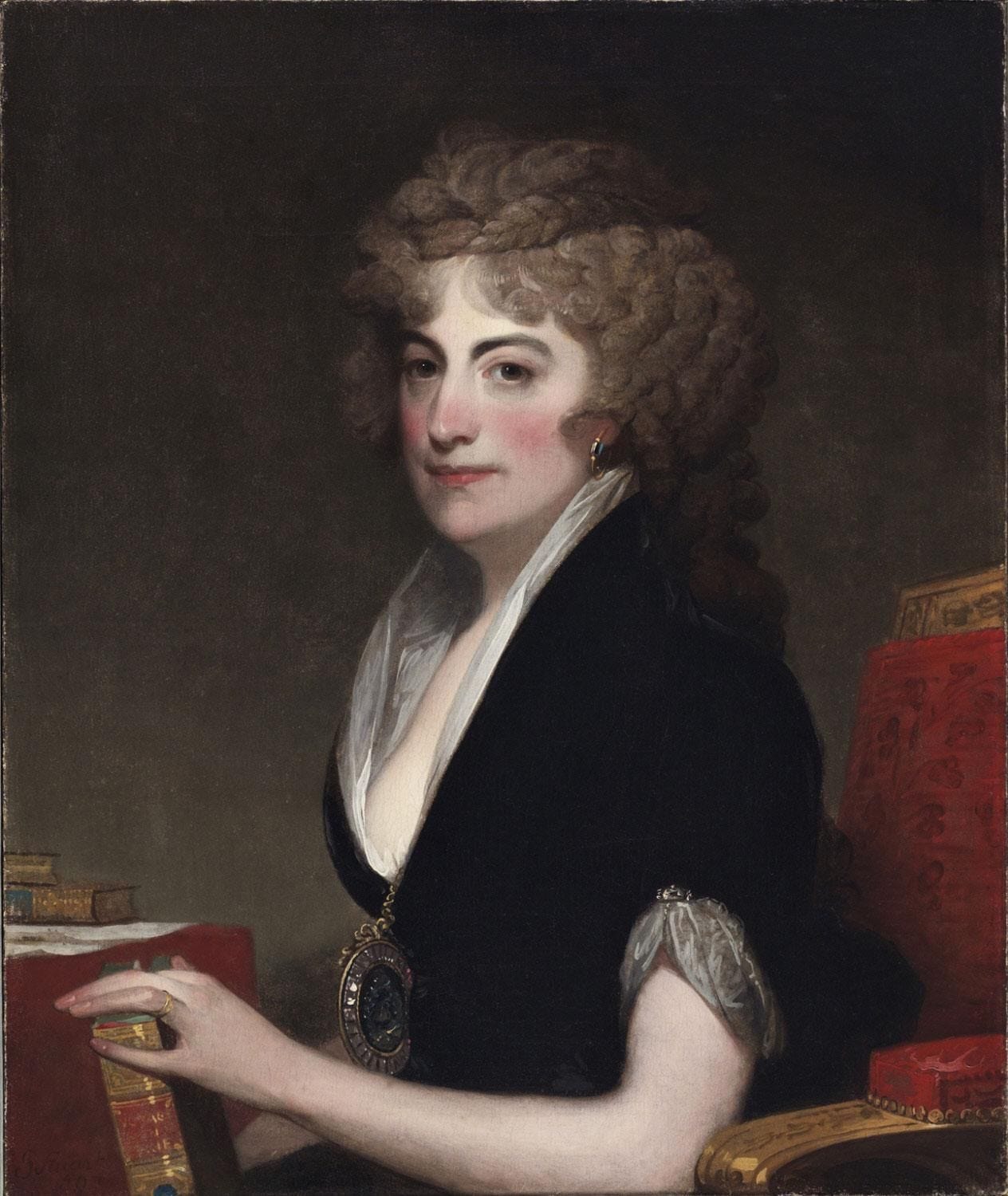
Dear Friends,
Today, to Philadelphia, the so-called City of Brotherly Love, to visit the great museum there and look at portraits of two women, Anne Willing Bingham and Juana Ines de la Cruz, lives that were different and alike, hanging in galleries separate but pulled together by the circumstance if only in my mind.
In other weeks, I’ve guided us virtually, but this time I actually visited, felt like a blast from the past. For the past months and more, I’ve been watching and waiting for the renovation of the Philadelphia Museum of Art, looking forward to the reinstallation of the collection of American art, rich in local and national history and I just knew that smart and aware colleagues there would do right. I attended teaser webinars, read the previews and reviews, and when it opened in May, I pined with longing to visit. And then realized, like a pinch on my arm, that I could go!! Just like old times, got up early, jumped on Amtrak, enjoyed a clean and safe train ride, walked with a very good friend along the Schuykill River path to the museum and went inside. Heaven.
The press promises “a museum reimagined,” years in the making that adds 90,000 square feet of gallery space for art and people. It’s the first major renovation since 1928 when the museum moved to Fairmount Park. The always astonishing architect Frank Gehry did indeed reimagine, the best part, to my eye, is the 640 foot vaulted corridor that spans the entire building, a magnificent space that has been used for museum storage for the past 50 years. Glorious, just glorious, as a passageway to the installations of new artists with new stories. An entirely new energy bathed in sunlight from above cast on the pretty pink stone walls. Given all of the white marble and stone museums in this country, this one is warm in tone, welcoming, and I have to say casts a rose-colored light on everyone. We all look good there. No wonder Rocky ran up and down the stairs, getting better and stronger and faster.
Because I know the collections by heart and have my favorites, I was looking forward to seeing Copley’s masterful portrait of the Mifflins, Charles Willson Peale’s Staircase Group, a clever fool the eye picture of two of his sons walking up steps inviting us to join them. These old friends are hung at key access points, the Mifflins welcoming us to Philadelphia in the pre-revolutionary period, filled with love and tension and that distracting fringe she is making. Nothing like craft to pass the uncertain times, sound familiar now? The Peale boys are the entry point to the early 19th century, moving up and onward, encouraging us to come along, follow us they say, to unknown parts and ideas. The advance team in the earliest galleries are portraits of Lapowinsa and Tishcohan, native elders painted in about 1734 by Gustavus Hesselius, a welcome to Lenapehoking, the unceded territory of ancestral people. These are the men who met with William Penn’s sons fifty years after their father’s famous 1682 Treaty of Shackamaxon, which turned out to be a not-so-peaceful agreement for a not-so-clear land arrangement. That these betrayed leaders start the new story in these galleries sets us up to question everything.
Everything including Gilbert Stuart’s portrait of Anne Willing Bingham, many rooms later but still bathed in the light of privilege and wealth that accrued from the fraught territorial treaties two centuries earlier. I’ll just say that there are so many ways to turn and look and think in these rich, evocative galleries, rearrangements that make my head spin delightfully with shifting narratives. But to me she seems to encapsulate all of it. Look at her: direct gaze, sharp features, dark eyebrows and long nose, hair piled and barely powdered, the newest fashion. Black velvet dress, crisp white scarf around her deftly revealed breasts, small jewels on her ears and sleeves, all the more captivating and elegant for their small size. And a huge locket on a long chain that we can barely see because hangs in her cleavage. The locket looks diamond encrusted and glistening. Stuart wisely cramps the moment—the breasts, the luxurious pendant, the gaze—by putting her left hand, wedding ring apparent, on a book as if to say, stop she’s married and smart.
Here is what we know, thanks to curators at the Philadelphia Museum of Art and Ellen Miles, who researched this portrait with her usual and remarkable skill for revelation and discernment. First, I love that we know that she was called Nancy. Fancy Nancy? And that she was remarkable. Beautiful, smart, rich, the daughter of one of the founding families of Philadelphia and the wife of the richest man in town, the banker William Bingham. In 1797, the year she sat for her portrait, and her husband did too, everyone who could escaped yellow fever in the city for the fresh air of country—sound familiar now? Even the painter Stuart had taken up studio quarters in Germantown in order to escape the pandemic. Stuart had arrived in Philadelphia just a few years before with the sole intention of finding a way to paint President George Washington; in that he succeeded, another story entirely, but the Binghams paved the way. Yes, Philadelphia was the capitol then, from 1790 until 1800, a decade of boom for the largest city in the new United States of America, until congress moved to Washington on the Potomac, our capitol city was sited on a grid-locked city that spanned from the Delaware River west to the Schuykill. The business opportunities made the city a hot spot for shipping, major industry, land speculation, for banking, for politics, and for what might be called diversity but not necessarily the good kind. A merchant at the time is quoted as saying that Philadelphia is “the London of America,” a comment meant in praise then that reads as fraught now.
Nancy Bingham was tall, beautiful, graceful, brilliant, spoke French, but before we judge her for her charms and wealth, what we also know is that she had and expressed her strongly held opinions about women’s roles. She worked it, let’s say. Famously, she kept up a correspondence with Thomas Jefferson, then in Paris, and wrote to him about her admiration for French women who knew how to make a difference: “The Women of France interfere in the politics of the Country, and often give a decided Turn to the Fate of Empires. Either by the gentle Arts of persuasion, or by the commanding force of superior Attractions and Address, they have obtained that Rank and Conservation in society, which the Sex are entitled to, and which they in vain contend for in other Countries.” Attagirl Nancy. Oh, that locket around her neck, certainly a portrait miniature, with the face turned away. A secret token of affection, I’ll say no more.
Looking at her portrait anew, I see so much more than I’ve seen before, power in the pose, the sensuality, the gaze. And here, in these galleries, my mind wanders back to a picture that had not been on view before at the museum, the portrait of Sister Juana Ines de la Cruz by Nicolas Enriques de Vargas.
Painted in Mexico and at least fifty years before Nancy Bingham sat for Stuart, the portraits seem a lifetime and a world away. But hear me out. Juana Ines de la Cruz is just one of countless women who entered the convent in order to pursue their intellect, their politics, their passions. Juana Ines became a nun to preserve her freedom, while Nancy married into powerful position to find hers. Juana Ines wrote feminist treaties and poetry, so powerful and well known that she was eventually condemned by the clergy and forced into a life of charity. Long after, she is recognized, her poetry was charity, a gift to all who read it.
One other detail that connected the portraits for me. Nancy wears that portrait miniature, while Juana Ines wears an escudo de monja, better known as a nun shield, a devotional badge with an intricately painted biblical scene. Fact is that the escudo is just as precious as the portrait miniature. So many women entered the convent in the 18th century for freedom, arriving with jewels and dresses and household belongings that the clergy clamped down on luxury in convent life, banned all excess. But here she is wearing a huge picture, framed in gold and precious stones, a narrative scene that speaks her peace. They never knew each other, but now in nearby galleries, these women speak volumes across the rooms.
Take a Walk
I walked and walked in the museum, and then back along the Schuykill River, enjoying the historic scenery and the peace and quiet after my mind became so full, joyful and troubled, peaceful and anxious, so much to learn over again, seeing pictures in new ways. The river provided calm, even as I wondered what William Penn or Tishcohan and Lapowinsa would think of the runners and cyclists. Doesn’t matter, as we ponder brotherly love.
And onward
Next week, I’m thinking Art Institute of Chicago, my hometown even though I won’t be there for awhile more, hoping for a real summer visit. In the meantime, I can’t stop thinking about Sir Joshua Reynolds’ portrait of Lady Sarah Bunbury Sacrificing to the Graces of 1763, a picture of absolute grasping, seeking, and solace. I know, not firmly in my American art wheelhouse, but I always regretted not studying English painting at the same time, the mother ship as Ralph Izard put it.
Until then, keep walking and looking, slowly and with curiosity and courage,
Carrie