Dear Friends,
Today, back to Philadelphia, instead of moving on, moving in. Back to the portrait of Anne Willing Bingham because my good friend Elle Shushan pointed out a few things in response to last week’s post. First, I had no idea that Anne Bingham was the model for the draped bust image on the silver dollar. Second, she turned her Philadelphia drawing room into a salon for conversation and debate, attracting the likes of Alexander Hamilton, James Madison, John Jay, and George Washington. Third, and right under my nose: the portrait miniature of William Bingham.
A brief recap from last week, for those of you catching up. We looked at Anne Willing Bingham and Juana Ines de la Cruz, lives that were different and alike, both in portraits hanging in the beautifully and newly renovated galleries of the Philadelphia Museum of Art? Looking at Gilbert Stuart’s portrait of Anne Willing Bingham, known as Nancy, we considered her direct gaze, sharp features, dark eyebrows and long nose, her piled up hair and her stylish black velvet dress, her tiny precious jewelry, and a huge locket dangling across her exposed cleavage? We only see the back of the locket, the edge studded with diamonds, the center decoration hard to make out.
We then considered how Nancy Bingham strategically applied her charms and beauty to issues of the day, effectively a feminist before her time. She called what she was doing “the gentle Arts of persuasion” using her “superior Attractions and Address” to call attention to topics of importance in the immediate post-Revolutionary period in Philadelphia. Those phrases were written by her to Thomas Jefferson, then a statesman in Paris, and I hinted that the locket she wears could be a secret love token.
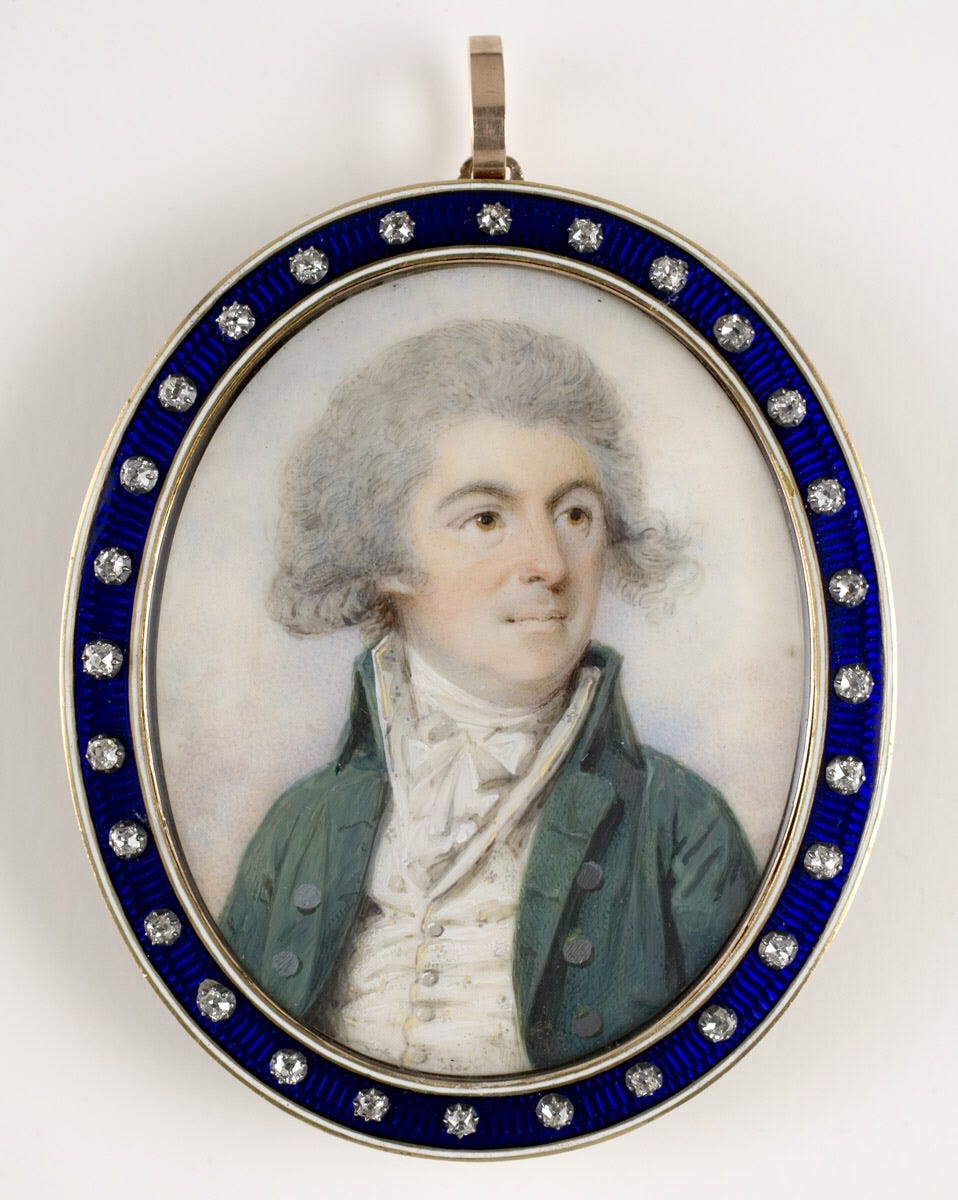
Turns out that while she had a correspondence with Thomas Jefferson, she wore a tiny portrait of her husband William. You know, on my first trip to the Colonial Williamsburg Antiques Forum, I stayed in one of the historic residences. The hang tag on my door said “Please do not disturb, Mr. Jefferson is over for some intellectual stimulation.” I wish I had saved it. At any rate, the portrait miniature of William Bingham exists, thank you again Elle, in the collection of the Worcester Museum of Art. Painted about 1795, two years before Nancy sat for Stuart, the French emigre painter Jean Pierre Henri Elouis painting William in small. The piece is just 2 ½ inches high. Elouis (1755-1840) was born in Caen, France, and mainly worked in London before coming to America. Calling himself Henry Elouis, he built a thriving practice in Alexandria, Annapolis, Baltimore and Philadelphia during the 1790s. He painted George and Martha Washington. Elle thinks that that he was probably chased out of town by the Peale family mafia--he wouldn’t have been the first artist to cut and run due to competition by this formidable family--and then took a position as draftsman to the great explorer Alexander von Humboldt and travelled in Mexico and South America until after the turn of the century.
Why would Stuart turn the face of the portrait away from us, leading us to speculate and wonder? He was clever, surely he pitched the intrigue, but he was also lazy, took short cuts in his work, always eager to finish a picture, get paid and onto the next gig. He wouldn’t have wanted to paint the face of a portrait miniature, too finicky, too detailed, too much time. But he put some good work into the back of the locket. Thanks to the magic of hi-res, here is detail. It’s the letter B, surrounded by some fleur de lis. B for Bingham.
More please. While I’ve been working on a different picture each week, and taking a different walk, I would gladly work on one picture for weeks, adding more and more as curiosity increases with interest and personal perspective, not just mine, adds narrative I wouldn’t have imagined.
Take a Walk
In that vein, I’m going to take the same walk today as I do everyday, usually with my rescue Lab, Sage. Out the door, through the woodland paths, over to the community garden to marvel at the Paris lettuce I grew from seed (not boasting, it’s a miracle this year), a romp with a tennis ball on the field, and back around the trails home. I’ve learned so much about native plants and invasives during this year of increased walking and looking, the garlic mustard abounds in the latter category and I’ve pulled bushels of it. But because I know it’s not a bad plant, just in the wrong place, I’ve made some heavenly garlic mustard pesto. Same with mint, wow how that travels and fights out the native understory plants. But makes a fine forest tea. I’ll brew some after my walk.
And Onward
A reminder for next week, Sir Joshua Reynolds’ portrait of Lady Sarah Bunbury Sacrificing to the Graces of 1763, a picture at the Art Institute of Chicago of absolute grasping, seeking, and solace. Unless the seminar on Anne Willing Bingham continues…
Until then, keep walking and looking, slowly and with curiosity and courage,
Carrie