Hello Friends,
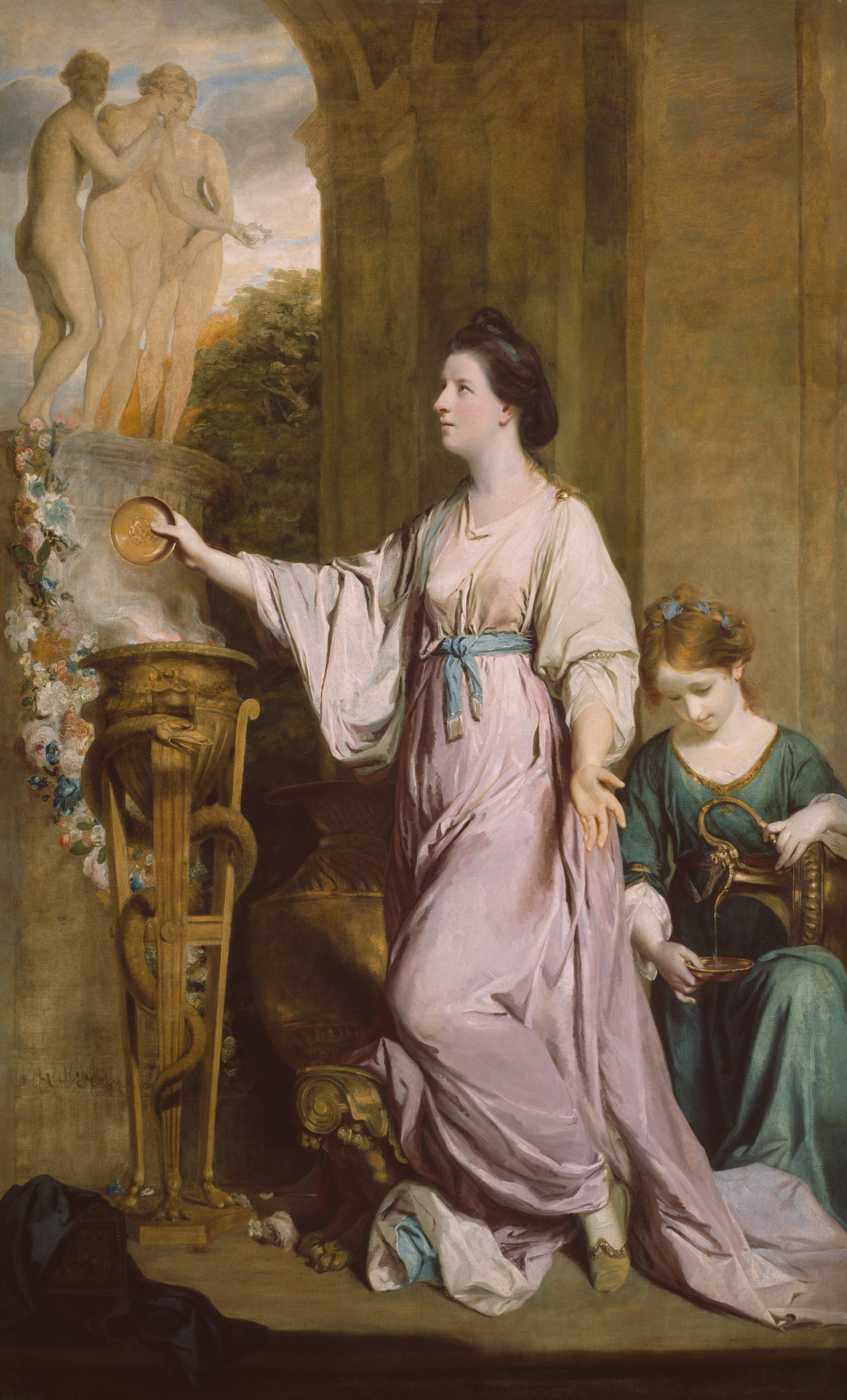
Happy Father’s Day, to those of you who are fathers or have fathers, which means all of us. I woke up this morning wondering how I could write about Sir Joshua Reynolds’ portrait of Lady Sarah Bunbury Sacrificing to the Graces on this day, how does this picture possibly relate to how much I’m missing my own father who died three years ago, how any of us relate to father figures, and what that means anyway. So instead of writing, I took a hike with my rescue lab Sage (@sage_the_hiker) near a lake in Yorktown, New York, and it came to me: it’s about prayer, sacrifice, and belief in higher powers.
I know, it’s a stretch but hear me out. My father worked hard, struggled to support a family of five children, eventually found peace in his maturity on a lake in Michigan, a weekend place where he fished, swam, grilled, and loved, but mostly I remember him sitting in a simple chair on the porch in the morning, in his bathrobe with a cup of coffee and he would say “best day ever.” Every day. Best day ever. His life was filled with family and financial struggle, lest any of you picture a man of leisure. No, he said “best day ever” as a way of making it happen. He set an intention for the day and lived it.
So how can I possibly connect him to a teenage British flirt, a picture he may or may not have seen at the Art Institute of Chicago, our hometown? It’s a long shot, but here goes: prayer, sacrifice, longing, and the best of intentions.
Let’s look: I’m going to Chicago next week and will pay a visit. In my mind, I’ve already walked across Millennium Park with Lake Michigan at my back, a warm and wonderful path to the museum. Lady Sarah’s portrait is upstairs in gallery 218, a room filled with eighteenth century paintings and sculptures evoking the classical past. It was a thing then, centuries later, artists mainly British and French setting their subjects in contexts that affiliated them with stoicism, belief in gods, allegories of love. Lady Sarah is, to my eye, the centerpiece. Life sized and captivating. A young woman with raven black hair and dressed in pink fabric, not even a dress, but yards and yards of fabric draped around her, she kneels, holds a gold disc and fans smoke from a brazier toward a marble statue of three nude women. We gather that the smoke from the burner is created by pouring liquid onto hot coals. Behind Sarah, a girl pours liquid from an ornate jug into another plate, as Sarah reaches her hand back to receive it. She had created an offering to these ladies, but she is not nearly done. This sacrifice will happen again and again, until the offering liquid is depleted. Everything about the setting is old, the arch above her, the vase, the group sculpture, her dress, she is set in the past.
Allow me to add a few details to suggest how past is present. Lady Sarah Lennox (1745-1826), was one of the four famed Lennox sisters, daughters of Charles Lennox, the 2nd Duke of Richmond. Some of us may know them best because of the 1999 miniseries called Aristocrats about the sisters, Caroline, Louisa, Emily, and Sarah. It’s not quite a bodice ripper, and liberties are taken, but the show captures the trials and travails of the girls. Hard to imagine that rich white girls would struggle, but really the reason the story makes it to TV is that it remains relevant.
Sarah was the great beauty of the family, already brought into society by her father when she was barely a teen. By the age of 13, she had caught the eye of George, the Prince of Wales, and when he became George III in 1760, Sarah at age 15 was presented to him at court. He liked her a lot, but his advisors thought otherwise. Spurned by the King, Sarah received countless suitors and marriage proposals, presumably arranged by her father, before she accepted the hand of Charles Bunbury in 1762. Alas, her own early training to court men led her into affairs, one with Lord William Gordon led to an illegitimate daughter who was quietly taken in by her husband, Charles. But then, as fate would have it, Charles divorced her, Lord William fled, and Sarah took refuge with her brother.
Charles, the angry husband, commissioned the portrait from Sir Joshua Reynolds, the top painter of the day. So much could be said about Reynolds, but for today the most important item is that he had an ingenious knack for putting complex Brits in classical setting, thus putting their quirks and travesties into historical context. Lady Sarah was a flirt, an adulterer, a social climber, a girl who wanted to please her father in a high ranking marriage, and then construed that into pleasing multiple men. And her husband commissioned Reynolds to paint her as a Roman priestess, praying to the goddesses of charity, not a little ironic that Sarah already had the gifts of these goddesses in spades.
The Three Graces or the three charities are the daughters of Zeus, the attendants of Aphrodite or Venus, devotees at the altar of all things wonderful. From left to right, Euphrosyne is the goddess of good cheer, mirth, joy, her name means merriment. Alglaea is the goddess of beauty, splendor, adornment, the wife of Hephaestus and the mother of Eukleia (Good Repute), Euthenia (Praise), Eupheme (Eloquence), and Philophrosyne (Welcome). And Thalia is the goddess of festivity, plenty, luxury, abundance, music, song, dance. Come on, we’ve all been to a movie theater called Thalia. In short, praying to the goddesses would imbue the supplicant with mirth, elegance, and beauty. Lucky Sarah, looks as though Alglaea is offering her a wreath, an invitation to join their company.
Best day ever, yes, back to dad. Sarah had a complex life, a screwed up childhood in court that had her poised as bait for the King at the age of 15. And as her marriage dissolved, she sat for a portrait that portrays her seeking the most desired traits for anyone, man or woman, child or adult. To laugh, to feel calm, to be loved. I could write an entire other post on seeking and solace, prayer and sin. Maybe I will.
Take a Walk
I took my walk today, actually a run. Tomorrow I’m headed to southwestern Michigan, to the very house where my father sat on his chair and praised the day. I’ll be sitting in his chair by tomorrow night, looking at the trees and lake, hearing him say “best day ever.” It was, no matter what was happening in his immediate life, in the world. Thanks Dad.
And onward
More next week, more looking, walking, contemplating, I’ll get back to you with a picture, but you know it will be worth seeing.
Until then, keep walking and looking, slowly and with curiosity and courage,
Carrie