Dear Friends,
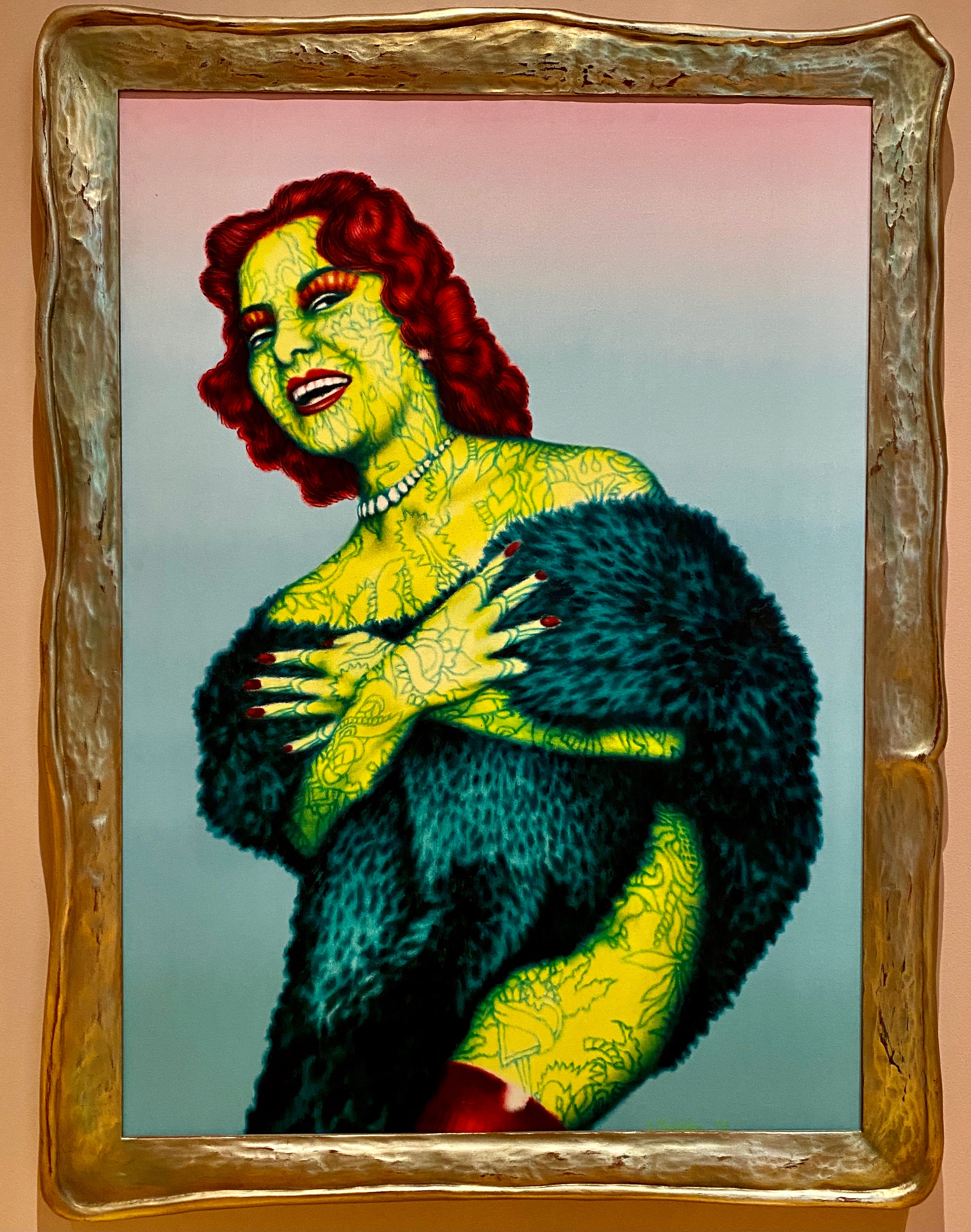
The painting called Heddy by Ed Paschke took my breath away when I approached the South Bend Museum of Art a few weeks ago. On approach, I say, because the image is on the banner on the front of the museum, welcoming all in a boldly inclusive hello.You may have heard that I’m here to help this fantastic, small, regional institution through a leadership transition and what, in museum circles, we are calling post-pandemic reopening. The South Bend Museum of Art was closed only for a short time and its strength in the community, through programs and exhibitions and classes in ceramics, weaving, painting and more, kept it strong even when capacities were limited and protocols were strict. Now, the staff and board are looking ahead, to a future vision of how much more this museum can do for its visitors.
And Heddy has always been right there. What I mean by this specifically, the painting seems to morph through time, chameleon-like, from the 1970s when Paschke painted it and it entered the museum’s collection, until now. The picture is an almost complete mystery. Let’s have a quick look.
A larger-than-life size figure stands before us, full body tattoo, brilliant red hair, nails, and thigh-high boots, a dark green fur wrap seems to be the only item of clothing, shoulders bare, left thigh and hip exposed, arms crossed holding the fur across the chest. The face is riveting—laughing or talking, mouth open, straight white teeth showing, flame-like eye makeup. The pose with one shoulder down, opposite hip pointing toward us, head leaning, sort of a cross between what art historians would call contraposto and fashion photographers would call voguing. The background is a wash of pale color, green at the bottom turning into pink at the top.
The picture is a test in looking, a subject so curious and wonderful, that trying to look at it as a painting is challenging. At the museum, school children sit before the picture to learn about primary colors: Red and green are opposite each other on the color wheel, so-called complementary colors which are, to the eye, not really complementary at all but rather jarring, visually pungent, in this picture almost garish in impact.
Here is a bit about Paschke, an artist from Chicago who is hard to categorize, but art historians have tried, putting him into groups of Outsider artists, the Hairy Who or Chicago Imagists, a post-pop art cohort who gravitated to depictions of urban life, human abnormalities, fetish objects, eerie and complex subjects painted with such clarity that the method further confounds the means. How could a subject, like Heddy, so clearly portrayed, remain so obscure? Paschke attended the Art Institute of Chicago, taught at Northwestern, eventually had paintings in all of the great local museums. He liked tattoo art, nightlife, news media, freaky and marginalized subjects, and his smartest commentators knew that his personal fascination with diversity led him to be one of the era’s most captivating critics of cultural values. He painted Heddy, so known by the title, in 1973, one in a group of pictures of colorful people, literally and figuratively. And he left us without much more about Heddy. Man or woman? Drag queen or diva? Tattooed lady or nightclub singer?
For me, well, she made me immediately feel welcome. Before I arrived in South Bend, I had done a great deal of study of the museum, its collections, its place in the region, etc etc etc, prep for an assignment, right? The museum is known for its Chicago Imagist collection, but equally for Indiana Impressionism and regional contemporary art, both quite strong. The Paschke out front had me at hello. About the time he was painting Heddy, I was barely in high school, my mother was growing her painting practice now that her kids were getting older, and we went to the Museum of Contemporary Art all of the time. It was new, founded in 1967 with the specific mission to show experimental works of art, ambitious, new, cutting edge, emerging artists, like Paschke. I hadn’t thought about him or his work for a very very long time, and it all came back to me like a flash. That’s what art can do, a solace washed over me as I entered the museum, looked for the actual painting, and began a new project.
As for Heddy, she’s been the poster-person for the South Bend Museum of Art for over a decade, a beacon of belonging set out in front of the museum long before this year of focus on inclusivity. And she even became the poster-person for protocols at the museum.
Look, if Heddy can wear a mask for protection and health, then you can too.
Take a walk
I’m staying at my family’s home on Diamond Lake in Cassopolis, Michigan, about a half hour from South Bend, where my walks are through the corn. The long—8 mile—walk around the lake starts with houses with landscaped front yards and quickly turns to roadside meadows covered in Queen Anne’s lace, day lilies, echinacea, and tall prairie grass, beyond which are fields of corn and soy, corn on one side of the road, soy on the other. And next year they will flip, soy on one side of the road, corn on the other. I get a chuckle out of seeing errant corn stalks growing up through the soy, hangers on from last year’s crop, poking up so tall through the bushy soy plants. I’ve done this walk, sometimes as a run, more times than I can recall, and it never fails to bring me solace.
And onward
Until next week, keep walking and looking, slowly and with curiosity and courage,
Carrie