Dear Friends,
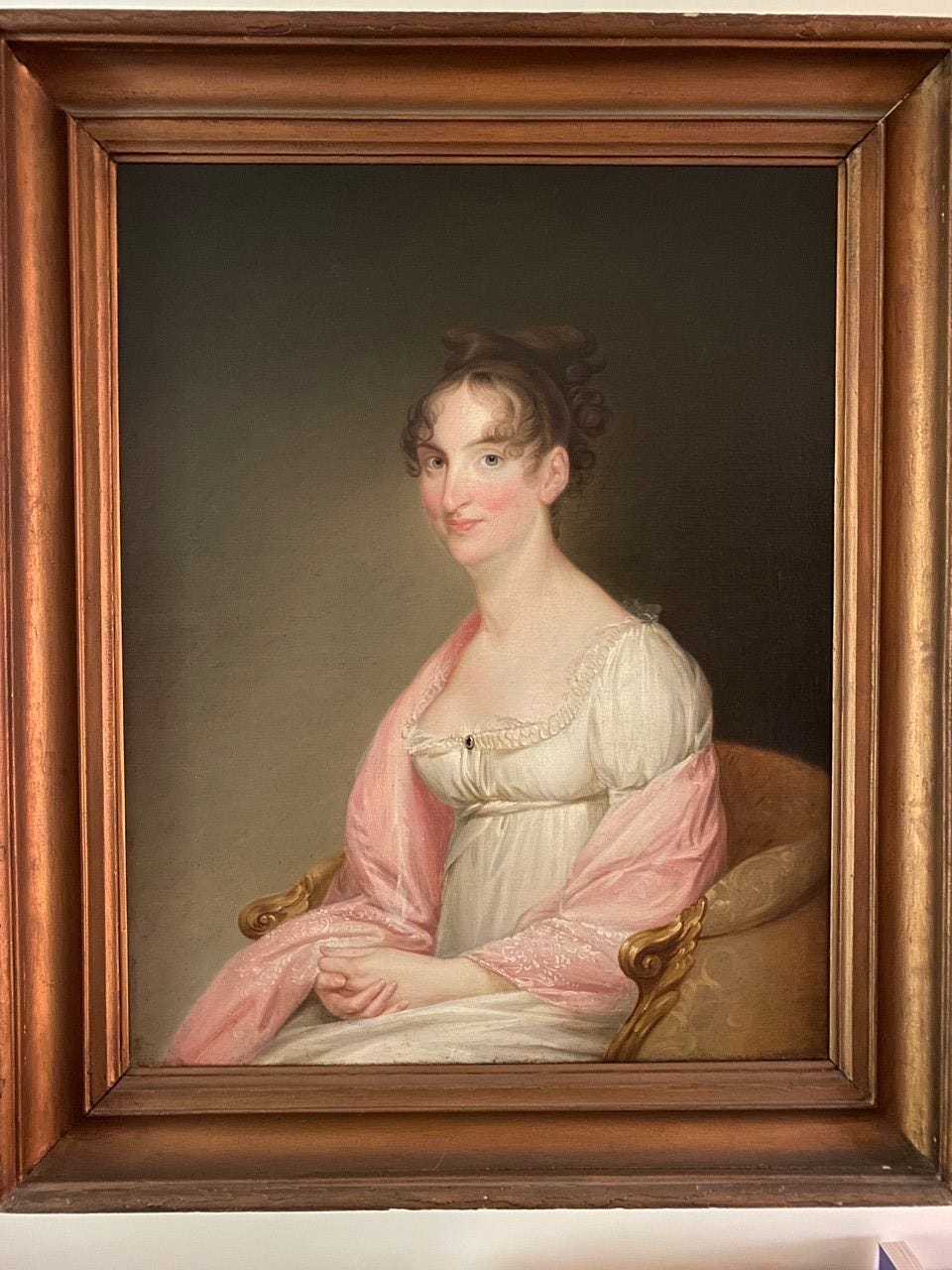
Here’s the thing about looking closely: we can get literally to the nub of things. This week I had a few ideas about what I would write today, and then came the most fascinating letter from Christina Vida, the curator of collections at the Valentine Museum in Richmond. She was curious about this portrait:
First a thank you to Christina, I love getting letters, images, inquiries about Gilbert Stuart so many years after Ellen Miles and I curated a big show back in 2005. As I’ve surely mentioned in other posts here, we scoured the field for his works, the best, the worst, the most interesting, the unfinished (loads of those), the unknown sitters, the famous sitters, and many many many portraits of George Washington. We sorted works by where they were painted, as Stuart grew up in Newport, Rhode Island, then moved to Edinburgh (his ancestral home), London, Dublin, New York, Philadelphia, Washington, D. C., and Boston, not so much peripatetic as following the money. I wouldn’t say that we saw everything, but we saw pretty much everything. But I had never seen the portrait at the Valentine.
Let’s look: a woman most distinguished by her long nose, bright eyes, rosy cheeks, and ringlets of soft brown hair, is seated in an upright manner, arms resting on her lap, fingers entwined, her right hand cupping her left. She wears a white empire dress, the style that cinches under the bosom, with a wide square lace-trimmed neckline showing her white neck and shoulders. A tiny brooch is pinned to the center of the neckline. A pink shawl embellished with white embroidery generously wraps around her right shoulder, and falls down her left arm. She sits in a low armchair, upholstered in fawn-colored velvet. The background is blank, a modulated version of the same color as the chair.
What we know, or what we learn from Christina: She is Elizabeth McClurg Wickham (1781-1853), the wife of John Wickham, and they lived in a house that is now part of the Valentine Museum, called, of course, the Wickham House. She presented two mysteries. First, there are apparently two portraits by Elizabeth by Stuart, the one at the museum and another one descended in the family, still in private hands. Those of us who love provenance research just lap up the sorting out of how pictures got from one place or person to another. Elizabeth and John had many children, even more grandchildren, a portrait that descended through their son Littleton Waller Tazewell Wickham, to his son Thomas Ashby Wickham, to his daughter Julia Wickham Porter, eventually put on loan to the Valentine Museum in 1974 and transferred permanently in 1980.
Second mystery is that the one in private hands is thought to be oil on canvas, the one at the Valentine “oil on canvas stretched on board.” That really got my attention. Happy always to know more about any portrait by Stuart, but bingo another example of Stuart’s work on panel scored to look like canvas. At this point, I looped in Ellen Miles—the virtues of email—and asked Christina to have a closer look at the painted surface. She wrote back literally in three days to say that she and a colleague, Rachel Asbury Cole, took the picture off of the wall at the house and saw the scoring. So exciting. Even those of you who are kindly reading or listening to me each week might be thinking, gosh doesn’t seem like a big deal or maybe these Stuart scholars have too little excitement in their lives. I’ll just say that we all have minute matters in some aspect of our lives that bring us solace and joy, too, and some of us, call us art history nerds, are thrilled by a new discovery. And the ability to help one another understand the past.
Ellen had figured out that Stuart’s portrait of Horace Binney from 1800 is the artist’s earliest documented use of a wood panel scored with a twill-weave canvas texture. Conservators working with her at the National Gallery (the home of the portrait) and the National Portrait Gallery, studied the panel under microscope to determine that the scoring is in the panel itself. I love technical notes: “The support is a 0.7 cm thick, vertical-grain American mahogany (Swientenia sp.) panel scored on the diagonal, from top right to bottom left, with regular, parallel grooves to imitate the texture of twill fabric. The ground is a moderately thick, smooth gray layer. The oil paint is thinly applied with a free brush stroke and is worked wet-in-wet in most areas. Low impasto is in the whites and on the brass buttons. The background is very thinly painted, allowing the ground color to show through.” Talk about close looking!!
An earlier study by a friend, Marcia Goldberg, suggested that these odd panels were scored in the gesso layer, that is the layer of prepared medium that a painter uses to cover a panel or canvas to create a uniform surface before beginning a composition. The same study put out the idea that Stuart started using these odd panels after the Embargo Act of 1807, when it became harder to get good canvas from England. The portrait of Elizabeth Wickham, thought to have been painted about 1801, more proof that Stuart used these panels in pre-Embargo Philadelphia.
Stuart moved from Philadelphia to Washington, D.C. in 1803, yes following the money which was linked to the shift of the U.S. capitol. Then in just two years, he decided to move to Boston, following a U. S. Senator who promised him many commissions, a great deal of money, and consummate fame. Stuart went, avoiding former president John Adams whose unfinished portrait had languished on his easel for years, and complaining about the cold, but he remained for over 20 years, until he put down his paint brush for good, in a manner of speaking. In Boston, he preferred the scored panels. For those of you who want to geek out a little further, have a look at his portraits of the great Boston beauty Hebzibah Swan Clarke, the painter John Trumbull, and General Henry Dearborn. Have fun looking!
Take a walk
This entire interchange makes me want to visit Richmond, Virginia, such a beautiful walking city with wide streets and beautiful trees. I’ll take a walk here, in southwestern Michigan, being where I am. Be where you are and please take a walk, enjoy August wherever you are and stay healthy, please.
And onward
Next week, I’ll write about my road trip to Crystal Bridges Museum of American Art. The Tyson Think Tank starts on August 16 and I’ve decided to drive, safer, healthier, and I can take my bike to explore the great northwestern Arkansas trails. My road trip starts at Diamond Lake, Michigan, our family house where I’ve been living to do my work at the South Bend Museum of Art. From here, it’s just 3 hours to Indianapolis for a visit to Newfields. From there, another 3 hours or so to the Speed Art Museum in Louisville. I’ve booked a room at the Louisville Bourbon Inn, a bed-and-breakfast down the road that will surely pour me a dram of Buffalo Trace in the evening and set me off with breakfast in the morning. On Saturday, I’ll drive to Kansas City for a late afternoon visit to the Nelson-Atkins Museum, then another few hours to Bentonville, my home away from home until the end of August. More to come, art, nature and adventures along the way.
Until next week, keep walking and looking, slowly and with curiosity and courage,
Carrie