Dear Friends,
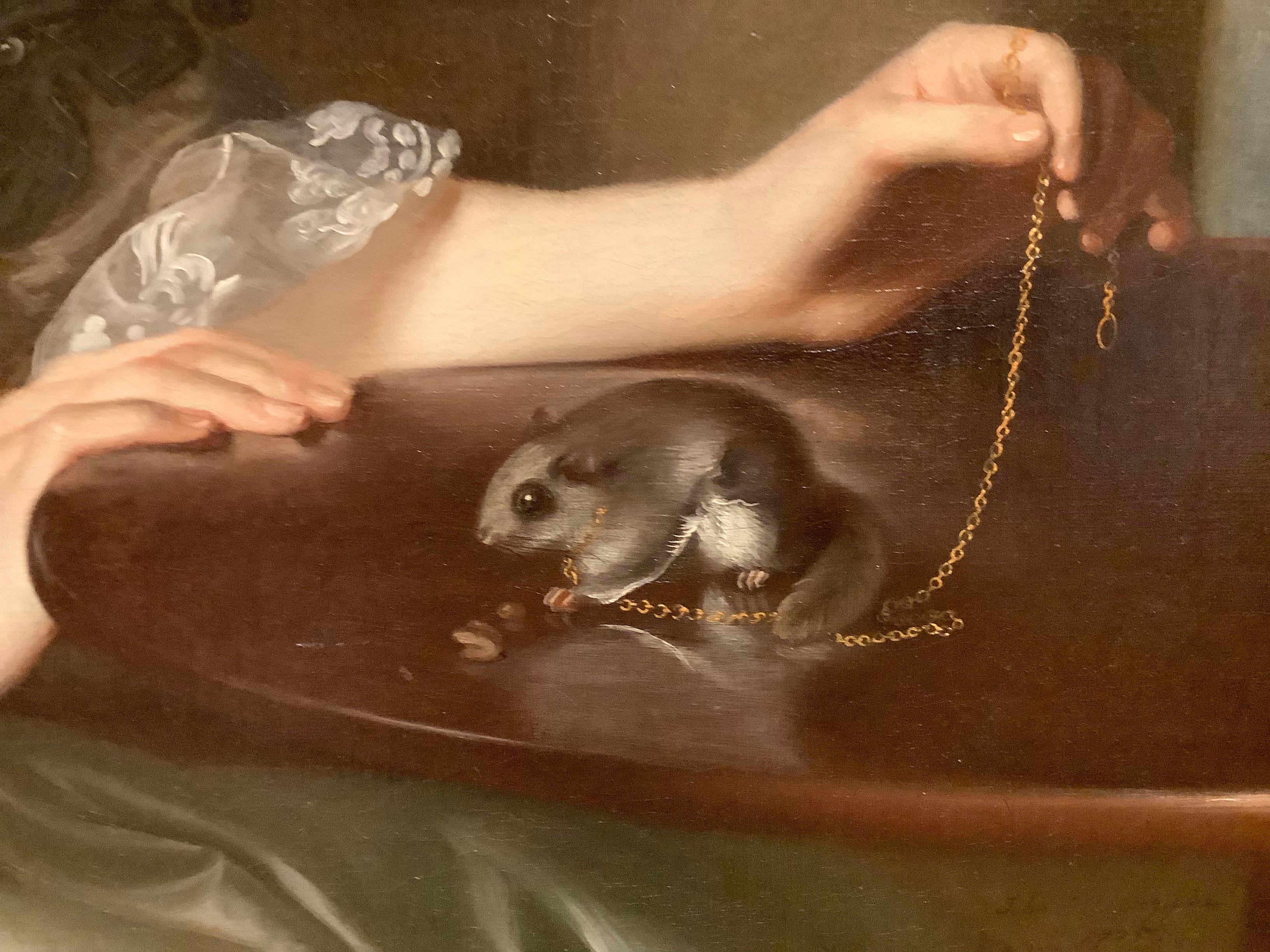
And now, about that squirrel….
Over the course of the past three weeks in residence in Crystal Bridges Museum of American Art in Bentonville, Arkansas, where I held the space for scholars in the Tyson Think Tank, my focus on the squirrel in Copley’s portrait of Frances Deering Atkinson of 1765 (you can catch up on the back story for this adventure) became a little obsessive. In my own defense, I would say that that little rodent on the chain attracted more interest than any other part of the painting, and I mean by far.
Last week I mentioned spending 6 hours over a weekend, perched on a camp stool listening to visitors, talking to them, curious about what they felt, liked, what caught their attention in the picture. I spent more time every day, a grand total of about 26 hours with Frances and her prospective viewers. I say prospective, as if they were suitors coming to meet her, and by and large, they decided to spend their time with the squirrel. In today’s terms, easily 85% of Frances’ viewers swept left and then shifted their gaze to the squirrel.
The squirrel is awfully cute and not at all dangerous in its leashed position on her mahogany table. A boy in the gallery asked his father, “why is the squirrel awake during the day?” Smart kid knows that the northern flying squirrel, Glaucomys sabrinus, is strictly nocturnal.
They live in coniferous forests across the northern states of our country, were quite plentiful in Copley’s day, it’s entirely possible that Frances actually had one as a pet. Most dogs and birds and, in Copley’s case a total of three squirrels, show up in portraits as symbols of discipline. In the iconographic language as old as the hills, if a young woman or man could be shown to tame a wild animal, then their own spirit and behavior was seen to be equally under control. More than this, as I go back to the wisdom of my friend Paul Staiti again and again, every bit and piece of a Copley portrait “had the cultural power to personify, to endow a sitter with the social, civic, or personal attributes he or she sought.” I’ve written before about the fun we’ve had studying and debating whether the stuff in his portraits actually existed, pictures so real in appearance, texture, light, that it is hard to imagine that most of what we see was manufactured by the artist to invent a persona.
Which brings me back to the visitors to the gallery at Crystal Bridges and that squirrel—see I am obsessed. I think that our eyes want to settle onto something we can believe is true, especially now in a time of such uncertainty, fear, fake news, altered images and the rest of it, it’s quite comforting to find a painting in a gallery that looks real and grounded, legible and not disturbing. Until we start to look, or in the case of my past few weeks, until they start to look. And then almost immediately, viewers find Frances hard to look at. There is the cuteness of the squirrel of course, but there is also the distinct or instinctive possibility that the squirrel actually existed. As for Frances, she looks vapid, said one or two visitors, too pretty, looks like a man in drag, has no body in her dress, and the most common refrain of all, “she is looking right at me, I don’t like that.” When I heard this, I was rushed back to my graduate school seminars on Jacques Lacan’s psychoanalytic theory of “the gaze,” when applied to viewing works of art, especially portraits, the self-awareness in a viewer that a person in a picture is looking back, that we are visible. That’s complex material, perhaps a little heavy for a Sunday afternoon in an art gallery, but darned if those now increasingly self-aware viewers didn’t shift their gaze from Frances’s direct gaze at them to that tiny little furry squirrel, much more interested in the nuts on the table than anything we’re doing out here in the real world.
Two more ideas that I’ll share, even before they are fully formed. One viewer wondered if both the squirrel and Frances are enslaved. Both constrained around their necks, the rodent with a gold chain and Frances with pearls tied high on her neck.
She controls the squirrel, while men and society control her. We know her family, the Wentworths, and her husband, Theodore Atkinson, owned people. Would Copley be referencing that colonial practice or suggesting that his sitter was enslaved, too? I have more thinking and reading to do on this notion.
The second idea is one that quite naturally came to me while in Bentonville, in a museum literally sitting in the Ozarks, with open and vocal acknowledgement of the Caddo, Quapaw, and Osage “as well as the many Indigenous caretakers of this land and water.” The traditional indigenous meaning of squirrel is gathering. Squirrel medicine teaches us to store, reserve, prepare, scurry. I’ll have to think on this too, on what Frances is gathering—oh wait, I know, it’s fabrics and finery and men. It may be that Frances’s squirrel buddy is less about discipline and more about her plans for how to escape the pearl chains that bound her.
Take a walk
I’m miss my very hot walks and bike rides on the Razorback Greenway through Bentonville, but will be back before long. Until then, I pledge to find nature wherever I go, as one of the best parts of the past month of study was the absolute mental release and ideas that flow after a day of study and looking indoors immediately upon going outside into nature. Immediate.
And onward
With the Think Tank now over, at least in terms of our residence together, I will gather my own thoughts about this still intriguing picture, maybe even write a little book about all of the ways I’ve looked at her, many paths to the same person. For this newsletter, I’ll find a new picture for next week, a cleansing look at something else.
Until then, keep walking and looking, slowly and with curiosity and courage,
Carrie