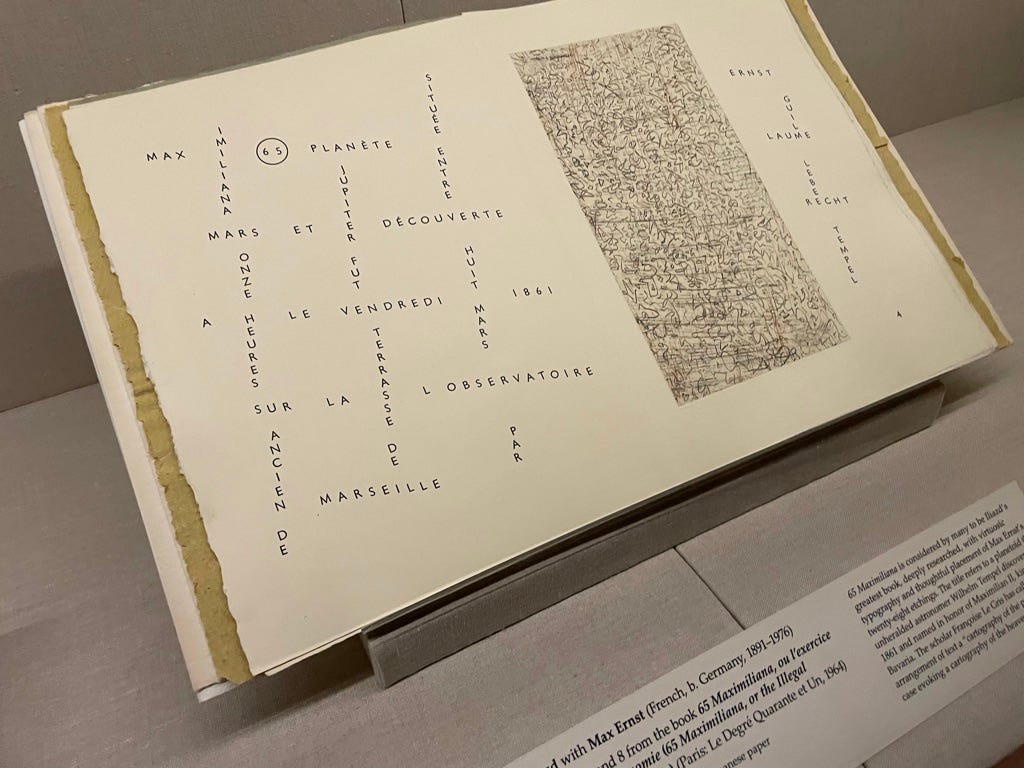
I recently was back in San Francisco. I had booked a trip back in March when the dates for the Joan Mitchell exhibition had been re-scheduled. I often struggle selecting one piece to focus on each week, especially after viewing so much great art between SFMOMA (Joan Mitchell), Legion of Honor (Wangechi Mutu), and the de Young Museum (Judy Chicago). I was able to visit each exhibit with great friends. Viewing art together, once again. I hit all my old haunts, re-visiting, and saying goodbye. It is time for me to move on from the 49 square miles of heaven. This made it even more difficult to select one piece of art - and of course I will write on Joan Mitchell and Wangechi Mutu, possibly Judy Chicago, again. I sometimes want to choose pieces I have command over, both the piece’s history and aesthetic. Other times, new pieces and unfamiliar artists grab me. What kept popping out of my digital photos this past week was not a sculpture or painting, or even that colorful for that matter, it was a book. A singular, absolutely beautiful, and simple book. I must write on what calls to me, right? It is a ritual, a prayer, an intention. The art may select me instead. I worked at the Legion of Honor for five years helping run public programming, which ranged from classical concerts in front of Rodin’s three muses, lectures featuring some of the greatest artists of history, and even a private performance of Tony Bennet. I know this museum, I know it’s galleries, the collection, and what to expect. The museum is approachable in scale. Though, there is always one gallery that stands out above the rest. Always. It never ceases to amaze me what this tiny little, dark gallery brings to my attention. It is called the Logan Gallery. Mr. Logan collected one of the most diverse and important private collection of modern artist illustrated books and gave them to the Fine Arts Museums of San Francisco in 1998. I love his collection for many reasons, which first and foremost is that, I love books. But, I think more importantly, the collection has always shown me something I never knew existed. Artist books never get as famous as a painting. These collaborations between publishers and artists are specific, private, and typically small affairs. Many times, it is for the artists themselves and not for collectors or the public. This time in the Logan Gallery, Iliazd: Publishing as an Art Form was on exhibit and it gave me something that is always a gift, another new unknown artist uncovered (for me), Ilia Zdanevich, (known as Iliazd). No wonder I had never hear of him, this is the first US museum exhibition devoted to his work in more than thirty years.
Ilizad was in a league of his own. Though, I had never heard of him, the artists he collaborated are some of the most famous names in the 20th century canon. The artists included Pablo Picasso, Georges Braque, Alberto Giacometti, Max Ernst, and Joan Miró. His innovative typographic and design work were pioneering. I was drawn to a specific piece with his collaboration with Max Ernst (which I primarily only know through his third wife, artist Dorthea Tanning). The book captured me like a web. The typeface was contemporary. I felt like it could have been created by a graphic designer in 2021, but nonetheless, Ilizad saw the potential for white space and serif typefaces well before digital technology start-ups. It is not always so important for me to know everything about the artist, or the context, but how does the object land in the context of today? As a designer, I am constantly looking back into history for innovative artists. Ilizad was a great discovery for me. Not only was he a master of the book, but it seems to me that he was a master of collaboration. He was able to see the artist’s vision and make it his own through the form. Not an easy feat whatsoever and less common throughout history. We are drawn to the idea of the singular artistic vision, in painting, sculpture, or architecture. We want desperately to believe that ideas stem from individual’s brains, like we are all stuck in some sort of solitary confinement. This is a myth we tell ourselves. Artists sometimes have a singular vision, egos that outweigh, and crush other visions. We need that sometimes, that command of the artist vision and truth. We also need cooperation and empathy. I see these values in the two pages of this book, the lightness and space of the text on the left page with a counterweight of Ernst's mathematical-like scribble. Almost like a mix of hieroglyphics and algorithms. The heaviness of languages held on paper as thin as feathers.
"An illustrated book by Iliazd is a book by Iliazd, and not a book by Picasso, Miró, or Max Ernst. . . . a standalone work of art just like a painting, a sculpture, a monument, a film. And Iliazd is its true and sole creator."
Louis Barnier, director of the Imprimerie Union, Paris, 1974