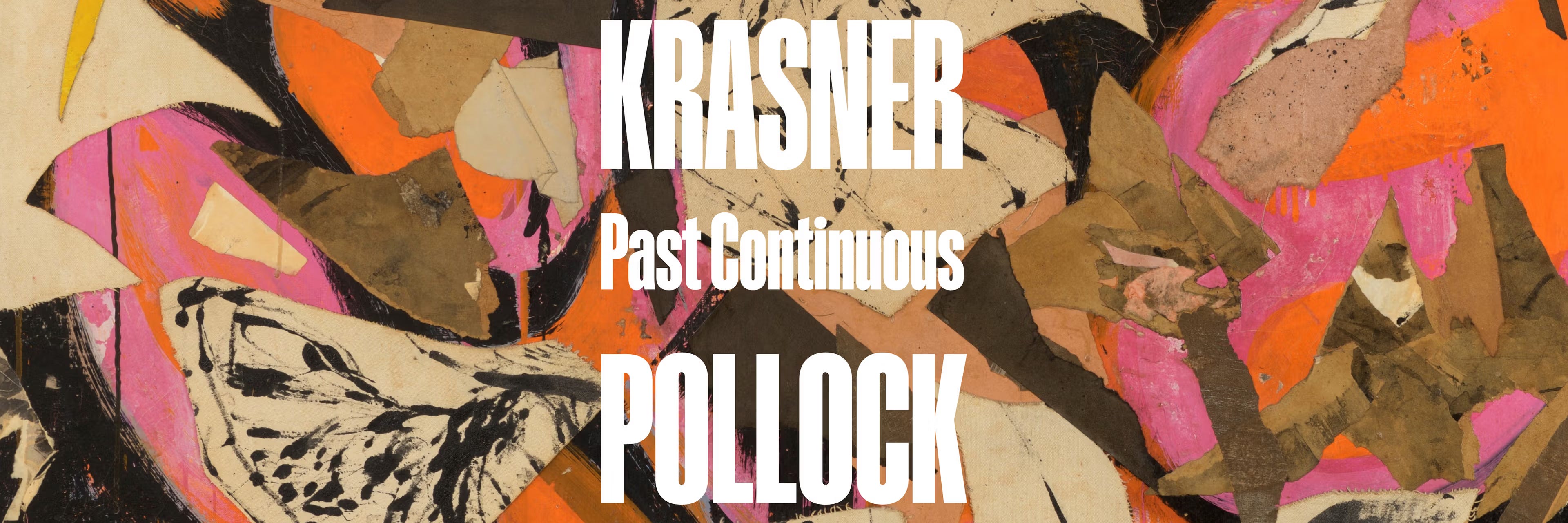
I stood between four canvases by Lee Krasner. It felt as if I was standing in the middle of a family of mature redwoods, young redwoods all grow together from mother trees close together. I felt as if I could finally sense Krasner’s ability to get close to earth, to feel nature and she represented aspects in these four canvas. Very rarely have I had such a great moment in gallery. Most of the time, the realization or connection to the work comes much later. This moment was immediate.
This moment was at the preview of Krasner and Pollock: Past Continuous. It is now on view at The Metropolitan Museum of Art through January 31, 2027. In short, it is a must see. There are a number of articles and hot takes on this exhibit already circling the internet. It does seem interesting that these art history narratives are still stuck in the 1950s. An exhibition by a major institution has the power to shift an artist’s place in history, they are often the gatekeepers to the canon. I find that both hopeful and troubling: how much does recognition depend on the work, and how much on the institutions telling its story? Art history, like most history, acts more like a thin veil to the truth no one wants to lift off. To me, nothing feels like a fresh take here. Critics are relieved for Lee Krasner (and for all women artists, for that matter). Who are we re-writing the history? Does it matter? My attempt here is not bring you the hottest take or expected review, but focus on the pure joy of looking. I wonder now what drew me to that image of Pollock in the first place, the cowboy, the drinking, the mythology of the difficult man. The resident American bad boy like Caravaggio, always drinking, smoking, and painting. How typical. He had a volatile friendship and mentorship with another favorite artist of mine, Thomas Hart Benton. Another famously gruff individual. Pollock famously said he ignored anything Benton taught him. I often wonder to myself when thinking of Jackson Pollock - who hurt you so badly? It does seem like a core deep wound coming from a possible lack of care, love, or nurturing. In my early twenties, I thought a Pollock canvas was American painting at its best. Moving through the exhibit, I felt an overwhelming nostalgia for his work. I am not quite sure what happened. Seeing Guardians of the Secret and Lucifer at the Met was moving to me. I had toured Guardians at SFMOMA and Lucifer from the Anderson Collection at Stanford, both paintings I knew well over from days in California. In 1945, Dr. Grace McCann Morley organized Jackson Pollock’s very first solo museum exhibition in San Francisco.
The exhibition is really shouting with joy, and that joy comes from both of them. In the reviews I’ve read, I’ve missed this: the sheer wonder of looking at abstraction. I also resist how quickly Jackson’s addiction becomes shorthand for his failings, leaving little room for its tragedy or for Krasner’s grief. Within three years, she lost both her husband and her mother. Grief is complex. It shaped her work, including the years when she restricted her palette to browns, blacks, and whites. Can we imagine standing beside someone out of loyalty or commitment, even through deep wrongs? I don’t know that the paintings can answer that question. But I felt pain and strength in Krasner’s canvases, alongside their joy. Those layers is what I appreciated most.
Though over the last decade, the women of abstraction have taken over my mind. I found Helen Frankenthaler. I found Joan Mitchell. And now I have re-discovered Lee Krasner. And there have been arguments for Lee to have her own show and I am here for it. I honestly think her work is more interesting here in dialogue with Pollock. She spoke to the power of their relationship. And how can you deny such a romantic, volatile, and dynamic relationship between two people. Why are we so quick to decouple and indvidualize into the great solo artistic genius (because institutions have been doing this for men for centuries)? I do not subscribe to the solo genius, ever. Along with their intellectual, romantic relationship, their painting relationship was symbiotic. And yes, it is disappointing that Krasner never got her rightful due while she was alive. It is so often the case with female artists, as well as minority artists, too. The only successful artist can be white, of a certain class, male, and straight. This is limiting. But, it is often not because of just the dominance of men, but also the void created by their silence. Krasner was busy advocating for him and no one could elevate her to quite the same degree.This exhibit made me think of an Alan Watts meditation, “Listen.” “Don’t worry about the futureDon’t worry about what progress you’re makingJust be entirely content to be awareOf what is”
One thing I particularly like about Krasner’s work is her use of materials: masonite, burlap, oil, mosaic, and other layered materials. I could not help by the end of the exhibit want to get closer to Krasner’s canvases, seeing her line, her precision. By the end, seeing how much Henri Matisse had influenced her quest of simplicity and form found a Matisse quote bubbling up for me. “Don’t try to be original. Be simple. Be good technically, and if there is something in you, it will come out.” It certainly came out of Krasner, it is bursting in this exhibit and it is a true joy to experience. I look forward to standing among her work again soon.
Past Continuous: Lee Krasner and Jackson Pollock The Met October 4 - January 31, 2027