Sightseeing trips to the ice
In the 1970s New Zealand’s national carrier Air New Zealand began operating “sightseeing” flights to Antarctica. The flights would depart from Auckland, fly south over the remote Balleny Islands and onto the ice continent, passing over Capes Hallett and Adare and from there, down McMurdo Sound to the ice continent. There they would circle for an hour or so, to give passsengers a good look at Antarctica, before turning around. They returned to Auckland via Christchurch in the South Island for a refuelling stop: the airline’s fleet of DC-10 wide-bodied jets did not quite have the range to make it back to Auckland comfortably in one go. The round trip took about 12 hours.
At 8 am on 28 November 1979 flight TE-901, the final flight for the season, left Auckland with two hundred and thirty-seven passengers and twenty crew. At the controls was an Air New Zealand veteran, captain Jim Collins. All was well, though visibility was not great. As he approached Antarctica shortly after midday, Collins reported cloud cover at 5,000 metres, and requested permission from local air traffic control at the McMurdo Sound naval base to drop below the cloudbase to give passengers a better view. McMurdo granted it.
Soon after that exchange, McMurdo Base lost contact with the DC-10. When it had not reappeared on New Zealand air traffic control systems a couple of hours later, officials began to fear the worst.
Over the afternoon, planes were scrambled from McMurdo Base. They traced TE-901’s last known position. They followed its scheduled flightpath. They found nothing.
This Substack is reader-supported. To receive new posts and support my work, consider becoming a free or paid subscriber.
Hours passed. News of the missing plane began to spread. As the Auckland evening drew in, relatives began to reconcile themselves to the idea of disaster. Air New Zealand issued a grim deduction: the plane could not possibly still be in the air: it would long since have run out of fuel.
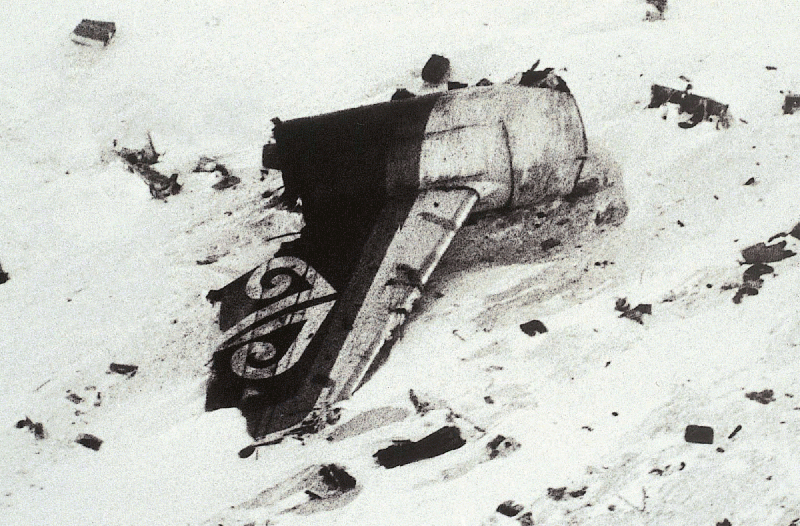
Then, at about midnight — the sun does not set in Antarctica in late November — the crew of a US Navy Hercules spotted a dark smear on Ross Island, some forty-five kilometres east of the plane’s scheduled flight path. They investigated. They quickly realised it was the remains of an air crash. The aeroplane’s tail section, but little else, was intact. It bore Air New Zealand’s distinctive koru. Wreckage stretched for hundreds of metres up the lower slopes of Mt. Erebus, a 3,900 metre volcano.
The Hercules radioed back to base. They had found TE-901. There would be no survivors.
A commercial airliner with two-hundred and fifty seven souls on board had flown at an altitude of 400 metres into a mountain the size of the Eiger.
At the time it was the fourth worst crash in the history of powered flight. It remains New Zealand’s worst single peacetime loss of life.
The crash recovery, at such an inhospitable location, was harrowing. Many on the rescue teams were permanently traumatised. The New Zealand Government created a special civilian award for gallantry for those who went down to the ice.
The government initiated an investigation. The cause of the crash remained baffling. The plane’s captain, Jim Collins, was an experienced and conscientious pilot. He had reported no trouble. The plane’s telemetry indicated it was functioning perfectly. The flight recorders indicated the cockpit seemed harmonious, though there was some discussion about visibility. But photographs recovered from passenger cameras indicated good visibility below the plane, and it had been the basis on which Collins’ was granted permission to descend below the plane’s minimum safe altitude of just under 5,000 metres. That altitude had been set a good kilometre above the highest point of the surrounding terrain, which was the crater of the active volcano Mt.Erebus, on Ross Island to the east of the Sound.
Yet, despite all this, the airliner had been nearly fifty kilometres off course and was flying lower than 500 metres above sea level.
Someone, or something, had plainly gone very wrong. Quickly — the consensus, after 45 years, is far too quickly — the question turned to who. As is so often the case in “human error” investigations, the first person in the frame was the operator: Jim Collins. Captain Collins, as is also so often the case, was in no position to argue.
Whether or not Collins was at fault, there is a deeper point. It ought to be a well-understood operating risk in any complex operation that people make mistakes. Human error is not an exception to the operation of a system but an inevitability. Yet, when failure happens, our instinctive response to find the wrongdoer.
It need not be that way.
Moonshot
When President Kennedy fired the starting gun on the space race in 1962 — at which point the Reds had a lap head start — the Apollo Programme was on an absurdly tight schedule. The farthest it had then got was Alan Shepard’s suborbital Mercury flight in May, 1961. That lasted fifteen minutes and reached an altitude of less than two hundred kilometres from Earth. It wasn’t even, truly, in space. Now Kennedy promised that NASA would have a man on the moon by the end of the decade.
The moon is nearly four hundred thousand kilometres from Earth. The mission would take ten days. The challenge NASA faced was, literally, an order of magnitude greater than its greatest achievement to date.
Then, in January 1967, disaster struck. A terrible fire during a launchpad test killed three astronauts in NASA’s Apollo programme. The immediate cause of the accident was a stray spark from exposed electrical wiring, which ignited in the pure oxygen environment of the sealed capsule. The crew did not stand a chance. They were bolted in: it would have taken them a minute and a half to open the door.
Programme director Gene Kranz shut down the blame game before it could get started with his famous “tough and competent” speech.
Spaceflight will never tolerate carelessness, incapacity, and neglect. Somewhere, somehow, we screwed up. It could have been in design, build, or test. Whatever it was, we should have caught it. We were too gung-ho about the schedule and we locked out all of the problems we saw each day in our work.
[...] Nothing we did had any shelf life. Not one of us stood up and said, ‘Dammit, stop!’ I don’t know what Thompson’s committee will find as the cause, but I know what I find. We are the cause! We were not ready! We did not do our job. We were rolling the dice, hoping that things would come together by launch day, when in our hearts we knew it would take a miracle.
[...] From this day forward, Flight Control will be known by two words: ‘Tough’ and ‘Competent.’ Tough means we are forever accountable for what we do or what we fail to do. We will never again compromise our responsibilities. Every time we walk into Mission Control we will know what we stand for. Competent means we will never take anything for granted. We will never be found short in our knowledge and in our skills.
Here are two divergent responses to disaster. The first, and often instinctive, is to find a single root cause in an individual—to isolate a “bad apple”. The second is exemplified by Kranz. He shifted the focus immediately from who to blame to what to fix: How can we redesign the system—the spacecraft, the procedures, the culture—to ensure this never happens again?
The Erebus disaster would, unfortunately, take the first path.
Investigation
Within a few months of the crash New Zealand’s chief air accidents investigator Ron Chippindale issued a preliminary report. It was thorough — something like 90 pages — and pulled few punches. Chippindale attributed the crash to pilot error, more or less upon the legal principle res ipsa loquitur — “sometimes, things speak for themselves”:
The probable cause of this accident was the decision of the captain to continue the flight at low level toward an area of poor surface and horizon definition when…