In the log this week
* Contest Spotlight: CQ World Wide DX Contest on CW This Weekend
* Special Event Spotlight: K2K Krampusnacht on the Air Interview with Caryn Eve Murray KD2GUT
* FCC Experiencing Continued Systems Degradation and ARRL VEC Processes Most of Backlogged Applications
* MVARC Breakfast and Meeting Recap
* MVARC Nets on the Air
* What’s happening with DX?
* Solar Activity Update
* Upcoming Contests
* Interesting Online Radio Content
Thanks for reading MVARC News! Subscribe for free to receive new posts and support my work.
As always, links to all referenced content can be found in the show notes, or at our Substack at mvarc.substack.com.
Contest Spotlight: CQ World Wide DX Contest on CW This Weekend
This weekend brings one of the most popular contests of the entire year: CQ World Wide CW. For operators who love DX, it is like Christmas comes a month early! The contest usually has over 35,000 contestants that get on the air the last weekend of November for to work the world on CW. The event starts at 0000 UTC on Saturday, November 29 (so 7 PM Eastern Standard Time on Friday) and ends at 2359 UTC on Sunday (or 6:59 PM Eastern Standard Time on Sunday). The goal is to make as many contacts with different DXCC entities and CQ Zones as possible. The opportunities for working DX in this contest cannot be overstated. In contests like this, some folks have managed to get a DXCC in a single weekend. Even working more casually, getting 50 or more countries isn’t unlikely. Even if you’re not planning on submitting a contest entry, working the stations is a great way to get some incredible DX in your log, and the QSOs count for them too, even if you don’t submit a log. Of course, submitting one is encouraged and helps their software do proper log checking, so if you can, join in the fun. There are operators around the globe with powerful stations waiting for your call.
The contest is limited to the 160, 80, 40, 20, 15, and 10 meter bands and the exchange is a signal report along with your CQ zone. For East Coast folks that would be “599 05” -- so quite a simple exchange and no serial numbers to worry about. QSO points are 3 points for contacts on different continents, 2 points for North American contacts in different countries, 1 point for contacts on the same continent but different countries (outside North America), and 0 points for contacts in the same countries (but you do get CQ Zone and Country multipliers for those QSOs). The score is the total number of QSO Points multiplied by the sum of zone and country multipliers.
There are several categories you can enter at various power levels. For Single Operators there is the classic Single Operator category where no spotting assistance is permitted and the Single Operator Assisted category where you can use QSO spotting networks. Power levels are High Power (over 100 Watts), Low Power (Over 5 Watts up to 100 Watts), and QRP (5 Watts or less). Entries may also be Single Band or All-Band. In addition to the main categories there are overlays like “Classic Operator” which specifies no spotting assistance and operating for up to 24 of the 48 hours, Rookie for ops licensed within the last 3 years, and Youth where the op is 25 years of age or under.
For Multi-Operator categories (All-Band Only) there is Multi-Single where only one transmitted signal on one band is permitted during any 10 minute period with power levels either High or Low. Multi-two has a maximum of 2 signals on 2 different bands. Multi-Multi allows all 6 bands to be activated simultaneously with one signal per band at any time. And Multi-Distributed has a maximum of 6 transmitted signals with one per band at a given time from stations in different locations (but the same DXCC entity and CQ Zone).
There is also a club competition where you can add a club you’re a member of and within a 250 mile radius circle from the center of the club area for additional awards. Participants get certificates automatically from the site and plaques will be awarded for top performance in categories. Logs must be submitted in Cabrillo format within 5 days of the end of the contest (2359 UTC December 5, 2025). Full rules can be found at https://cqww.com/rules.htm.
This is always an exciting contest, and I encourage you to get on the air and work the world this weekend. Good luck!
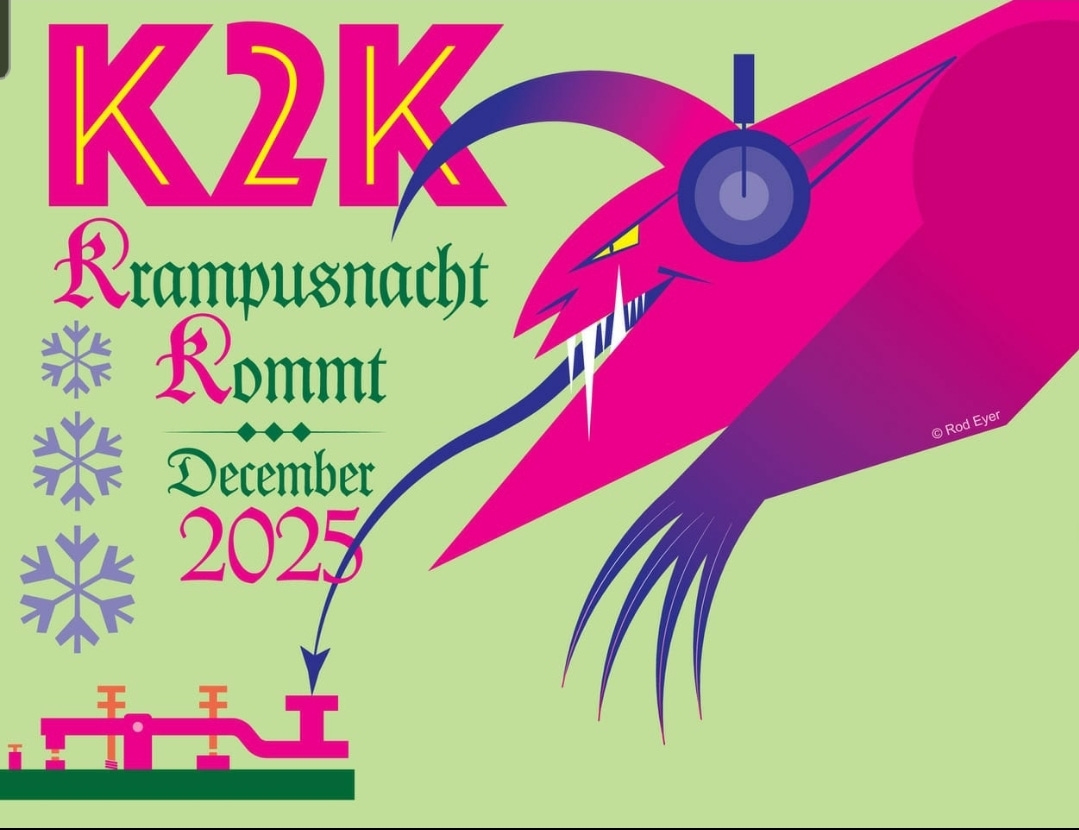
Special Event Spotlight: K2K Krampusnacht on the Air Interview with Caryn Eve Murray KD2GUT
Image Courtesy Rod Eyer and Caryn Eve Murray KD2GUT
Next week, a special event station will be on the air to celebrate Krampusnacht. From 00:00 UTC on Thursday, December 4th—that’s 7:00 PM Eastern Time on Wednesday night—until 23:59 on Friday, December 5th, or 6:59 PM on Friday night, a team of operators operating as K2K will head to the air with their paddles and microphones to celebrate ahead of the official observance of St. Nicholas Day on Saturday, December 6th.
To find out more about the history of Krampusnacht and what operators can expect from K2K Special Event, I’m joined by Caryn Eve Murray, KD2GVT, who’s been coordinating this year’s on-air celebration. Caryn, welcome to Amateur Radio News and Notes.
Caryn: Thank you so much, Ed, and thank you for the invitation. I’m very, very excited.
Ed: Me too. And I know Krampusnacht has a long and storied history, especially in Europe. But for any of our listeners who may not be familiar with what Krampusnacht is, and the Krampus for whom the event is named... who they... who they are—and also, maybe, because there might be more than one—the Krampus... and what happens on Krampusnacht? Maybe you can tell us a little bit about that.
Caryn: Absolutely. It is in the plural, actually. It is who really are the Krampuses? Or... it’s not the “Krampii.” I have been doing a lot of reading in preparation for this because I wanted to know more about this fascinating creature. And one of the books I read indicated that the plural of Krampus is Krampuses. I thought it would have been Krampii. Whatever the plural may be, we want our hunters, our chasers, to work as many Krampuses or as many Krampi among us as they can.
Who is Krampus? Who are the Krampus? The Krampus is a folkloric figure. If you’ve ever met him, you would remember him. He is a large, horned, goat-like figure who carries chains that he rattles and switches, and he menaces children. He started menacing them in the Alpine regions of Europe, but now he’s kind of expanded his territory. He’s here in the U.S. People have taken up the cause of Krampus and Krampusnacht and had their own parades and celebrations of him.
He usually comes right before St. Nicholas Day, when the bearded fellow—not to be confused with the other bearded fellow—shows up and brings sweets to children. Krampus, the Krampus, reminds children to be good. Um... I don’t want to draw any comparisons, but I’m sort of thinking there’s the Enforcement Bureau of the FCC, and then there’s Krampus, who shows up before Santa Claus. So, Krampus is fearsome, but in recent years he’s been a little more gentle. He may grab a kid and roar at him, but I don’t think he’s been stuffing them in his sack and carrying them off anymore.
Ed: Well, that definitely sounds like a lot of fun, and I’m glad that they’re not getting hauled away in the sack. You do have a big group of operators this year. I know I’m honored to be a part of the team. How will the folks on the air be celebrating Krampusnacht with the world?
Caryn: Well, we’re going to be talking a lot about Krampus, the Krampus, which is why we’re using conversational modes. We’re using Sideband, we’re using Phone. And we’re using CW for those who’d like to ragchew a little bit about the Krampus. We even have DMR. We’ve been very fortunate to have a DMR channel made available to us, a talk group that has a bridge to D-STAR and Fusion.
So we are using conversational modes to talk about the Krampus and to hear people’s stories. You do know one of our ops has a... I don’t want to say personal acquaintance, but at least personal knowledge and experience with a Krampus, and that would be Mike, N2PPI, who was personally terrorized by a Krampus or two during his childhood when he spent the holiday season in Bavaria.
Ed: Well, hopefully, he has lived to tell the tale and has some good stories to tell on the air. Now, one thing I’ve heard is that the people who are going to be running this event, that they all have their own Krampus names. So I know I’m going to be Belsnickel this year, who is a disheveled Krampus who carries a switch to beat the naughty children, and also brings cakes, nuts, and candies for those who are good. I’m going to try to be more in the cake, nut, and candy category. But he traditionally hails from the southwestern part of Germany and is also popular mythology with the Pennsylvania Dutch communities as well. What is going to be your Krampus name this year, and is there anything that we should know about your version of the Krampus?
Caryn: Oh, yes. Oh, yes. I am Knecht Ruprecht. I am not going to attempt to send that full name when I am operating CW. So I encourage listeners to this podcast to not be afraid to come back to me if you hear me calling CQ Krampus. I will not make you copy Knecht Ruprecht in CW. I will be using it definitely during my time on phone, though.
My Krampus... not too different from your Krampus. Filthy, filthy person... or creature, I should say. With soot and ashes. Giving nuts and candies and fruits to the kids who’ve behaved well, and giving, you know what, to the others. Switches, punishment, and instilling great fear in them.
Now, one thing I did learn about Knecht Ruprecht—a very privileged thing—Knecht Ruprecht apparently had a composition Robert Schumann wrote in 1848. It’s on his Album for the Young. It’s one of, I think, 43 pieces he composed. So, I am probably representing the most musical of the Krampuses. I’m kind of happy about that because it’s not all screaming, yelling, and chain-rattling.
Ed: Very good. So how can operators around the world who want to join in the fun this year get involved with the K2K Krampuses on the air? And you said the modes—conversational going to be CW and Sideband—so tell us a little more about that.
Caryn: Yeah. We’re going to be on HF. Since this is not a contest, we can be on 10 meters for CW... uh, we can basically be on the bands where casual operating is allowed. Sideband and CW. And for those who don’t have either or are not able to get to us because of operating privileges—as we have in different countries—the good people at the ICQ Podcast are giving us use of their channels for 48 hours, and we will be using the DMR talk group that they have there, which has a bridge to Fusion and D-STAR as I mentioned before. And all of that information is on our page on QRZ. You’ll see the numbers of the channels and where to tune.
I will be monitoring those channels. I know I’ll be on during the day on one or the other of those. And in the evenings, I will be on one of the HF modes, either CW or Sideband, or probably both. Because you cannot... you cannot get enough of Krampus. We’ll be posting on the clusters, so look for us.
Ed: Fantastic. And since this is the festive season for giving, is there anything that Krampus chasers can expect to fill the stockings in their hamshacks?
Caryn: Well, I can tell you there are some things you don’t want to find in your stockings if you’re dealing with Krampus. Krampus does not give rigs or linear amps. You got to go to the big guy in the red suit for that. No, I think Krampus chasers, the most you can get from him perhaps is forgiveness for bad behavior.
And a beautiful downloadable certificate that was crafted by a person very close to me—my husband—who has been most patient since he is not a ham radio operator, but he knows how I love Krampus, and he is a graphic designer. And so anybody working a Krampus this year will get that certificate. You’ll get a link to it that you can download with the confirmation of your QSOs.
Ed: And I can confirm I’ve seen some of the artwork; it is absolutely beautiful. Really, really cool. So I’m... in fact, you can get a taste of it on the QRZ page. Definitely worth checking that out. And, of course, getting in the log so you can get one yourself. This really does sound like it’s going to be a blast. Is there anything else we should know?
Caryn: Well, yes, and thank you. Thank you for the kind words about the certificate. Yeah, I think everybody should know that we are all excited. And this is the first time we’re doing this, so we don’t know how it’s going to go. And we’re counting on everybody who either has experienced a Krampus or wants to experience a Krampus... God, it almost sounds like crumpets, doesn’t it? Crumpets are tasty; this Krampus is not.
This should be fun. This is a part of folklore and culture that is important to share. Amateur Radio is about being global and sharing one another’s cultures and educating one another on cultures. And yeah, we’re getting a little crazy and having a little fun and talking about this wild goat-like creature named the Krampus, but we’re also educating folks on history, culture, and welcoming the holiday season. Because once Krampusnacht is over, then we get into the good stuff. We get the sweets and the presents and everything else.
So what I’d like to advise everybody is, if you’re listening to this: Have you been good? Or will you be visited by Krampus?
Ed: Well, I’d like to think I’ve been good. I’m very excited for this year’s special event. So, hey, thank you so much for talking with us today. And also for doing all the hard work to make this happen. This is the fun part of Amateur Radio, and I really do want to say thank you for all of your hard work, and I can’t wait to see this unfold in the next week.
Caryn: Well, thank you, Ed. Or should I say, Belsnickel? That is your Krampus name. And thank you for your enthusiasm and all your support. I think we’re going to have a lot to talk about once the two-day event is over. So we’ll see everybody on the air.
Ed: Fantastic. Well, thank you so much. And more information about the event can be found on the QRZ page. That’s at https://qrz.com/db/k2k. And we do hope you’ll join us for two days and nights of fun on the air.
FCC Experiencing Continued Systems Degradation and ARRL VEC Processes Most of Backlogged Applications
The ARRL reported in this week’s ARRL Letter that the ARRL VEC has processed most of the more than 2,500 backlogged license applications that could not be filed as a result of the shutdown of the federal government. I can confirm that a person who I know who passed her exam during the shutdown has been issued her license. Congratulations! That said, there are still issues with FCC systems including the Universal Licensing System (ULS), Antenna Structure Registration (ASR), Tower Construction Notification System (TCNS), and Electronic Section 106 System (E-106). As mentioned last week, the Federal Communications Commission announced that it would extend the filing deadline to March 5, 2026 for any licenses that were set to expire during the period between October 1, 2025 and March 5, 2026 in their Public Notice DA-25-943. This means anyone whose license renewal deadlines were missed during the period now has more time to complete the filings and continue operations.
The FCC’s site reported that users should expect delays in search results, delays in processing of applications, intermittent timeouts of submissions, general sluggishness, and inability to complete fee payments. While they’re working to resolve the issues the FCC asks that users postpone non-urgent filings and refrain from repeated submissions if there are errors. According to the FCC “FCC technical staff and contractors are actively investigating the cause and are working to restore normal system performance as quickly as possible. This issue is being treated with the highest priority.” More information can be found at:
https://www.fcc.gov/document/fcc-announces-revised-filing-deadlines
https://www.fcc.gov/wireless/uls-asr-tcns-experiencing-significant-performance-degradation
MVARC Breakfast and Meeting Recap
Image Courtesy Corey Law KN4YZY
Last weekend MVARC had another great turnout for our monthly breakfast at IHOP. Afterward we went to the Mount Vernon Governmental Center where Ed N2EC gave a talk about his VersaHex Antenna system. We look forward to the upcoming holiday dinner in December , so stay tuned for more updates. Due to the holidays, we don’t have a December meeting, but will resume our monthly meetings in January. We look forward to seeing you soon.
MVARC Nets on the Air
* 2 Meter FM Net: Tuesdays at 7 PM [146.655/- MHz (141.3 Hz PL Tone) ]
* 2 Meter Digital Net: Immediately Follows 2 Meter FM Net [146.655/- MHz C4FM]
* MVARC Slow Speed CW Roundtable: Saturday and Sunday at 7:30 AM [3.565 MHz CW]
* MVARC Cherry Tree Net: Saturday and Sunday at 8:30 AM [3.920 MHz LSB]
What’s Happening with DX
Remember how I mentioned that CW World Wide CW is like Christmas coming early for DXers? Well in this week’s DX report, you’ll see what I mean. There will be a ton of DX on the bands this week. Stations on the air include Aland Islands (OH0Z), Mauritius (3B8M), Thailand (E2A), Sao Miguel Island in the Azores (CR2M), Cape Verde Cabo Verde (D4P), Corsica (TK0C), Bonaire (PJ4A, PJ4K), Oman (A44A), Barbados (8P5A), Saint Martin (TO9W), Sint Maarten (PJ7UK), Martinique (TO7A, FM/KL7WA), New Providence Island Bahamas (C6AQQ), Antigua (V26K), Guyana (8R1/AG6UT), Greenland (OX7A, OX7AM, OX7AKT, OX3LG), Bermuda (VP9I), Cambodia (XU7RRC), Aruba (P44W), Cayman Islands (ZF1A), Chatham Islands (ZL7IO), Bhutan (A52AA), Vanuatu (YJ0GC), Saint Kitts and Nevis (V47T), Sint Eustatius (PJ5C), Grenada (J38W), San Andres (5J0EA), Lord Howe Island (VK2/LZ1GC), Ghana (9G5ZZ), Uganda (5X1XA, 5X1DF, 5X7W), Gabon (TR8CR), Rodrigues Island (3B9KW, 3B9/M0CFW), Colombia (HK3JCL), Madagascar (5R8IC), Mali (TZ4AM), Marcus Island Minami Tori Shima Islands (JG8NQJ/JD1), and Antarctica (DP0GVN, FT4YM). If that doesn’t make you want to work CQ WW CW this weekend, I don’t know what will! Good luck.
A calendar of DXpeditions can be found at https://dxnews.com/calendar/
Solar Activity Update
As we go to press the Solar Flux Index (SFI) was 120 and the estimated sunspot number was 85 with 5 numbered sunspot regions visible from Earth. Over the last week the SFI has stayed about the same. Solar activity has been at low levels in the last 24 hours. The geomagnetic field has been at unsettled to minor storm levels and the Kp index reached 5 yesterday. The solar wind peaked at 779 km/s. Solar activity is predicted to be at low levels with a slight chance of M-class flares through Sunday. The chance of solar radiation storms at the S1 or greater level is at 1% today through Sunday. R1 to R2 radio blackouts are unlikely in the near term with a predicted probability of 15% today through Sunday. R3 or greater blackouts are unlikely with a 1% chance predicted today through Sunday. There is a chance of 6 meter propagation so keep an eye on the band and spotting clusters to be ready for the next time the magic band does its thing. It remains a fantastic time for amateurs to get on the air and work the world.
Good sources of real-time solar information include https://www.spaceweatherlive.com/ and https://solarham.com/ . A good overview of conditions can be found at https://dx.qsl.net/propagation/. To see D-layer absorption data and associated radio blackouts, visit https://www.swpc.noaa.gov/products/d-region-absorption-predictions-d-rap. To see real-time Maximum Usable Frequency (MUF) and Critical Frequency (foF2) information from radiosonde data, visit https://prop.kc2g.com/.
Upcoming Contests
As we spotlighted earlier, the big contest this weekend is CQ World Wide CW. As a result there aren’t any other big contests on the calendar over the weekend. As always the K1USN SSTs, MSTs, and CWTs will also be on the air.
The full contest calendar with events and exchanges can be found at https://www.contestcalendar.com/weeklycont.php
Interesting Online Radio Content
Forrest KI7QCF gives his 5 favorite QRP radios still on the market -
Michael KB9VBR does a second look at the Alpha Hextenna, this time as a vertical -
Matt M0DQW talks about HAARP conspiracy theories why they’re nonsense -
Steve KM9G tests an LCR meter and power supply from Fnirsi -
Mike K8MRD builds the Just OK Mini 20 meter antenna -
Tim K5OHY continues his deep dive into the end-fed half-wave antenna and looks at deployments -
Kevin W1DED talks to Jose CT1BOH about the battle for CQ WW CW this weekend -
Kevin W1DED talks to the European Contest Crew about CW WW CW -
Kevin KB9RLW builds a ground isolated antenna switch and compares it with a common ground switch -
Rob N1NUG hacks an old microphone to use with his zBitx radio -
Craig KM6LYW talks about how to find packet radio modes in your area -
Mike K8MRD gives his 10 most innovative radio accessories for QRP -
Walt K4OGO tests out an AlexLoop magnetic loop antenna -
Vince VE6LK shows how he keeps track of the discharge levels of his Lithium Iron Phosphate batteries -
Dr. Tamitha Skov WX6SWW gives her space weather updates -
Matt M0DQW takes a look at the 10 meter capable President Washington radio -
That’s it for this week.
Best 73,
Ed
N2EC