In the log this week
* Contest Spotlight: North American SSB Sprint
* ARRL Atlantic Division Director Declared Ineligible For Office
* Desecheo DXpedition Update
* MVARC Winter Field Day Recap
* MVARC Nets on the Air
* What’s happening with DX?
* Solar Activity Update
* Upcoming Contests
* Interesting Online Radio Content
As always, links to all referenced content can be found in the show notes, or at our Substack at mvarc.substack.com
Thanks for reading Amateur Radio News & Notes. Subscribe for free to receive new posts and support my work.
Contest Spotlight: North American SSB Sprint
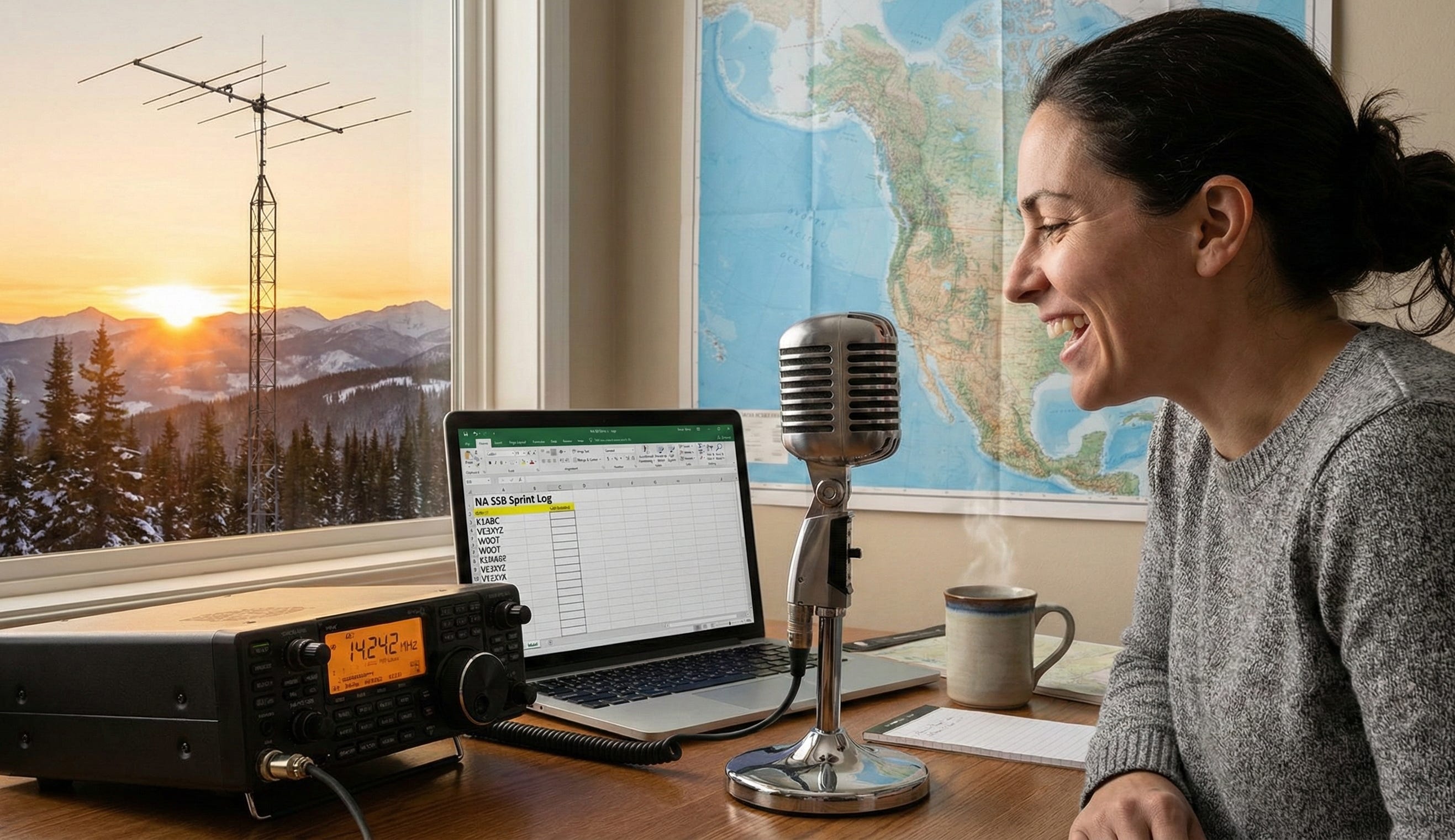
This weekend brings the latest edition of the North American SSB Sprint. This contest starts at 0000 UTC on Sunday, February 1, 2026 (7 PM Eastern Time Saturday) and goes until 0359 UTC Sunday (10:59 PM Eastern Time Saturday). The objective for the contest is for North American stations to make as many contacts as possible and for non-North American stations to contact as many North American stations as possible. One feature of the contest that makes this one a bit different is the QSY rule that makes it a “sprint” which stipulates that any station that calls CQ, says QRZ, or says “Going Up 5” or something to that effect to solicit a contact needs to change frequency by at least 1 kHz after the completion of that contact. Essentially, you can’t stay on a single frequency and make more than a single contact if you’re calling CQ.
The exchange for the contest is the other station’s call sign, your call sign, your sequential serial number (starting with 1), your name, and your location (State/Province/Country with DX for outside of North America stations). So if I was contacting K4US for my 42nd QSO, my exchange would be “K4US N2EC 42 Ed VA”. Participants can enter as QRP (5 Watts or less), Low Power (100 Watts or less), and High Power (1500 Watts or less). The contest is limited to 20, 40, and 80 meters with suggested frequencies between 14200-14275 kHz, 7125-7225 kHz, and 3700-3825 kHz (but stay out of the DX window from 3790-3800 kHz). The multipliers are US States, Canadian Provinces, and North American countries listed in the rules. DX doesn’t count as a multiplier, but does count for QSO points. Logs must be submitted within 7 days of the event and Cabrillo format is preferred.
This should be a fun contest to test your skills and get a bunch of contacts in the log. More information can be found at https://ssbsprint.com/. Good luck!
ARRL Atlantic Division Director Declared Ineligible For Office
Image Courtesy ARRL.org
In a bulletin to members sent on January 28, 2026 the American Radio Relay League announced that Atlantic Division Director Robert Famiglio K3RF was made ineligible to remain in his elected position due to him not signing a recertification of the “Board Member Statement on Authority, Responsibility, and Expectations” that had been added to the ARRL By Laws section 46(d) last year in the July 2025 board meeting.
In a separate communication from Robert Famiglio he wished to make it clear that he is not resigning, but “being removed without [his] consent by the application of the new code of conduct rules passed in July of 2025”. Famiglio, who is also a lawyer, believes that the new rules “now limit or prohibit a director’s ability to advise his division of matter involving important board decisions without advance permission”. He continues that his “interpretation of the new rules and required confidentiality agreement, and that of other lawyers [he has] consulted, contradicts [his] obligations under Connecticut law to [ARRL members].” He adds that he “cannot in good conscience sign the new director’s oath of confidentiality that is now demanded by the new bylaws”.
As a result of his removal as director, Marty Newingham AG3I, the previous Vice Director for the Atlantic division, has assumed the role as Atlantic Division Director.
Desecheo DXpedition Update
Image Courtesy https://desecheo2026.com/kp5/
In an update on their web site on January 28, 2026 the KP5/NP3VI DXpedition announced that they had made over 43,000 QSOs with over 10,700 unique call signs in 123 DXCC entities. They have been working through the challenges of operating the station remotely under renewable battery power. They state that low power and efficiency are key to their operations, band choices will follow real-time propagation, and adjustments will be made as necessary. They plan to continue operations on CW, SSB, and digital. They also have been posting provisional schedules for modes and targets on their web site at https://desecheo2026.com/kp5/. Good luck.
MVARC Winter Field Day Recap
Photo Courtesy Corey KN4YZY
Last Saturday the Mount Vernon Amateur Radio Club operated Winter Field Day in Alexandria, Virginia as K4US. We were a 2O station (2 transmitter outdoor station) and despite temperatures in the morning of 12 degrees Fahrenheit we had a great turn out. The club was hosted by club president Corey KN4YZY and his wife who made sure everyone felt welcome and had plenty of warm food and drink. Ed N2EC brought a double-sized ice fishing hut and a diesel heater to allow for the operating team to have a warm shelter that got up into the mid-80s during the event. We made 58 contacts on CW and 73 on SSB for a total of 131 QSOs including the first HF contact ever for a new operator who joined us. We operated primarily on the 15 and 20 meter bands using the N2EC VersaHex Antenna and a Chelegance MC-750 attached to an Icom 7100 and a Yaesu FT-991A. We decided to call it a day in the late afternoon as the severe snow event was barreling down on the Eastern half of the US and we wanted to make sure that everyone got home safe and sound. Thanks to everyone who joined in the fun to help us set-up, get on the air, socialize, and take down the station. It was an absolute blast.
MVARC Nets on the Air
* 2 Meter FM Net: Tuesdays at 7 PM [146.655/- MHz (141.3 Hz PL Tone) ]
* 2 Meter Digital Net: Immediately Follows 2 Meter FM Net [146.655/- MHz C4FM]
* MVARC Slow Speed CW Roundtable: Saturday and Sunday at 7:30 AM [3.565 MHz CW]
* MVARC Cherry Tree Net: Saturday and Sunday at 8:30 AM [3.920 MHz LSB]
What’s Happening with DX
There will be a lot of DX on the air this week. Stations on the air include Saint Kitts (V47JA), Rwanda (9X2AW), Guadeloupe (FG4KH), Tanzania (5H3DX), Gambia (C5SP), Guinea Bissau (J52EC), Desecheo Island (KP5/NP3VI), South Sudan (Z81D), Solomon Islands (H44MS), Colombia (HK3JCL), and Antarctica (DP0GVN, FT4YM).
A calendar of DXpeditions can be found at https://dxnews.com/calendar/
Solar Activity Update
As we go to press the Solar Flux Index (SFI) was 129 and the estimated sunspot number was 135 with 9 numbered sunspot regions visible from Earth. Over the last week the SFI has decreased. Solar activity has been at low levels in the last 24 hours. The geomagnetic field has been at quiet to minor storm levels and the Kp index reached 4 yesterday. The solar wind peaked at 781 km/s. Solar activity is predicted to be at low levels with a slight chance of an M-class flare today through Sunday. The geomagnetic field is forecast to be at quiet to active levels today, at quiet to unsettled levels on Saturday, and at quiet levels on Sunday. The chance of solar radiation storms at the S1 or greater level is at 1% today through Sunday. R1 to R2 radio blackouts are unlikely in the near term with a predicted probability of 15% today and 10% Saturday and Sunday. R3 or greater blackouts are unlikely with a 1% chance predicted today through Sunday. There is a chance of 6 meter propagation so keep an eye on the band and spotting clusters to be ready for the next time the magic band does its thing. It remains a fantastic time for amateurs to get on the air and work the world.
Good sources of real-time solar information include https://www.spaceweatherlive.com/ and https://solarham.com/. A good overview of conditions can be found at https://dx.qsl.net/propagation/. To see D-layer absorption data and associated radio blackouts, visit https://www.swpc.noaa.gov/products/d-region-absorption-predictions-d-rap. To see real-time Maximum Usable Frequency (MUF) and Critical Frequency (foF2) information from radiosonde data, visit https://prop.kc2g.com/.
Upcoming Contests
This weekend brings the Feld Hell Sprint, the UBA DX Contest on SSB, the North American SSB Sprint, the Marconi Club ARI Loano Slow CW QSO Party, and the Real Time Contest. As always the K1USN SSTs, MSTs, and CWTs will also be on the air.
The full contest calendar with events and exchanges can be found at https://www.contestcalendar.com/weeklycont.php
Interesting Online Radio Content
The Long Island CW Club has a presentation about the CW journey of members -
Dugbo KD7DUG gets QRP DX to Japan with a straight key from a mountain -
Ciprian YO6DXE shows off his new Spy Transceiver with just 3 transistors -
Duff WA7BFN gives another edition of the Long Island CW Club Podcast with the NAQP, Arduino Programming, DXpeditions, and AI -
Mike K8MRD gives us a tour of his ham shack -
Peter VK3YE’s tin can transmitter is heard 2,500 km away -
Matt M0DQW shows off his desktop SSTV receiver system -
John AE5X does Winter Field Day from Florida by motorcycle -
Mike K8MRD saves an old Kenwood HT from the trash bin and shows it to us -
Walt K4OGO daydreams about a 100 Watt Xiegu rig he wishes would exist -
Fact Quickie talks about why circuit boards are generally green -
Callum M0XXT builds a vertical from scrap materials and gets it on the air -
Kevan 2E0WMG shows how amateur radio and kayaking are a “match made in heaven” -
Craig KM6LYW talks about the MeshCore messaging platform -
Jeff KF0MYB takes a look at a portable Fnirsi oscilloscope -
Steve KM9G looks at a flexible solar panel setup for his portable operations -
Rob N1NUG asks us to be kind and helpful in our interactions with newer operators -
George VK2 AOE does round two of his Tasmanian portable operations -
Save it for Parts tests faraday bags for RF isolation -
Matt M0DQW tests out the MLite-880 Portable Receiver -
Mike K8MRD builds an inexpensive linked dipole -
TJ K9KJ talks about working DXpeditions and using ClubLog to find if you’re in their log -
That’s it for this week.
Best 73,
Ed
N2EC