In the log this week
* Contest Spotlight: CQ World Wide 160-Meter Contest
* DXpedition Spotlight: J51A Guinea Bissau
* Bouvet Island 3Y0K DXpedition Update
* Desecheo Island KP5/NP3VI DXpedition to be QRT March 3
* HamClock Gets New Community Backend
* MVARC Nets on the Air
* What’s happening with DX?
* Solar Activity Update
* Upcoming Contests
* Interesting Online Radio Content
As always, links to all referenced content can be found in the show notes, or at our Substack at mvarc.substack.com
Thanks for reading Amateur Radio News and Notes. Subscribe for free to receive new posts and support my work.
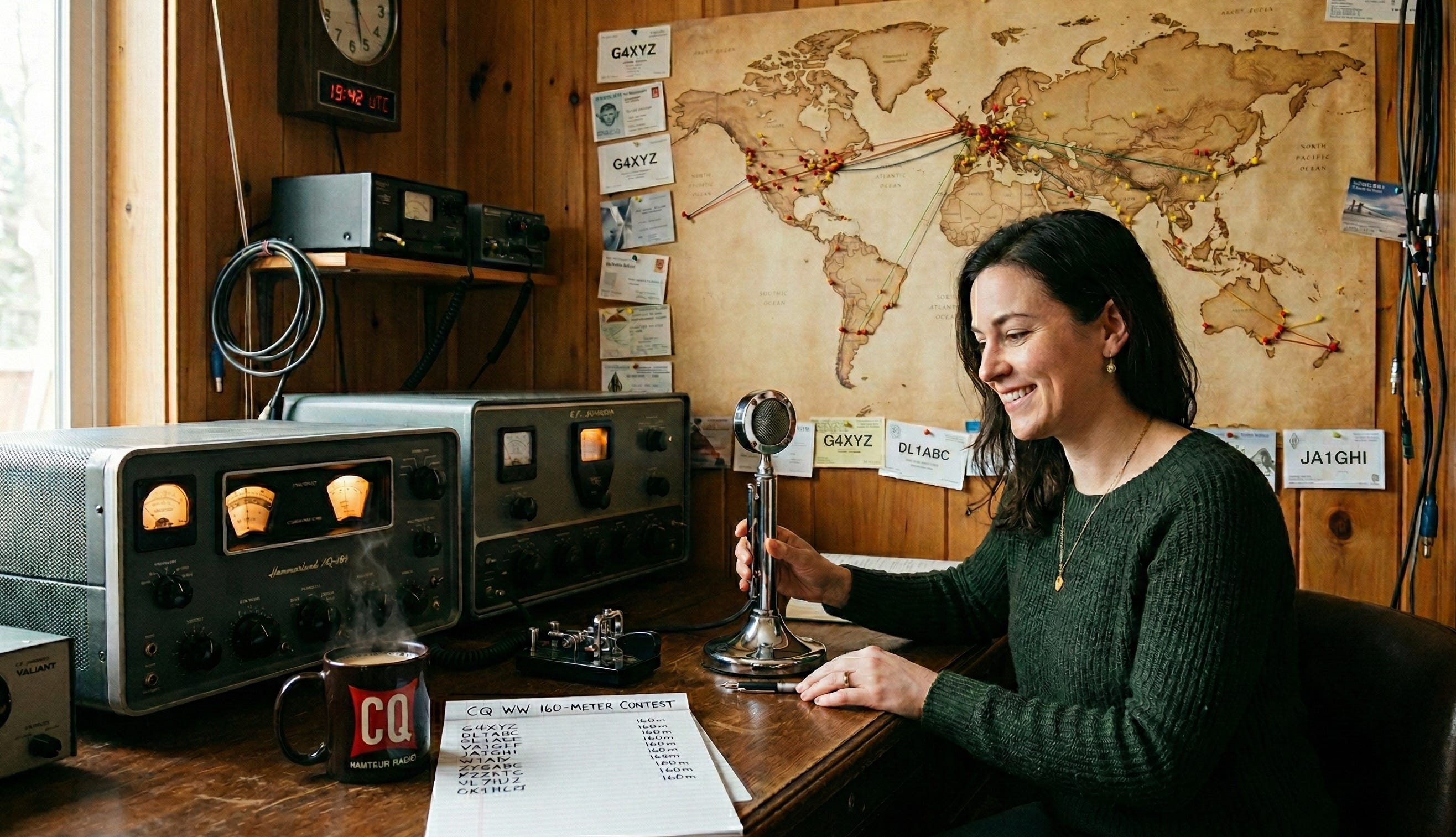
Contest Spotlight: CQ World Wide 160-Meter Contest
This weekend brings the latest edition of the CQ World Wide 160-meter contest on SSB. The contest starts at 2200 UTC on Friday, February 27th (5 PM Eastern Time Friday) and ends at 2200 UTC Sunday, March 1 (5 PM Eastern Time Sunday). The contest is all about having amateurs from around the world make as many contacts with U.S. states, Canadian provinces, and countries as possible using the 160-meter band. For single operator assisted stations only, operators are able to use one remote receiver within 100 kilometers of the main transmitter if conditions (like local noise) require. This includes WebSDRs, but they must be within the 100 km limit. The unassisted entries may not use a remote receiver.
Single operator stations can work as much as 30 hours of the 48 hour period. Operating categories include Single Operator with no QSO finding assistance allowed for High Power up to 1500 Watts of power, Low Power up to 100 Watts of power, and QRP up to 5 Watts of Power. There is also the Single Operator Assisted categories (High Power, Low Power, and QRP) with spotting assistance allowed and a remote receiver is permitted within 100 km of the station.
The exchange is the RST, State for US, Province for Canada, or CQ Zone for DX. So for me in Virginia, my exchange would be “59 VA”. Multipliers are the 48 contiguous US States plus DC, the 14 Canadian Provinces (VO1 and VO2 count as two provinces), and DXCC countries including WAE countries. Points are awarded as 2 for QSOs in ones own country, 5 points for other countries on the same continent, and 10 points for contacts on other continents. Maritime mobile counts for 5 points but no multiplier. Logs must be submitted by March 6, 2026 at 2200 UTC. This is a great opportunity to make a lot of contacts on the top band. Good luck.
DXpedition Spotlight: J51A Guinea Bissau
Image Courtesy https://www.dx-world.net/j51a-guinea-bissau/
The J51A DXpedition to the Bijagos Archipelago in Guinea Bissau has been very active on the bands in the last week. Your author was able to work them on 15, 17, and 30 meters CW with a strong signal into the East Coast. Yesterday the team reported they had logged 61,300 QSOs in 69 hours of operation. The operators include several members from the Bavarian Contest Club. They are currently scheduled to operate until March 15. Guinea Bissau is a country on the West coast of Africa with a population of about 2 million people. It is currently listed as #84 on the ClubLog Most Wanted List. For more information about the DXpedition with photos, live streams, log searches, and team updates visit https://www.qrz.com/db/J51A and https://www.dx-world.net/j51a-guinea-bissau/. Look for them on the bands and good luck.
Bouvet Island 3Y0K DXpedition Update
Image Courtesy https://3y0k.com
The highly anticipated 3Y0K DXpedition to Bouvet Island departed from Cape Town, South Africa in the last week and has been steadily making its way to Bouvet. On February 25th the team provided an update saying that the boat was in an area of bad weather which was slowing down their journey. They slowed their speed for safety since they would not be missing any weather windows for landing. They were 140 miles from the island when they posted on the 25th and believe that their ETA will be Friday the 27th around 6 PM Local Time (Noon Eastern Time).
The 3Y0K DXpedition is one of the most expensive and logistically complicated in history with a reported budget of around $1.7 million. The plan is to have a 3 week DXpedition although with extreme weather at Bouvet, they will be dependent on weather windows to get to the island via their helicopter. The 3Y0K team has mentioned that they have received reports of individuals pirating the call sign on-air. They ask you not to work the pirates and do say there will be official communications from pilots or a team leader when the team is operational.
Links with more information can be found at:
The Official Site:
The Ship Tracker:
https://www.vesselfinder.com/?imo=7104752
DX News Coverage: https://dxnews.com/3y0k/
Desecheo Island KP5/NP3VI DXpedition to be QRT March 3
Image Courtesy https://desecheo2026.com/kp5/
The KP5/NP3VI Desecheo DXpedition has had very successful and extended run with its remote operations with the total number of QSOs exceeding 100,000 as we went to press. Sadly, all good things must come to an end, and this DXpedition is no exception. They are scheduled to be QRT on March 3, 2026. If you haven’t gotten Desecheo in your logs, you still have time, but make sure to act fast. For more information including schedule plans and log searching visit https://desecheo2026.com/kp5/ . Good Luck.
HamClock Gets New Community Backend
Image courtesy https://qso365.co.uk/2024/01/hamclock/
The announcement that the popular HamClock software would stop working after the passing of its creator Elwood Downey WB0OEW set the community into action to provide alternatives to the amateur radio community. This week the team at https://hamclock.com/ announced that they have created a back end server that allows HamClock to continue to function. They have instructions on their site for how to modify your installation to have it work with their back end. Their site says they are already serving over 2,700 HamClock installations. For more information visit https://hamclock.com/.
MVARC Nets on the Air
* 2 Meter FM Net: Tuesdays at 7 PM [146.655/- MHz (141.3 Hz PL Tone) ]
* 2 Meter Digital Net: Immediately Follows 2 Meter FM Net [146.655/- MHz C4FM]
* MVARC Slow Speed CW Roundtable: Saturday and Sunday at 7:30 AM [3.565 MHz CW]
* MVARC Cherry Tree Net: Saturday and Sunday at 8:30 AM [3.920 MHz LSB]
What’s Happening with DX
There will be a lot of DX on the air this week. Stations on the air include Ethiopia (ET3AA), Bouvet Island (3Y0K), Guinea Bissau (J51A), Gambia (C5SP), Palau (T8OK), Anguilla (VP2EAD, VP2ELX, VP2EWE), Bangladesh (S21WD), Desecheo Island (KP5/NP3VI), Colombia (HK3JCL), and Solomon Islands (H44MS).
A calendar of DXpeditions can be found at https://dxnews.com/calendar/
Solar Activity Update
As we go to press the Solar Flux Index (SFI) was 130 and the estimated sunspot number was 43 with 3 numbered sunspot regions visible from Earth. Over the last week the SFI has increased. Solar activity has been at low levels in the last 24 hours. The geomagnetic field has been at quiet to active levels and the Kp index reached 4 yesterday. The solar wind peaked at 613 km/s. Solar activity is predicted to be at low levels with a chance of M-class flares today through Sunday. The geomagnetic field is forecast to be at quiet to unsettled levels today and Saturday and at unsettled to active levels on Sunday. The chance of solar radiation storms at the S1 or greater level is at 1% today through Sunday. R1 to R2 radio blackouts are possible in the near term with a predicted probability of 25% today through Sunday. R3 or greater blackouts are unlikely with a 5% chance predicted today through Sunday. It remains a fantastic time for amateurs to get on the air and work the world.
Good sources of real-time solar information include https://www.spaceweatherlive.com/ and https://solarham.com/. A good overview of conditions can be found at https://dx.qsl.net/propagation/. To see D-layer absorption data and associated radio blackouts, visit https://www.swpc.noaa.gov/products/d-region-absorption-predictions-d-rap. To see real-time Maximum Usable Frequency (MUF) and Critical Frequency (foF2) information from radiosonde data, visit
Upcoming Contests
This weekend brings the CQ World Wide 160-Meter Contest on SSB, the UBA DX Contest on CW, the South Carolina QSO Party, the North Carolina QSO Party, the North American QSO Party on RTTY, the NA Collegiate Championship on RTTY, the UBA Spring Contest on 2m, the NSARA Contest, the SARL Hamnet 40m Simulated Emergency Contest, and the WAB 3.5 MHz Phone Contest. As always the K1USN SSTs, MSTs, and CWTs will also be on the air.
The full contest calendar with events and exchanges can be found at https://www.contestcalendar.com/weeklycont.php
Interesting Online Radio Content
Stuart VE9CF talks about the scheduled shut down of Canadian Weather Radio -
Tim K5OHY builds and tests a 300 Ohm Ladder Line Fed Doublet -
Mike K8MRD looks at the new community backend for HamClock and shows you how to switch -
Walt K4OGO takes us behind the scenes at “Shack Day” in Chesapeake, VA -
Dugbo KD7DUG does 2m CW for SOTA -
Jason KM4ACK shows his Hamvention haul -
Mort G4BSK shows how he builds his 3D Printed microphones -
Bob WV1W takes a look at the Xiegu VK-6 Paddles -
Lewis M3HHY listens in to pirates jamming Russian military signals -
Forrest KI7QCF talks about what QRP means to him -
Yuri UT4LW shows his 2BSIQ run for ARRL DX CW -
Mike K8MRD takes us along at the Greater Houston Hamfest -
Lidi KQ3Q builds a 17-five antenna and gets it on the air for POTA -
Dr. Tamitha Skov WX6SWW talks about the first spotless sun in years -
Steve KM9G takes a look at a portable solar power bank for portable operations -
Forrest KI7QCF shows part of his ARRL DX CW run -
Colin MM0OPX tells you why you should be using the 10 meter band right now -
Mark KD7DTS takes us aboard the Battleship Iowa to see the radio facilities -
Peter VK3YE shows what you can do with 10 meters of wire to get on the air -
Mike K8MRD activates POTA with Caitlin K8FAE -
Matt M0DQW takes a look at FT2 for digital communications -
Steve KM9G shows how he uses an inexpensive Z-Match antenna tuner -
That’s it for this week.
Best 73,
Ed
N2EC