For all my interviews and more, subscribe on YouTube.
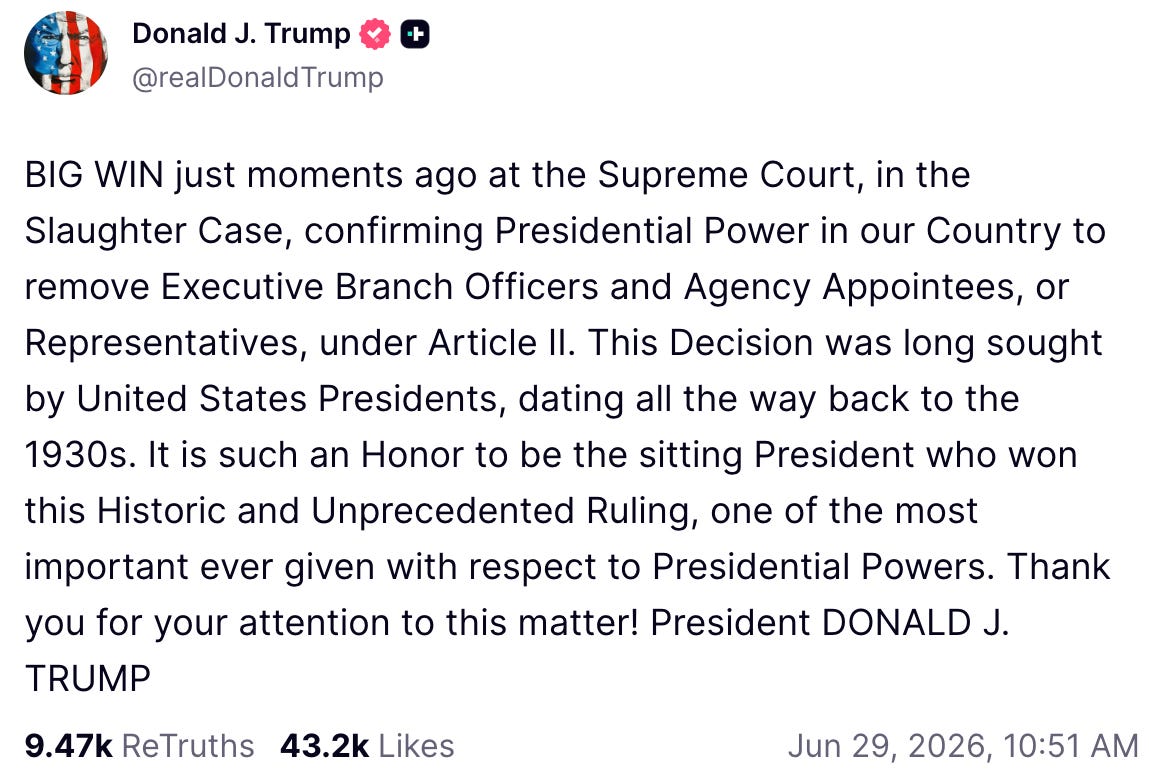
Lisa Graves is the author of Without Precedent, a history and analysis of the Roberts Court and the expert on how the Federalist Society has been working to undermine democracy. Yesterday this happened:
So I managed to arrange a conversation with Lisa about what is happening:
. . .
TRANSCRIPT: Paul Krugman in Conversation with Lisa Graves
(recorded 6/29/26)
Paul Krugman: Hi everyone. This is a bit of an emergency recording and podcast because today, which is Monday as we’re recording this, the Supreme Court has just handed down several decisions, of which one was really alarming. And I had talked earlier with Lisa Graves, head of True North Research, and Court Accountability who had been warning about all this stuff when I talked with her previously and on other occasions. And I wanted to get somebody who’s actually following this to weigh in. So, hi Lisa.
Lisa Graves: Paul, thank you so much for inviting me back on. I really appreciate it.
Krugman: Yeah. So, there were obviously several decisions that came down, but Humphrey’s Executor… This is absolutely mind-boggling. So why don’t you talk about Humphrey’s Executor and then we’ll talk about the background and what this says about the Roberts Court?
Graves: Yes. Today’s Slaughter case involving the FTC, is a case where the Roberts Court has overruled nearly a century of legal precedent which prohibited presidents from firing commissioners, specifically on the Federal Trade Commission, the case that you mentioned, Paul. Humphrey’s Executor was specifically about the FTC. It was about this provision that barred FDR, Franklin Delano Roosevelt, from firing someone whom Hoover appointed to that commission. When Congress created the FTC, it set a standard that required that you would have to have cause to fire someone outside of their term.
The way the FTC is set up is that it has five commissioners by statute. Three of those commissioners are appointed by the president, two from the president’s party, and two are not from the president’s party. What’s happened over the past year is since Donald Trump became president again, he fired the Democratic commissioners on that commission. And so for the last 15 months, that commission has had only two commissioners, two Republican appointees, which has meant there hasn’t been a Democrat even in the room to consider these cases that are brought to the FTC, which relate to the power of huge corporations to merge with one another or not. And so, in essence, the FTC investigates proposed mergers and other things that might be considered a restraint on trade or affect the ability of consumers to get a fair price on things, for example. And what Trump has done is that he’s basically dominated that board in defiance of the plain language of the statute.
So any legal action by Donald Trump that has been countenanced by this Supreme Court, which allowed that firing to stand, in essence, did not allow the lower courts to reinstall Rebecca Slaughter to that post while the case was pending, and then just today ruled that, in fact, under their new approach to the Constitution, Donald Trump has the power to fire anyone at any independent agency—other than the Fed, it seems—no matter what Congress has said. And this is the result of an invention of a theory from the Reagan revolutionaries back in the day to try to aggrandize presidential power through what they describe as “the unitary executive theory.”
So the bottom line is that this ruling by the Roberts Court will allow more of the corruption that we’ve seen going on by this administration in terms of people who may be donors to Trump seemingly getting out of investigations or having their mergers go through, and we will not have a commission at the FTC that has any independence—just loyalists for Donald Trump for the foreseeable future.
Krugman: And it applies obviously not just to the FTC but to any agency except not the Federal Reserve. But the FDA—if there’s an FDA official who is viewed as being too hostile to RFK Jr’s vaccine doctrine or something, then Trump can fire him. And the Supreme Court has said, “Well, yes, the president has that power. Congress cannot set any ground rules that can’t be overruled by presidential edict.” Is that a correct interpretation?
Graves: Well, that’s the broad strokes of it, but just to add a little bit of gloss to that, which is that Roberts has been pursuing this agenda for years now. And he accomplished part of it through a case called the Seila Law LLC case, where he allowed Trump to remove the head of the Consumer Financial Protection Bureau. And the CFPB also had restrictions on whether that person could be fired without cause, and Roberts already moved the ball forward on that. And that has had a cascading effect along with the terrible, unprecedented immunity decision, where the Roberts Court gave Donald Trump immunity from criminal prosecution for any of his so-called official acts, which included directing agencies like the Justice Department to do his bidding.
And so, up until now, what was left was this notion that if Congress created a board that specifically had limits on how a person could be removed from that board because of its regulatory function to implement congressional will to act in a legislative way, boards like the Federal Trade Commission or the National Labor Relations Board could not be swept of their members. But before this decision, through the machinations of John Roberts, in essence, Donald J. Trump was already exerting a power to fire anyone within the executive branch, whether they were on an independent board or not.
Krugman: The Consumer Financial Protection Bureau felt like it was a little bit different. It was basically Elizabeth Warren’s creation. It was a relatively new agency. But this now generalizes it to everything, and it goes back to the FTC, which is a very, very old institution and is where this whole Humphrey’s Executor comes from. So now that’s everything.
Graves: Yes, except for the Fed. That is correct. And I think, as you were describing it at the outset, Paul, this has enormous implications for the American people and American consumers, because, in essence, consolidating power in this way in a president is not required by the Constitution. Although Roberts is somehow claiming it is, it’s not. This is part of this invention of this so-called “structural Constitution” under this very rigid notion of separation of powers, which basically guts some of the core powers of Congress and vests those powers, in the views of this court, in the hands of the president and the president alone.
And this ignores the reality of what’s happening, which is that you have a president who’s not actually executing the laws passed by Congress; who’s thwarting those laws. When you look at Article One and Article Two of the Constitution, what you see is that the president’s primary job is “to faithfully execute the laws of the United States.” And what’s happening here is that the president is circumventing those laws, thwarting those laws, and doing so in ways that raise serious questions of corruption or potential corruption or undue influence.
And the area of trade and mergers is one of the most, you know, potentially profitable areas for people trying to curry favor with Donald Trump. And what we’ve seen over the past fifteen months is that the FTC under the control of two Trump loyalists has dismissed more than thirty-three investigations into mergers that were begun before Donald Trump took over.
Krugman: This is basically a Federalist Society thing, and when they began pushing this, they probably had in mind that we would be pursuing an ideological agenda, that this would be something that would allow a right wing president to essentially just overrule Congress when it was doing things that weren’t sufficiently right-wing, or weren’t sufficiently “Reaganesque,” since this goes …