Welcome back to In the Loop with Nadja Wlasiuk, where we break down important healthcare topics to keep you informed and empowered. Today’s episode is one that’s both professional and deeply personal for me—we’re talking about preeclampsia. I’ve experienced it twice during my own pregnancies, and while I was fortunate to have good outcomes, I wasn’t told at the time about the increased risk for heart disease, stroke, and other vascular complications later in life. That missing piece of education is one of the reasons I’m so passionate about having this conversation today.
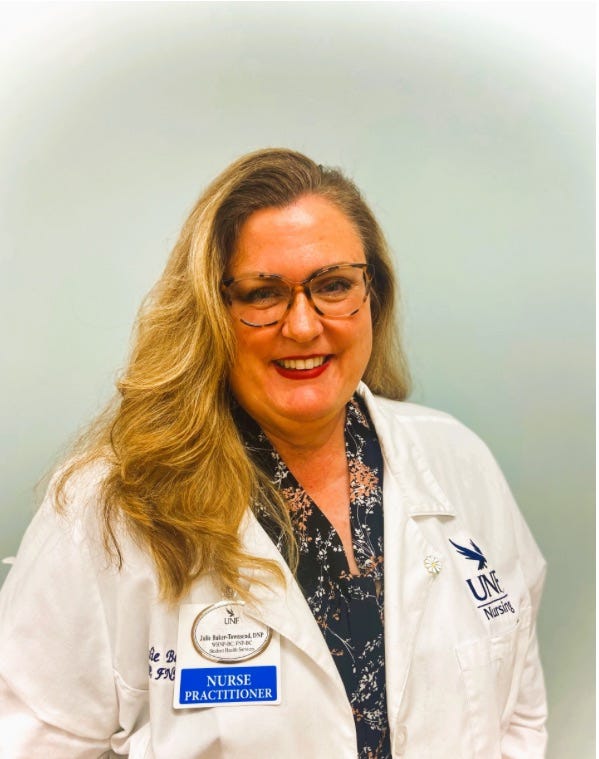
Joining me is Dr. Julie Baker-Townsend, a nationally certified women’s health nurse practitioner, Clinical Associate Professor at the University of North Florida School of Nursing, and a highly respected educator and clinician. Julie earned her BSN at the University of North Florida, her MSN at the University of Florida, and finally her DNP at the University of North Florida. She was recognized as one of the Great 100 Nurses of Northeast Florida in 2003. She has worked in high-risk obstetric units with level III NICUs, served vulnerable and underserved populations through the health department, and now divides her time between teaching women’s health at UNF and practicing as a women’s health nurse practitioner. She is highly regarded by her students and colleagues for her clinical expertise, compassion, and unwavering dedication to advancing women’s health and nursing as a whole.
Not only is the topic that we're discussing very close to my heart, but Julie is also very close to my heart. She was one of my very first nursing professors and mentors. Her passion for women’s health and her dedication to educating both patients and future clinicians have left a lasting impact on me—not just as a nurse practitioner, but as a woman who’s experienced preeclampsia firsthand.
In this conversation, we’ll explore what preeclampsia is, how to recognize early warning signs, what treatment looks like, and the often-overlooked connection between preeclampsia and long-term cardiovascular health. It's almost like you get a peek inside one of her lectures at the University of North Florida. Whether you’ve been through it yourself, care for patients at risk, or just want to better understand this condition, this episode offers both insight and practical steps you can take for prevention and early detection.
Let’s get started.
Florida Gateway College: https://www.fgc.edu/academics/programs/health-sciences/nursing.html
University of North Florida School of Nursing: https://www.unf.edu/brooks/nursing/index.htm
University of Florida College of Nursing: https://nursing.ufl.edu/
What is Preeclampsia: https://www.preeclampsia.org/what-is-preeclampsia
ACOG Preeclampsia and Pregnancy:https://www.acog.org/womens-health/infographics/preeclampsia-and-pregnancy
ACOG Preeclampsia and High Blood Pressure During Pregnancy: https://www.acog.org/womens-health/faqs/preeclampsia-and-high-blood-pressure-during-pregnancy
Long Term Effects of Preeclampsia:
Preeclampsia Foundation: “Large population studies have demonstrated that two of three preeclampsia survivors will die of heart disease. That’s news to most survivors of preeclampsia and often – sadly – to their doctors.” https://www.preeclampsia.org/the-news/Healthcare-practices/understanding-long-term-effects-of-preeclampsia-and-taking-charge
How preeclampsia accelerates aging in women: https://newsnetwork.mayoclinic.org/discussion/how-preeclampsia-accelerates-aging-in-women/
Hypertension in Pregnancy: Diagnosis, Blood Pressure Goals, and Pharmacotherapy: A Scientific Statement From the American Heart Association 10.1161/HYP.0000000000000208
Long-Term Impacts of Preeclampsia on the Cardiovascular System of Mother and Offspring: “A series of biomolecules involved in inflammation, oxidative stress, and angiogenesis may link pregnancy vascular bed disorders in preeclampsia to the pathogenesis of future CVD and thus could be valuable for the prediction and intervention of long-term CVD in women with a history of preeclampsia and their offspring.” https://doi.org/10.1161/HYPERTENSIONAHA.123.21061
Preeclampsia beyond pregnancy: long-term consequences for mother and child 10.1152/ajprenal.00071.2020
Preeclampsia: 3 Things Women Should Know: “Patients diagnosed with preeclampsia would likely benefit from earlier cardiovascular risk factor screening, including cardiometabolic testing, which involves checking cholesterol levels, markers of type 2 diabetes and other diseases, within a year after delivery, she adds.” https://www.yalemedicine.org/news/preeclampsia
Damage from preeclampsia may be seen decades later in the eyes: https://www.heart.org/en/news/2022/02/14/damage-from-preeclampsia-may-be-seen-decades-later-in-the-eyes
HELLP Syndrome:
https://youtube.com/shorts/73dGUEkaQ6o?si=RvuN2DK6HgKrocFM
Postpartum Cardiomyopathy: https://www.heart.org/en/health-topics/cardiomyopathy/what-is-cardiomyopathy-in-adults/peripartum-cardiomyopathy-ppcm
Magnesium Sulfate:
New postpartum program aims to decrease post-birth complications and readmissions in Alabama: https://www.uab.edu/news/health-medicine/new-postpartum-program-aims-to-decrease-post-birth-complications-and-readmissions-in-alabama
Pre-eclamptic women were associated with a significantly and at hitherto unknown long-term increased rate of arrhythmias. 10.1093/eurjpc/zwae176
Julie and me providing free school physicals for school aged children in rural Florida
Produced by: Nadja Wlasiuk, DNP, APRN, FNP-BC