I’ve been thinking about local news a lot lately. You have probably heard about a lot of newspapers closing across the country or being bought out by media conglomerates that slash the newsroom staff and mostly just want to show us ads instead of actual news.
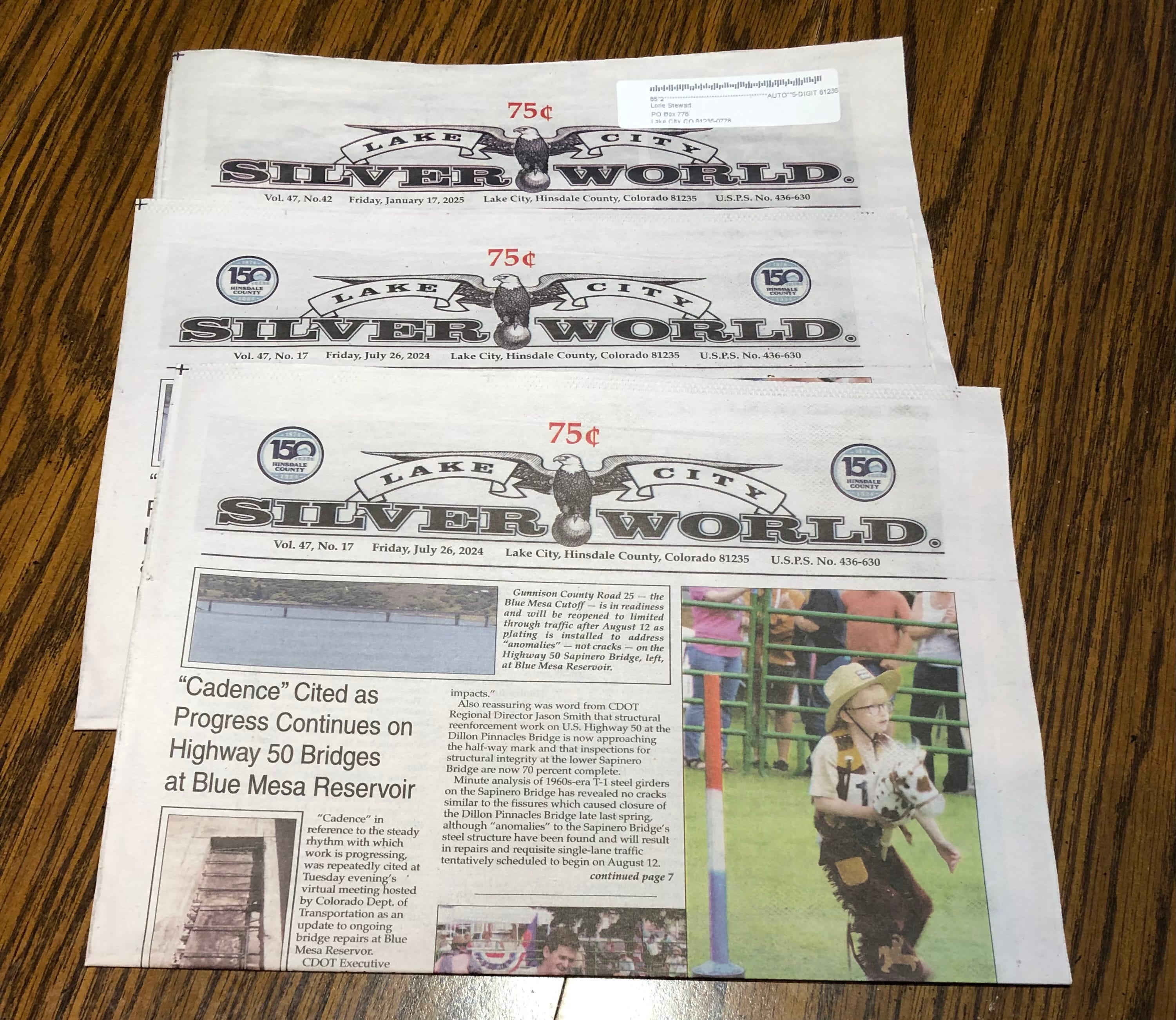
For many years now, my stepmother has been helping out with proofreading the Lake City Silver World newspaper in Colorado. Every Wednesday night, she gets a hard copy draft of the paper and checks it for spelling, grammar, and typos. The work of keeping this small-town weekly paper going has been a true labor of love by several people in Lake City, and most of all, by Grant Houston, who founded the paper in 1978 and still keeps it going to this day. Grant has done an enormous amount of work over his career documenting the history of the town as it happens and also preserving the past through his work at the Hinsdale County Historical Society. Usually, he’s the one doing the interviewing, but I really wanted to hear his own stories about his life and work documenting a small town every single day.
Recent Issues of the Lake City Silver World
Kate: Okay, I'm here with Grant Houston, who is the editor and publisher of the Silver World newspaper in Lake City, Colorado. Today, we're going to talk a little bit about his early life, how he got into the newspaper business, which I'm really curious about. So welcome to the podcast, Grant.
Grant: Thank you for the invite.
Kate: I know you were born and raised here, right, in Lake City?
Grant: Born in Gunnison and came here when I was six weeks old.
Kate: Oh really? Okay. So, your parents were from Gunnison?
Grant: No, dad was a game warden and was stationed in Gunnison.
Kate: I see, okay.
Grant: And they were so lawless in Lake City that they said we better transfer you from Gunnison to Lake City.
Kate: Lawless? Okay.
Grant: All those Texans and some Arizonans were catching too many fish and poaching animals regardless of whether it was hunting season or not. I think it's interesting because dad was in on that cusp as Lake City changed from a backwater mining community to a tourist town.
Kate: I see, that was in the 50s right?
Grant: Right, and the population was increasing.
Kate: So, then the mining. I know that that declined. Did it decline in the ‘30s?
Grant: Probably declined after 1900. By 1910, we were pretty well over with. I think I've told you, Lake City had great expectations in the 1870s. But they weren't realized. We didn't live up to those expectations. The ore here wasn't as pronounced or readily mineable as they thought. So, a lot of that in the 1870s was pure promotion, and we didn't live up to it. So, a brief period in the 1870s when …
Kate: Like a boomtown?
Grant: When we were the boomtown.
Kate: Bust immediately?Grant: But we never lived up to expectations.
Kate: Okay, I see. By then, the 50s, I've heard stories about, you know, I guess it was would have been pretty cheap for people to move here then, land and property.
Grant: Abandoned houses. You could have just picked a house along Main Street.
Kate: You could have just grabbed whatever you wanted. So, your parents moved here when you were a baby.
Grant: 1955.
Kate: 1955. Did they move into this house? I heard you grew up in this house.
Grant: No. there was a game warden’s house. It's where Wee Care is today on Henson Street.
Kate: Oh yeah, I know where that is.
Grant: But they've torn that down. None of that exists now. But there was a cabin there that was seasonally occupied by game wardens and then enlarged for my dad and his family, and that became his year-round residence starting in 19, probably, 56.
Kate: What was it like for you as a kid to be here?
Grant: The local kids had their parents were those who were poaching year-round. It was more the visitors from Texas that were catching too many fish, but the locals tended to get subsist throughout the year by poaching. So, in first grade, I came home and asked my parents, “What does fuzz mean?” Because they were calling me the fuzz's son. They correlated that with law enforcement, when in fact, Dad was a game warden. He had a lot of empathy. If a family really needed that meat, he would look the other way. But if they were just trophy for an antler or a head, he didn't have much patience for that
Kate: So he would go after them.
You can see the transformation that's going on. Lake City never had a resident game warden until my dad. So, look at the transition that's taking place at that point. Population’s increasing. Summer is increasingly popular with visitors from Texas and adjoining states. So, a game warden was a necessary component of that.
Kate: Yeah, that makes sense.
Grant: They started the school here. My mom started the first kindergarten. They hadn't had a kindergarten until then. So my mom, Betty, was the kindergarten teacher. I think there was probably seven of us in that initial kindergarten class in 1960s. I would have been five.
Kate: Did she have a background in teaching?
Grant: Yeah, she had some, a degree in it eventually. But at that point, I think she had just a lot of classes. It was a bit of a radical concept. It was held in the old schoolhouse, which they've now torn down. They made room in part of the high school room. One of Mom's first deals was to take empty cans, and we played supermarket and were not very quiet.
So, she immediately had problems with the other teachers about us rambunctious kids.
Kate: You were too loud.
Grant: But again, don't you see that as the change in Lake City that was going on, the very first kindergarten. They may have had one at the turn of the century, but certainly nothing generations prior to my mom suggesting that, and now it's an essential part of the school program. You have preschool and kindergarten. It's just taken for granted now, but it was a little bit radical at that time.
Kate: Where was the school then?
Grant: Same location that it is today, that's 6th and Gunnison Avenue, is where that's located.
Kate: I guess at some point, didn't the high school was that moved or they made the kids go to Gunnison?
Grant: Right. At that time, though, it was a first through 12th grade, and there were all of 19 students, so, a very, very small school at that rate. As the school grew, and they outgrew that space, they began sending kids to Gunnison, and they would commute. It started with high school in about 1967, and then it was increased to also include middle school, and there was a bus route at that point. A bus went from Lake City and picked up students along the way and ended up in Gunnison and then brought them back.
Kate: That would be a long day, I guess.
Grant: That would be a long day.
Kate: You did that too when you were in high school?
Grant: Yeah, minimally, not a lot. My folks then,nDad stayed as the game warden here. They were eventually divorced, my parents. Dad stayed as the game warden, and Mom and I would move to Gunnison in the winter.
Kate: So, you just lived there?
Grant: I was a Gunnison student from the seventh grade through high school. My first, kindergarten through sixth, though, was a product of the Lake City schools.
Kate: Was that like a big change to move up there?
Grant: Yeah, tremendous. I was just used to the small town.
Kate: New kids,
Grant: Right. it's so
Kate: I didn't realize it's so much colder up there than it is here.
Grant: You see what it is lately?
Kate: Yeah, it's crazy how cold it is up there.
Grant: My cat has missed me while I was in Montana.
Kate: Clearly, yeah.
Grant: You are the nicest cat.
Kate: You graduated in the 60s, I guess, or no, 70s?
Grant: 1973.
Kate: What did you do after that?
Grant: So, I edited the school newspaper in my high school year, La Remuda, and that came out once a month, and it seemed like an hellacious amount of work, Kate, to put out maybe an eight-page paper once a month. I said, “How would you ever do anything bigger than that?”
So then, after high school, I entered Western State, which was a college at that point in Gunnison. They immediately drafted me t…