Kate: All right, today I'm here with my dad at his cabin in Colorado, and we're sitting by a crackling fire, drinking coffee. For this interview, we're going to focus on my dad's life in math minus his career as a statistician at Marion Labs, because we're going to talk about that later. But all the other stuff we're going to talk about today. So, thank you for being here today, Dad.
Dad: Okay, it might be a lot of fun.
Kate: Okay. So, the first question I have is, do you think your gift for math was inherited and if so, who did you inherit it from?
Dad: Yeah, I believe it was probably inherited from my mother that when she was going to school, her best subjects were math and art, and so she was able to teach me quite a few things that helped me in school. She knew when we were trying to memorize how to add things up and multiply and divide and all that. She knew how to help me on those. So, I knew a few tricks like anything that's divisible by nine, the integers of it will add up to something that's divisible by nine, and usually that's nine itself. But a lot of times might be 18 or 27 or something. That was a trick that I knew, and other kids didn't have that. I don't know, I just liked it and so, it was easy for me to do that.
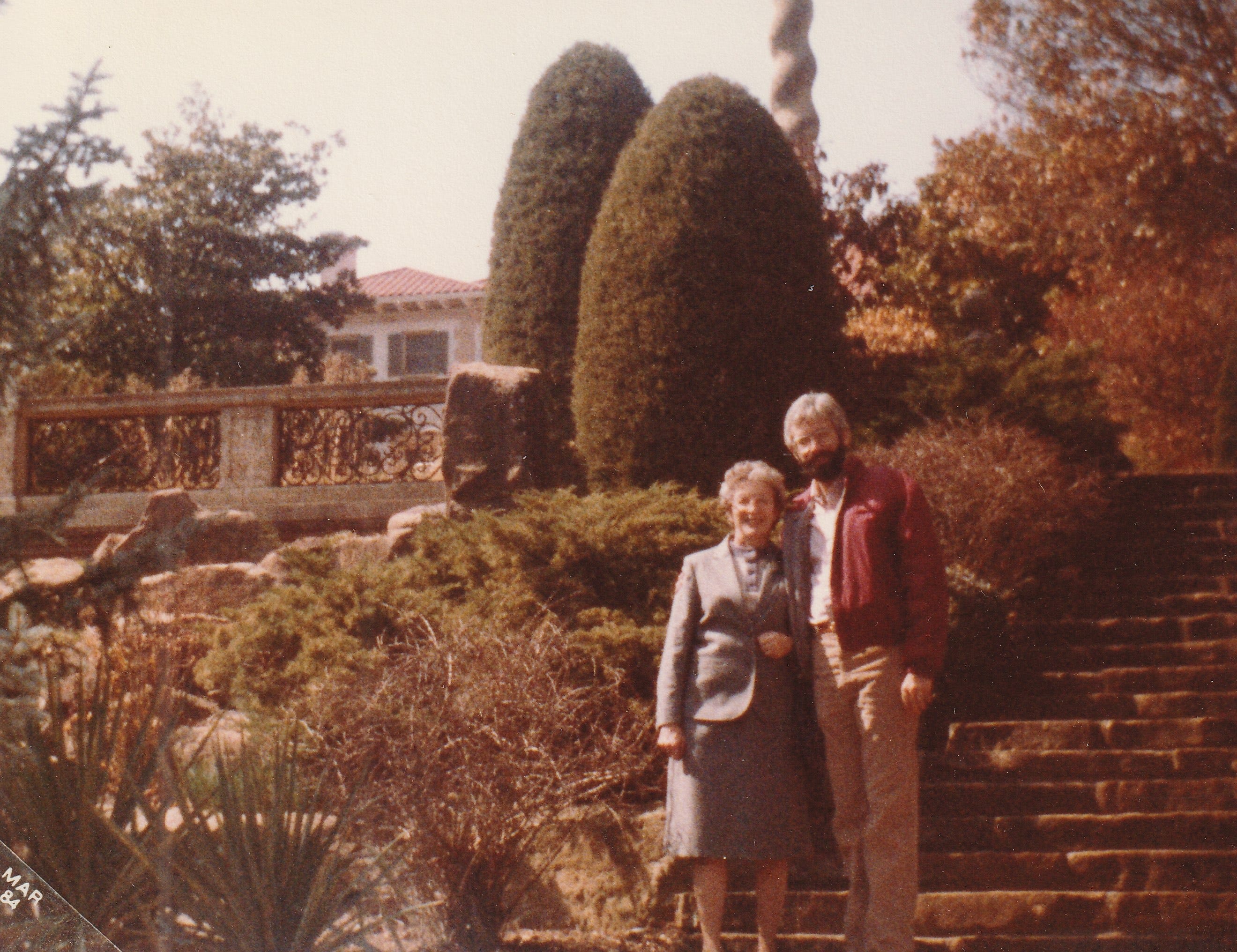
My dad and grandma at the Gilcrease Museum in Tulsa in the early 1980s. ©Mom.
Kate: And her dad was an architect, right?
Dad: Yeah, he probably taught her some stuff. Somehow, I would say that that my mom was his favorite, but he taught her his best things, which were math and art and how to draw and stuff, so mom knew all the all the tricks to teach us how to how to draw something that looked like it was three-dimensional as opposed to you know what normal kids would draw. We were all pretty good at that. Silvia became the artist in the family, whereas I became the mathematician.
Kate: It makes sense.
Dad: And I, Renee, I don't know what to say she became.
Kate: She's a gardener.
Dad: She did. She's a gardener.
Kate: She got that from your dad, I think.
Dad: She got all the cooking experience that my mom developed.
Kate: I know your whole family loves to play games like card games and chess. You learn that at an early age.
Dad: Well, I'm sure we most of us got how to do it sort of thing from my mom. I think she taught my dad how to play chess. What he knew how to do was play checkers. I learned that from him. And then I learned chess at an early age because they were playing that, and I would watch them and I just kind of learned what they were doing and developed that.
Later, when we lived in Muskogee, and I was probably 10 or 12 years old, my dad decided to have a chess club at the library. So, on Saturdays, we would meet there and play chess, and he would show everybody things about it.
He had the janitor make this big board that stood on legs. And it was a chessboard, and it had a hole in the middle of each square so that he could take these pieces that the janitor had put screws in the bottom and put them up on the board, and everyone could see. And so from that, it's kind of hard when you're trying to teach somebody how to play chess, you truly should start with just a few pieces and simple things that you can do. He would show a lot of those things where maybe you just have a pawn and two kings and how to get the pawn down to become a queen at the end, and what to do with that, or how to make a checkmate if you just have a rook and a king versus another king, and things like that. Once you know that kind of stuff, then it's good to memorize certain openings that are known to be really good for you and how that plays out. He would always have one or two things that he was going to show, and he'd do that.
Then we'd play against each other. For a long time, I was sort of the best player, but then all of a sudden, this guy, Ed King, came along and he really studied chess. All of sudden, after a long time with that, he became really the best player.
Kate: That's funny.
Dad: We had a thing where Tulsa also had a chess club of some sort like this. We had several matches where we would drive up to Tulsa with several cars. Then we'd set up, and we'd play typically a match is that each person plays one other, and then you score from that. Typically, it would be if you win, you get one point. If you lose, you don't get any. If it's a tie, you get each get a half, and then you add all that up for the team. I think we lost every time.
Kate: Okay. What about all the card games you played?
Dad: Yeah, Mom liked to play cards, so she taught me several little kids’ games, which I knew, and I could teach you guys at some point.
Kate: Yeah, we all learned those too.
Dad: But the best thing was that when I was four or five, we were living in this, I always remember that house a whole lot because I knew every corner of it and stuff, but we were living in this house where we had a card table that we could put in the living room and play bridge. But to play bridge, the main person they knew how to play was a cousin named Gerald. He would come over and there were only three of them. There's a way you can kind of play bridge with three people, but it's not very good. So, they taught me how to play bridge.
Kate: How old were you?
Dad: I was five, six, right in there. Now, I would always play with my mother, and she knew all this stuff that I would learn from her. She taught me how to play the cards well, and then how the bidding was supposed to go and all of that stuff. Another thing we would do is sometimes we'd get my grandmother to play with us. But my grandmother could just barely play, so I found myself teaching her how to do things.
Kate: Yeah, that’s funny.
Dad: But at any rate, that was the bridge thing and the chess. Those were the two best games. Later, when we were older, we started getting boxed games. I think Monopoly was my favorite, and we would play Monopoly with Joe and Bill Lunn and all three of us as kids, and it was just a nice game. Then from that in terms of games, I started realizing there were these war games you could get. I would play those with Joe, but also, I would play it against myself all the time trying to figure out the best way to do things.
Kate: Those are with the little soldiers?
Dad: Well, the war games were with just a map, and they would put this hexagonal pattern on it so you could move from one hexagon to another.
Kate: Oh, okay.
Dad: It would just be a little square of, here's a cavalry unit, and it is worth two points in strength, and it can move six of those, or you might have an infantry unit, and it can move, say, three. Then you might have an artillery unit, and it could move two, but it could hurt somebody from a distance. To find out how much you hurt somebody, you would roll the dice. If you rolled something like a six, then that was terrific, and you would get the maximum hurt on the other side to try to reduce their unit to nothing. If you rolled a one, that was no good, stuff like that.
So any rate, the first game I got was Waterloo, and it was probably the most interesting game of any to begin with because it had the French under Napoleon, and the first army he bumps into are the Prussians. You would have that fight, and then the British would start arriving, and then you'd have to fight the British and that whole setup of how that worked. I worked at that a long time trying to figure out what was the way that the French could win this thing because they were outnumbered. Ultimately, I finally decided if the British and the Prussians were smart, you just couldn't beat them. But I must have played that a zillion times.
Then, the next game after that was Stalingrad. This was the thing of World War II.
Kate: Cold War era or World War II.
Dad: And the Germans and the Russians and working that out. That one, the Germans had the best army for sure, and they would start on the attack. But then, the Russians started getting reinforcements and training, new soldiers and stuff. They would ultimately have the real powerful army, s…