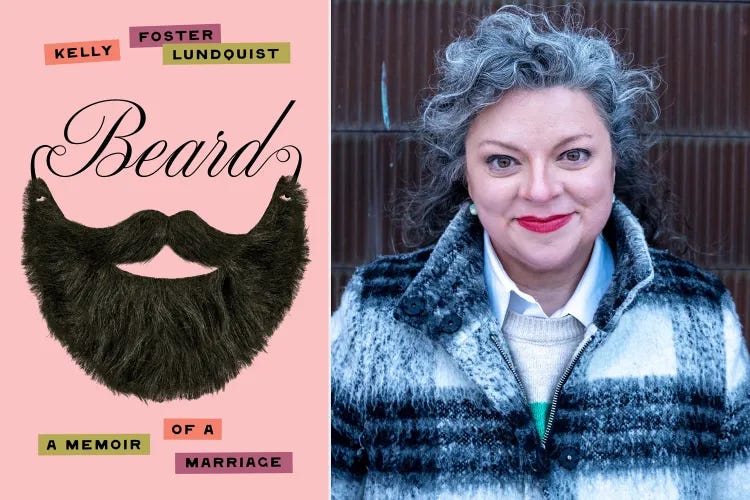
While I was researching for a story about the popularity of “lavender marriages,” I discovered Kelly Foster Lundquist’s debut memoir Beard, and I was instantly intrigued.
We don’t hear the term as much these days, but growing up, it was a common trope that referred to the opposite-sex partner of a closeted gay person. Think Brian Batt’s character Sal on Mad Men and that scene where his wife Kitty realizes she’s married to a gay man. Or, more recently, Matt Bomer’s character Hawk in Fellow Travelers, who tramples all over his wife Lucy (played by Allison Williams) because he still loves Jonathan Bailey’s character Tim. Then, of course, there’s Harper Pitt in Tony Kushner’s Angels in America. If you don’t recall the play or miniseries, Mary-Louise Parker plays Harper in the 2003 HBO adaptation, opposite Patrick Wilson as closeted Mormon Joe Pitt. Plus, there’s the old Hollywood stories about Montgomery Clift, Cary Grant and Rock Hudson. And as Kelly so smartly dissects and relates to: the three generations of women—Liza Minelli, her mother Judy Garland, and her mother Ethel Marion Milne—who all married gay men.
These are typically stories about men who hide and women who pay the price, and it’s a topic that fascinates me because I understand the collateral damage such a relationship can cause. In fact, I dated two closeted Christian men in the South in the 1990s who had their beards to help protect them at church, school, their jobs and with their families. I was also the GBF who had several close female friends who tried to date me, to “fix me” or just to have an idea of what they thought a happy relationship could be. So often this story is centered on the gay male storyline, and I was eager to see how Kelly tackled the subject since a woman’s side of the story hasn’t been shared so prominently. But I was also nervous: Was she seeking revenge? Settling scores? Or providing yet another cautionary tale for women to vilify gay men?
Luckily, none of that proved to be true. Kelly has crafted a smart and nuanced memoir that not only shares her story sensitively, it is generous to so many of the other people central in it—most of them gay men. It begins when she meets Devin at an evangelical church camp in Jackson, Mississippi, when they’re both teenagers. The two are quickly inseparable, and Devin is Kelly’s first love. They get married young (something I could also relate to and feel I was saved from) and start their lives together.
“Love has to be something like sameness,” Kelly thinks in her twenties, hoping that Devin will save her. It’s a story many can relate to who come from certain backgrounds and aspire to other lifestyles: We search for a life raft to get us out of our situation. But once you get that other shore, does that mean you must stay together or is there another version of a life that you couldn’t quite imagine at the beginning?
Later, while she’s in college, we witness Kelly’s awakening to her own agency, despite being in a codependent relationship, when a professor introduces her to a seminal feminist text, Women’s Ways of Knowing. Later, once the couple has moved to Chicago in 2003 so Kelly can attend graduate school in Chicago, they become entrenched in their new neighborhood: Boystown. Soon enough, it becomes harder for Kelly to ignore the signs that her husband is gay, cheating on her and her marriage is not sustainable.
I’ll let you discover the rest of the story, but Kelly and I had a lovely conversation about her journey to write the book. As she mentioned, a piece of advice from Mary Karr’s The Art of Memoirwas pivotal: “Show yourself wanting something dumb.” Ultimately, the message that Kelly left us with is that “you can do this wrong and still be worthy of love”—which is a bit of advice that I think most people can benefit from.
Overall, I want people to know that there is room for so many types of queer love stories, and I feel like Kelly’s and Devin’s is a special one that I’m confident others can relate to. I’ll leave you with the words from a piece Kelly published with Peopleahead of publication where she stated it eloquently:
“True love stories are always messier than tropes, and the ultimate reason I wrote my book was because it is and was a love story. Once, there were two sweet kids who came of age in the evangelical purity culture of the 1990s, a world in which being LGBTQ+ or accepting anyone who was gay was seen as a sin that could send you straight to hell. From the moment those kids met each other, they kept talking and talking and talking. They made each other laugh. They understood each other. They had the same vision for the life they wanted to lead. They loved the same movies and TV shows and songs. They loved each other. They slept together no less — maybe even more — than the average American couple. Really.
“But it was what happened after that made this a love story — the way we were able to let each other go, the way we’ve been able to support each other in the 20-plus years that have elapsed since we split up. In the last few years, it’s become easy for us to talk and talk and talk again. We met for brunch this past Sunday when I was back in Boystown, and as we laughed and talked about so many things, I was so grateful for the grace of that relationship.
“We were never a joke.”
So well said.
The Queer Love Project is a reader-supported publication. To receive new posts and support my work, consider becoming a free or paid subscriber.