I reached out to Andrew Restieri, a PhD candidate who shares his writing on Gay Man’s Terms, because he’s demystifying digital intimacy by combining research with personal narrative to discuss how modern platforms—from the curated worlds of Instagram “Close Friends” to the dating and hookup apps such as Hinge or Grindr—actively dictate how queer love, community, and consent are formed today.
He’s currently in graduate school at Cornell University, where he has been analyzing the unwritten “rules” of digital privacy, including how nudes are shared and “owned” among gay men specifically. Because he’s enrolled at an institution that’s currently in the news and provoking a massive national conversation regarding sexual violence on college campuses, we also chatted about that topic a little as well (you can listen in at the 18-minute mark).
I hope you enjoy this intellectual, deeply vulnerable and essential conversation—one that I think will dredge up questions and memories on multiple fronts. Especially for anyone who has ever felt the sting of app fatigue or the thrill of a digital spark.
As Andrew explained at the beginning, he doesn’t have easy answers to settle your debates about the “rules” of online intimacy, but these conversations are certainly ones we’ll keep having for some time.
“People hear about my work and they expect me to come back to the community and say, ‘OK, here are the rules.’ I looked into it because none of us know what the rules are, and here I am investigating the rules, but I can’t come back and say, ‘These are the rules, and we’re now bound by them.
Because we think, ‘Oh, well, this is my boundary.’ And maybe it’s the boundary I share with some friends or some people with demographic profiles, etc. And so I think this boundary is normal. But both sides of the exchange assume that they’re sharing a boundary that they’re not actually communicating with each other.”
Andrew then gave an example about “disappearing” and “expiring” photos and how some folks assume that if they receive a photo that’s not disappearing, it’s “fair game” and can be saved or “collected. Andrew points out that the assumption is invalid.
He also doesn’t vilify Grindr (or fill in the blank with another gay hookup app like Scruff or Jack’d) for having “killed gay sex,” explaining:
“I don’t take the view that Grindr came in and destroyed cruising culture and hookup culture and made it harder to forge community. I think that was a confluence of factors. There’s a larger societal shift, first of all, towards digital space. It’s not just in the hookup culture that we see people feeling isolated and feeling like interaction is transactional and that it’s harder to find community. That’s just at a baseline nowadays. Grindr didn’t do that. And there’s evidence that a lot of this being reduced to a collection of stats and photos and being measured according to dick size and stuff like that didn’t start with technology.”
Oh and…
“Spoiler alert: I’m a gay guy and I have used these platforms to exchange nude photos with people.
So I was like, ‘There are norms and there’s a culture around this and this is what they are.’ What was surprising is that I was wrong about that: It manifests differently for different people.”
Around the 28-minute mark, we pivoted and got into more personal questions and Andrew had some great insights and advice to share, including how there’s a process of self-objectification that happens when you fill out a profile of any type and how this misdirects how we value ourselves and others.
But one of the most fun details was when I adapted our QLP Questionnaire question about a first intimate moment to an Andrew-style variant and asked about an early pivotal digital moment—a text, a pixelated photo, a chat room interaction—that felt completely real and electrifying. Andrew told me about a Facebook message group around 2014 that connected him to other gay men in the Tri-state region that was very enlightening (you can find that around the 33-minute mark).
“It was called the G-Unit. It was a collection of the gay-straight alliances of all the local high schools. … You got added to it when you joined your high school’s GSA. And it got used for exactly what you’d think it got used for.
That’s how I lost my virginity. That is like how I went on all my early dating experiences; they were from people like cold-Facebook messaging each other by scrolling through the members of this group. …
Obviously it wasn’t a huge group, so everyone knew each other. Obviously it got exactly as messy as you think it did. But it was also a total lifeline because everyone remembers what it’s like to be gay in their town that they grew up in and to only have so many other gay people in your town. And so it was really cool to get to have intimate experiences that I wouldn’t have otherwise gotten to have in high school. … I was a bigger slut in high school than I ever have been in my adult life so far, because it was fun.”
We also spoke about the age-old advice about how, when you stop trying to find a person to date, that’s typically when something has more opportunity to happen.
“It's not that you're not trying,” Andrew said. “It's that you're not evaluating people as boyfriend candidates. And then when they're not boyfriend candidates, you’re not discarding them and you can expand your options…”
Thanks again for listening and supporting! You can also like and follow the podcast on other platforms, including YouTube, Spotify, and Apple Podcasts (as well as other podcast platforms).
Follow us on Instagram for more updates about events and activities.
Your support matters! And it helps our larger mission to share more stories and wisdom.
If it doesn’t burn a hole in your wallet, would you consider upgrading to a paid subscription?
We keep all our words and stories free, and we intentionally keep our annual subscription rate low so all of this amazing stuff is available to people around the globe. Help keep it going for years go come!
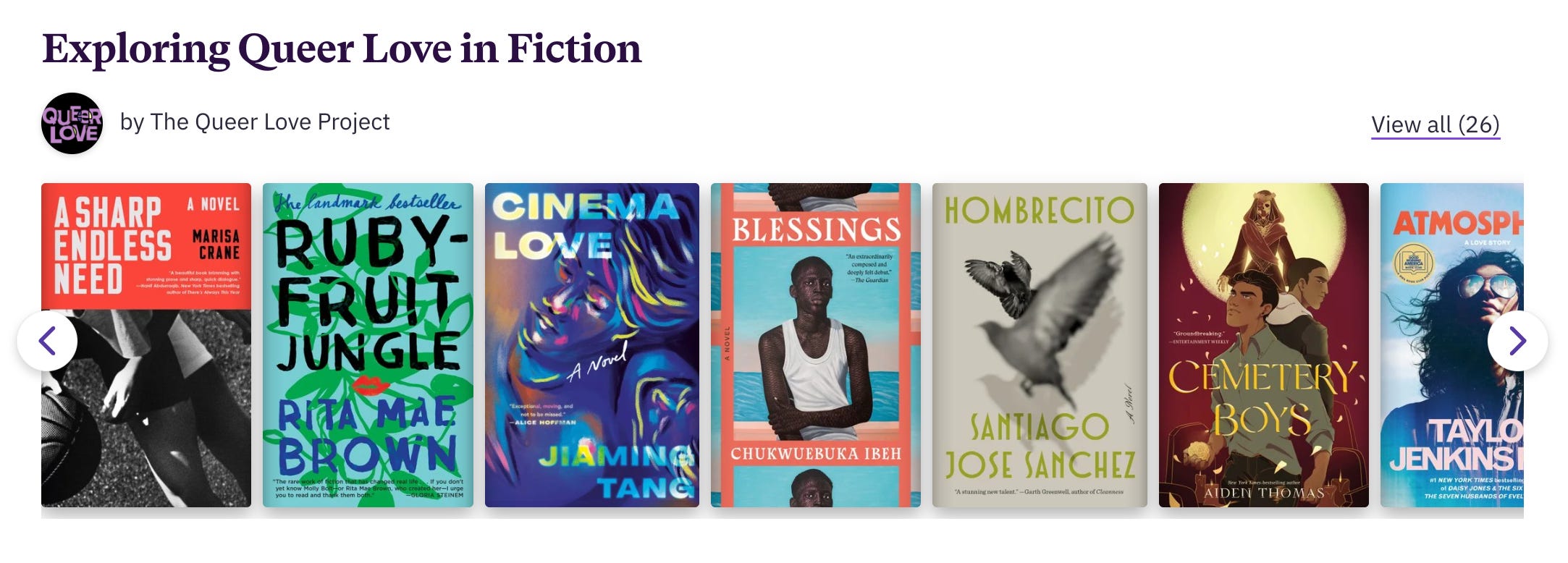
Looking for more books to read? Check out QLP’s recommendations over at Bookshop.org for curated lists of memoirs, novels, poetry, nonfiction and more!
The Queer Love Project is a reader-supported publication. To receive new posts and support my work, consider becoming a free or paid subscriber.