Before I recap this fantastic conversation, I want to make sure you know about our next live reading event taking place September 20th in the Boston area to celebrate our 2-year anniversary. It is taking place at All She Wrote Books, a queer-owned bookstore in Somerville, Massachusetts, and it will include readings by Lynette D'Amico, Michael Lowenthal, Anthony DiPietro, Jingo Mante and myself.
Click here for more details and to RSVP!
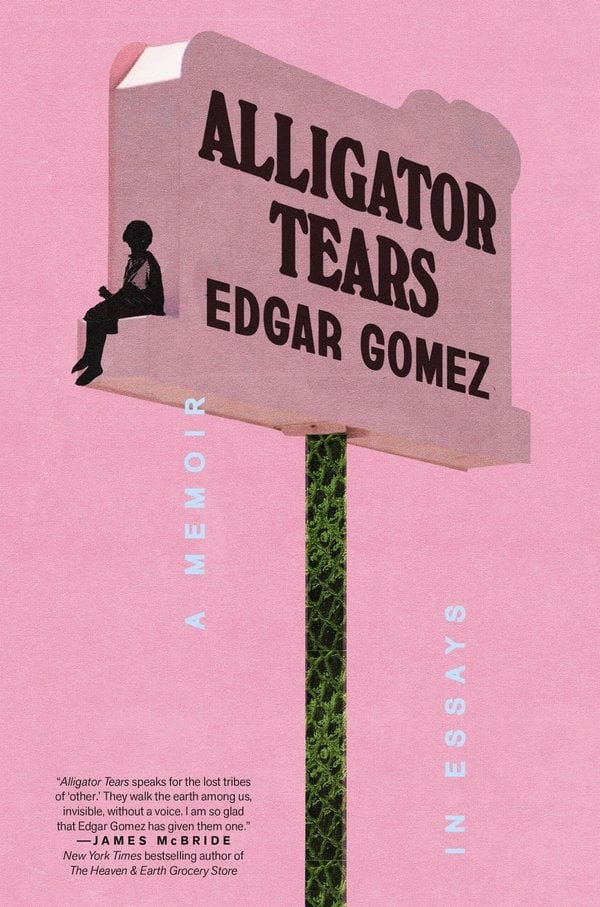
I first met Edgar Gomez soon after I launched the Queer Love Project, while I was at a book party where he read from his first memoir, High-RiskHomosexual. In fact, he was the very first person who I asked to reply to the QLPquestionnaire! So much has changed since. Not only has he released his second memoir, Alligator Tears, but Edgar got married and bought a home with his husband in Puerto Rico. Plus, as Edgar reminded us, it’s Hispanic Heritage Month (which runs Sept. 15-Oct. 15), so we had plenty to catch up about.
As Edgar explained:
“High-RiskHomosexual, like the title implies, is more about queerness and coming of age in terms of starting in a place of deep shame when I was a kid. To coming to Pride and sort of understanding that queerness actually is a great privilege for me and has helped me throughout my life. … I didn’t really get to delve as deeply into issues of class and the American Dream and just money that I really wanted to.
“And so the second book, Alligator Tears, gave me the opportunity to. And of course, there’s still a lot of, you know, gay stuff happening. But it is really more about me trying to claw myself and my family out of poverty and figure it out.
“When I read books, my two favorite things to read about within stories are how much everything costs. I’m always super excited when people drop those details. Especially in older books. It’s always like, ‘Oh, that’s how much that cost back then. And particularly because—before I even realized that I wanted to be a writer—When I just knew that there were books out there and authors, I thought they were all rich!”
We both talked more about coming from working-class backgrounds and the hustle it took to create a life as a writer and how tough it still is, then we pivoted to the reality of being queer in the world and not wanting to sugarcoat it.
“For example, when I’m talking about queerness and coming out of the closet, I have been tempted in the past to get rid of all the moments of suffering in the story and just focus on the joy,” Edgar explained. “But I don’t want to mislead a queer reader because Into thinking, oh, you come out of the closet and it’s going to be, you know, all, you know, sunshine and butterflies and unicorns.”
Remembering Pulse 10 years later
We then began talking about the Pulse nightclub shooting, which took place 10 years ago. I told Edgar about the essay I published earlier this year about how it compelled me to shoot my first gun. And Edgar reminded me about the the piece he wrote about Pink Pistols for Narratively in 2020: “My Journey Into the Secret Subculture of Gays With Guns.”
We both wondered why there hadn’t been more coverage or remembrances for the tragedy that happened at Pulse, which at the time was the worst mass shooting in U.S. history.
“I'm not the only person who has, at this point, experienced more than one mass shooting where, you know, it's reached this like absurd place,” Edgar said. “And so I do think that has taken some of the weight from Pulse, where there is just so... There's not much going on that people are frankly overwhelmed.”
Then I asked Edgar about race and ethnicity in dating, referencing his Rumpus essay, “My Boyfriend, His Lover, and Me,” which is also included in Alligator Tears, since I think it gets at the heart of the struggle with class and whiteness and many other topics that are not often addressed openly. In it, he details a situationship he was in with a Mexican American guy who was also dating a white celebrity that Edgar was also a fan of. This “love triangle” got complicated, to say the least. But that’s not what ultimately broke them up.
Edgar admitted he’s hesitant to write about romantic relationships.
“Because, honestly, whether it’s a relationship or whether it’s like some kind of trauma that I’m working through, a lot of times when I write about something, it’s like I’m trying to put a period at the end of that story and just get it out of me. … I was hesitant to write that story because I thought, Onceyouwritethis,thentherelationshipisofficiallyoverinmybrain. And once I published it, it’s weird. It’s like a flip switches. And I’m like, I’m done with this. I’ve written the end of the story. And all right, it ended in an ambiguous place. And now it is just over.”
Edgar also spoke about the diversity of Latinx storytelling available.
“Our stories are out there but, oftentimes, there are certain types of stories that are highlighted more than others. Whether it’s straight Latinx people or, under the ethnicity umbrella, it’s usually Mexican stories or Puerto Rican stories.
“And I’m half Puerto Rican, so I always felt like that part of me, I had representation. I always had J-Lo! But Nicaragua—which is the culture that I actually grew up more with because I grew up with my mom’s side of the family and going to Nicaragua every summer for months at a time—I just felt like there was really not a lot out there. And so to get a very queer Nicaraguan story out, it just feels very, very special to me. And whenever I see another queer Nicaraguan or even just another Nicaraguan writer, I just get so, so excited. I mean, I would even say a Central American writer. A writer like John Manuel Arias, who just released Crocodilopolis, which is set in Costa Rica. Yeah, it makes me very, very excited!”
To wrap things up, I asked Edgar if he had any advice for those who may be searching for love and finding it difficult to connect with others. He shared a really special realization about his mother and how he arrived at his current place of happiness.
“I always thought, I don’t want to lose myself in a relationship. I don’t know how I’m going to be able to live with somebody and share that space with somebody for 24 hours a day. And I’ve realized it is a lot easier than it sounds, at least for me.
“It might be that, you know, I fell in love with my husband in the pandemic when it was like truly me and him, you know, at the end of the world. And it was just us together in our literal bubble, in our safety bubble. Yeah. But I actually like sharing space with somebody—it’s kind of awesome. You get to be a DINK: double income, no kids. You know about that? And, you know, I have somebody that, you know, I can sort of share my life with and the ups and downs. And I have this support system with me everywhere that I go.”
Giving his mamá more credit
“And the other fear that I had was that I just wasn’t giving my family, specifically my mom, enough credit. And I always worried about getting too serious in a relationship because I thought, OK,onceyoustartgettingserious,that’swhenyouhaveto start introducingthemtoyourfamilyandmeetingtheirfamily. Maybethatleadstoaweddingandthenthatmeansinvitingalltheextendedrelativesandthisandthat. And because of that fear that I had, I think I kind of sabotaged a lot of my relationships.
“Once I started getting serious with my husband, it reached a point where he was like: “Hey, does your mom know about me?” And I had to have this big conversation with my mom. I went to Orlando, and itwaslikecomingoutoftheclosetagain.Iwassonervous.
“I got into bed with her, I was just like, “Hey, just want to let you know I’m seeing somebody.” I told her two things about him. And she didn’t say anything back. And I was like, “OK.” And I crawled out of her bed and I went into my childhood bedroom. And I kind of just sat there, you know, a little bit frozen and was like... I was almost like, OK,Iguessyouwereright.Maybeyoushouldn’thavetoldheraboutthis.
“I already had all these walls up where I never really told her about the queer parts of my life. But eventually, she got up, and she knocked on the door and she came in and she gave me a big hug and she said, “I’m so happy for you. And, you know, the rest was history.”
“I guess I forgot that I am not the main character of the world. We are all undergoing transformations. We are all growing. And the person that she was back then is not the person that she is now. And I had to really extend that opportunity to her. And I’m so glad that I did. Because, like I said: Now, they’re besties and my relationship with my mom is also a lot stronger because we can talk about anything.”
It was so lovely to hear that story from Edgar, and I hope you enjoyed it too.
Thanks again for listening to the Queer Love Podcast. If you enjoyed this conversation, any of our essays or other features, consider upgrading to a paid membership tier to keep funding work like this. We’re currently celebrating our 2-year anniversary.
You can also like and follow the podcast on other platforms, including YouTube, Spotify, and Apple Podcasts (as well as other podcast platforms). Follow us on Instagram for more updates and fun stuff.
We also have an Etsy page where you can find some of our merch!
The Queer Love Project is a reader-supported publication. To receive new posts and support my work, consider becoming a free or paid subscriber.