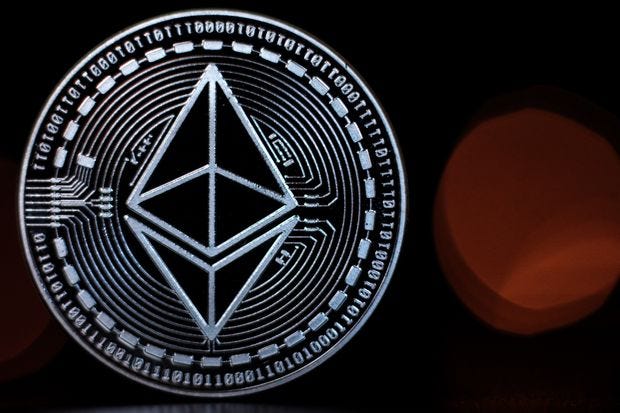
If you managed to be on any social media app in the last 48 hours, you'd see that Bitcoin’s ‘little brother' Ethereum surpassed $3000 for the first time EVER! I can promise you Ethereum will no longer be the youngest sibling who gets talked over at the next Defi family dinner! To add to the hype in the altcoin space, Dogecoin continues to do 'DOGE' things as usual, and the community continues to march the coin to the moon. Last week we spoke about the Bitcoin flash crash, which caused the biggest liquidation in the history of crypto. Ethereum managed to receive a bit of blowback from that incident but bounced back quite well to new ATH's.
First off, let me clear the air. Ethereum is NOTHING like Bitcoin. As I've mentioned in previous newsletters, Bitcoin's primary use case is a store of value (akin to Gold) and a currency. The value of Bitcoin is essentially just the value of the currency itself. Here's why Ethereum is different. By definition, think of Ethereum as a blockchain-based decentralized platform that acts as an open-source internet protocol and a decentralized app store that enables something called a smart contract to be built and run on top of it. Let me break that down.
You ever hear the term 'Code is Law'? This coined term essentially means that sometime in the future, we will live in a society that is governed by code. A smart contract is essentially a self-executing agreement where the terms and conditions are specified by code – and a transaction is triggered once the agreement is met. Smart contracts are stored and executed on the blockchain to make them immutable, decentralized and secure. Ethereum is most widely known as the blockchain that supports smart contracts, but there are many others such as Cardano, TRON, and Polkadot. I'm fascinated by the fact that smart contracts ultimately can remove the human factor from decision making – human error is proven to be one of the leading causes of decision failure.
The Ethereum network running these contracts uses its own currency called "Ether" to make these transactions happen. Not only does the Ether coin act as a medium of exchange on the platform, but it also acts as 'fuel' for the decentralized apps built on top of the platform – meaning if someone intended to change or add anything to one of the apps, they have to pay a fee based on how much 'gas' the action required. So, two things, when we go check the price of Ethereum, we're actually looking at the price of Ethereum's native coin 'Ether,' but the terms are used interchangeably in the space. And when we hear that the 'gas fees' of Ethereum are too high, we are simply referring to the network's transaction fees.
My views on Ethereum are similar to Jason Lau, COO of OKCoin, except his analogy is 10X better than mine. He sees Ethereum as "something like oil, a very important asset, used to power the network." The Ethereum network is designed to be a decentralized "unstoppable world computer" that gives us a new opportunity to do things in this space that have never been done before using smart contracts.
From the end of 2019 to now, the ETH/BTC price ratio has been around 0.02 – 0.04, BUT after the recent price surge of Ethereum, the ratio has stretched past 0.05 for the first time since July 2018 (at the time of me writing this). The ETH/BTC ratio was flirting around 0.15 in June 2017 during the last bull run to bring this into context. If this is the breakout that analysts and investors have been hoping for, we could see a healthy ETH price at the end of 2021. To add, as more decentralized applications are built and more use cases come into play on the Ethereum network, we are witnessing the 'little brother' grow up right before our eyes and go off to college to start his new journey. What I'm getting at is, as the community continues to grow, ETH is slowly starting to trade under its own umbrella and no longer akin to Bitcoin's price action.
Ethereum is the most used platform in the crypto world right now. As of today, it has a bigger market cap than PayPal and Bank of America. Its adoption is rapid, and we are watching web 3.0 unfold before our eyes. What is most attractive to me about Ethereum is that the value of Ethereum lies in the network and future utility use cases. Ethereum maximalists argue that it is becoming "a platform for future transactions to take place since you can directly code contracts into the network itself," which I believe holds a lot of validity.
Going back to the phrase "Code is Law," what do you think the world would look like without lawyers? Imagine we lived in a fully automated world where 'code' decided what is right and wrong with the development of smart contracts. The question I just asked you sounds farfetched right now, but we may be closer to it than you think.
I've only scratched the surface on one part of Ethereum. We'll go into part two in the weeks to come discussing Ethereum 2.0, the London hard fork and much more.
Until then,
Have a great week and stay curious
-Zo
If you enjoyed the newsletter today, please forward The Zo Code to someone that may find this insightful.