Clemens Kutschera is a young luthier who recently made a Violoncello da Spalla as his degree instrument. He got in touch with us last year about an apprenticeship, but unfortunately, it was a bad time for us. In Italy, there is a lot of paperwork and regulations to comply with when you accept someone into your workshop. Anyway, we kept in touch, and he was one of the first to subscribe to our “How it’s made” series, and the first to complete an instrument following that.
We had a video call to discuss the playing position because, as a cellist, he was having difficulty finding one that was comfortable and reliable. The video is long and may be a bit repetitive, but it is filled with tiny insights, so it was not really editable into something shorter. Thanks for watching!
A few questions to Clemens:
1. Where are you based, and where did you study/graduate in violin making?
Hi, my Name is Clemens Kutschera, I’m 23 years old, and I am attending the last of 4 grades at luthiery school in Hallstatt, Upper Austria. It’s practically the only possibility to do such an education in the country. After my graduation in June, I plan to do internships in violin making across Europe.
2. As a cellist, what attracted you to the Violoncello da Spalla?
I remember first learning about the Violoncello da Spalla when seeing a YouTube video of Sergey Malov playing the 6th Bach cello suite, and I was immediately in love. The da Spalla offers a very interesting alternative to the traditional cello, with an even larger register and portability more akin to a viola. To me, it’s an endlessly fascinating instrument, and I hope it’ll become more popular and widely played in the coming years.
3. A few words on your approach to its construction (your model, the process you chose)
I had a very hard time researching the dimensions, general build information, etc. The most significant help was Daniela and Alessandro’s “How it’s made” Series, a CT scan PDF with many views of a Hoffmann I got from a kind person at the Musical Instruments Museum in Brussels, and, first and foremost, the wise advice I got from my Teachers, Helge Murgg and Robert Grieshofer. I took the Hoffmann as a starting point, but everything about the instrument I built was designed and refined by me, with the Thomastik-Infeld strings in mind. I made it using the same philosophy as with the school model violin I built the year before. Utilizing an internal mold, carving the outside arching first, then the inside. Finishing the body first and setting the neck with a mortise joint. The fingerboard was carved from a solid block of ebony. I finished it with oil varnish, painted on with my fingers and karate-chopped with my palms. My bridge design was lifted from a baroque viol model I found on the internet, and my tailpiece has fine tuners on the E, A, and D strings. (G and C wouldn’t fit)
4. (If you like) what would you do differently next time? Is there something different that makes you curious to try?
I’m generally quite pleased with the way it turned out. Building another one is definitely worth pursuing, even though I want to make the 4/4 cello I have moulds for first. I feel like my next da Spalla could definitely be thinner, especially given the high, curvaceous archings.
News from da Spalla world
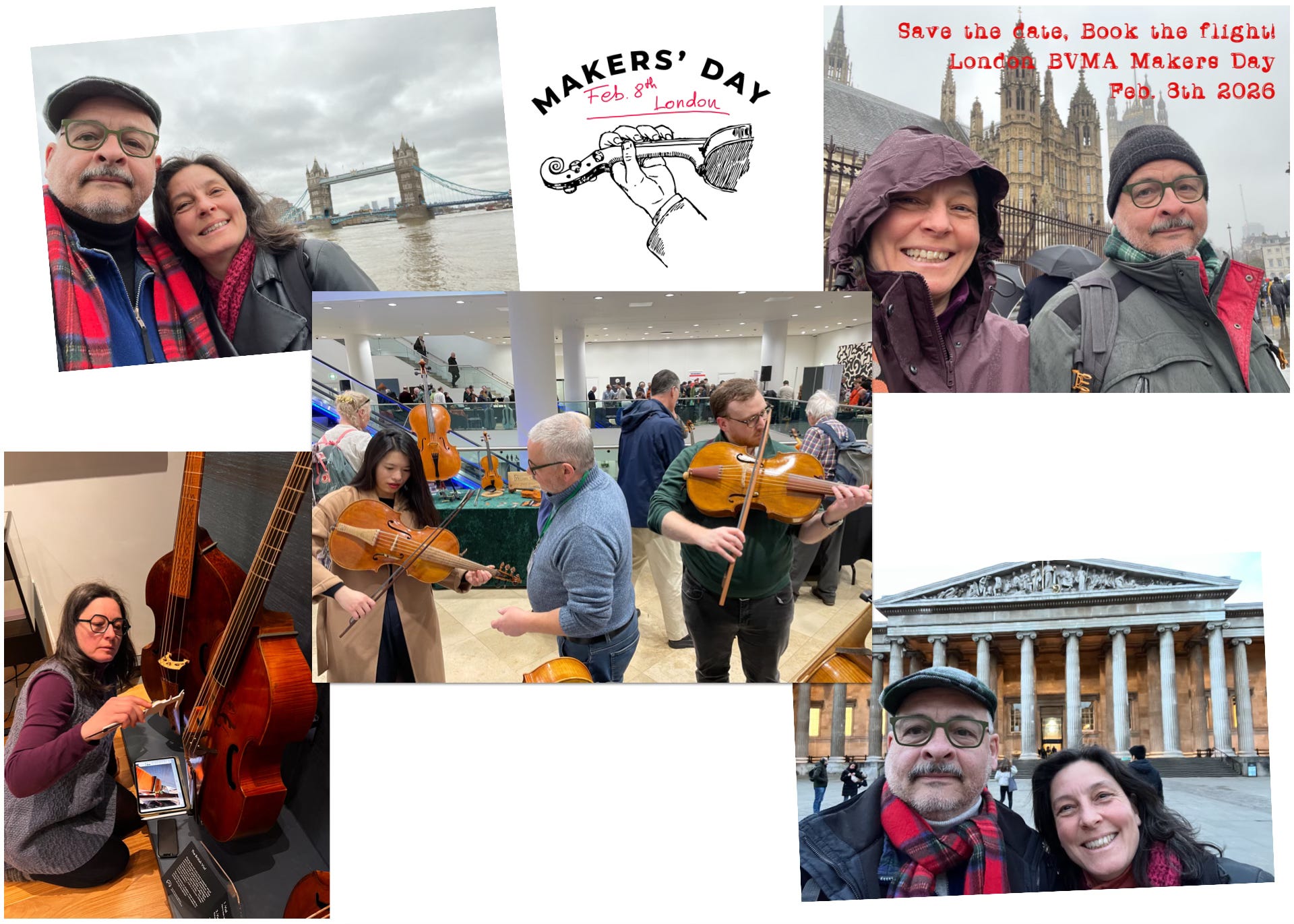
We’ll be exhibiting in London again! On February the 8th, in Kings Place London, we’ll be exhibiting at the British Violin Makers Association Makers Day. We’ll probably bring there 3 da spalla cellos by Daniela, plus a violin and a cello by Alessandro, the wonderful cello that you can hear in this video.
Updates from our workshop
Are you a luthier interested in making a Violoncello da Spalla?
In the archive of this newsletter I documented the whole process, sharing measures and templates. You can check the index and some of the posts at this link, and if you subscribe to a payed plan you have instant access to all the posts and to a private chat where you can ask me any question.