THERE IS A HAND TO TURN THE TIME. . . .
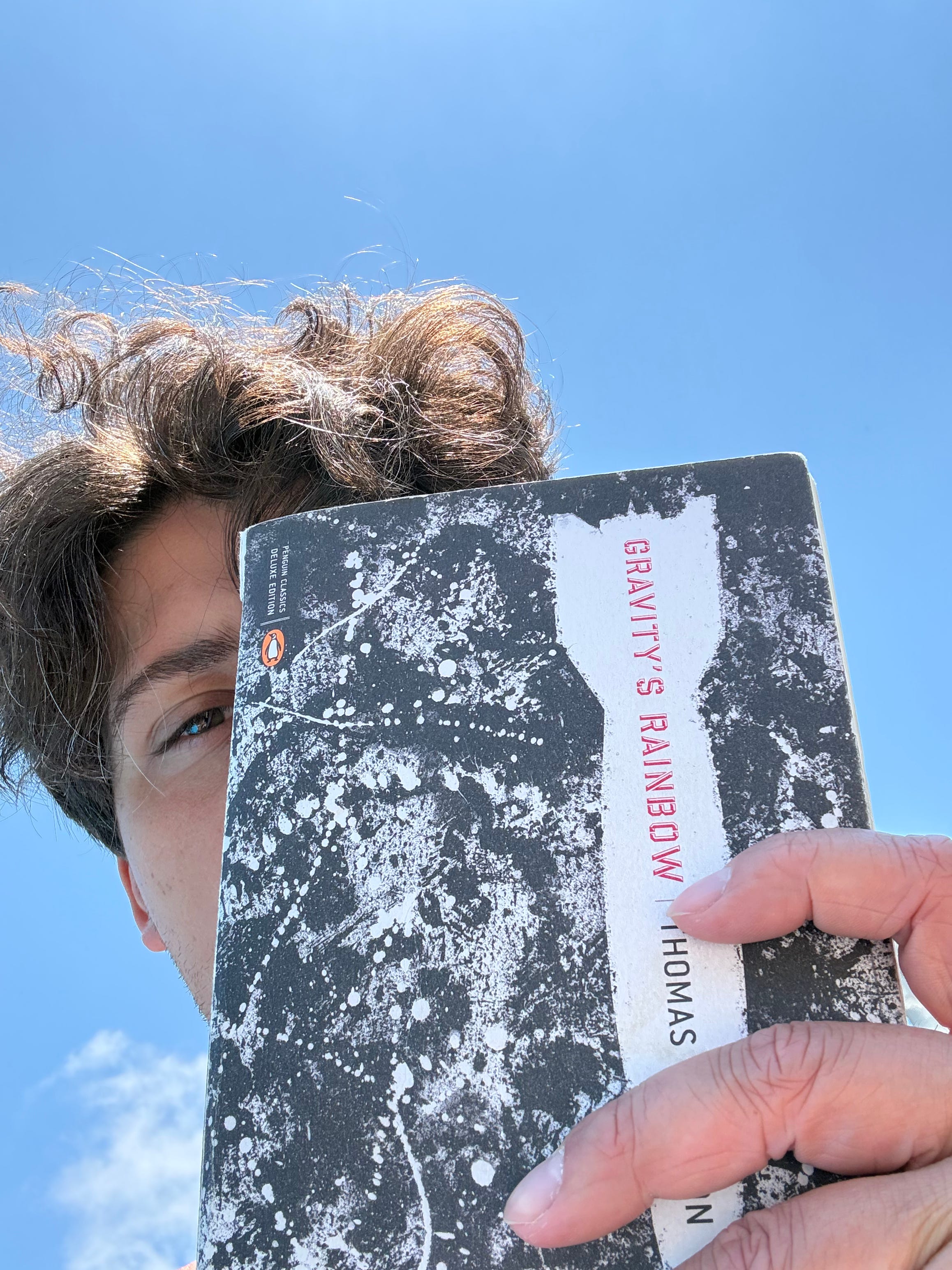
I BOUGHT GRAVITY’S RAINBOW 10 YEARS AGO.
Suffering from an Infinite Jest addiction, I was on the prowl for anything that could fill me up the way Wallace did. . . but the book was so terror-shrouded, I couldn’t crack it open. . . what did that phrase “gravity’s rainbow” even mean!?
I bought the guide book. But seeing the book required a guide book almost equally as thick tossed another crocodile in Pynchon’s moat of impenetrability. . . .
I was petrified as a chubby kid at a pool party, fidgeting with my shirt, catching sight of the prettiest girl in school before retreating, bashful & humiliated.
Back then I wasn’t so keen on penetrating the impenetrable.
My first literary friend Matt (with whom I bonded over IJ) tried to convince me to read Ulysses my freshman year of college; I started quaking, said,
“B-b-but isn’t t-t-there L-l-latin in it?”
Gravity’s Rainbow followed me around for a decade; — once I had more fiercely erected weaponry for fortress-piercing, there were other obstacles.
I’d privately ejaculate, “it’s Pynchon time!,” crack open the book, read until,
“His name is Capt. Geoffrey (“Pirate”) Prentice.”
SLAM the book closed, —SHUT UP! Pirate Prentice!Are you f*****g serious?! What a stupid name!
But on this attempt, I gave it five more pages and encountered this paragraph:
“Now there grows among all the rooms, replacing the night’s old smoke, alcohol and sweat, the fragile, musaceous odor of Breakfast: flowery, permeating, surprising, more than the color of winter sunlight, taking over not so much through any brute pungency or volume as by the high intricacy to the weaving of its molecules, sharing the conjuror’s secret by which
—though it is not often Death is told so clearly to f**k off—
the living genetic chains prove even labyrinthine enough to preserve some human face down ten or twenty generations. . . so the same assertion-through-structure allows this war morning’s banana fragrance to meander, repossess, prevail. Is there any reason not to open every window, and let the kind scent blanket all Chelsea? As a spell, against falling objects. . .”
Which earned the earliest WOW I ever wrote in the margin of a book. . . . Meander, repossess, prevail! As a spell against falling objects!
There ain’t many writers in history capable of writing a paragraph with this much sense, color, and beauty. If you can do this, I’ll follow you anywhere.
And it also introduces the main theme of the book : Telling Death to f**k off.
ALL THRU OUR CRIPPLED ZONE. . . .
WHAT’S THE BEST WAY TO BEAT OFF DEATH?
Tyrone Slothrop thinks it’s by getting a lot of pussy; he’s f*****g just about every girl in London : on a map above his desk he marks each ejaculation-location with a star,
“Christ they’re all beautiful. . . in leaf or flower around his wintering city, in teashops, in the queues babushkaed and coatwrapped, sighing, sneezing, all lisle legs on the curbstones, hitchhiking, typing. . .
How Slothrop’s garden grows. Teems with virgin’s-bower, with forget-me-nots, with rue—and all over the place, purple and yellow as hickeys, a prevalence of love-in-idleness.”
The sex-spots correspond with places rockets have been dropped on the city, leading to a very complicated, careening, rocket-business : — the main plot of the book; — I couldn’t tell you what b/c I don’t give a damn about the rockets.
My reading was balustradeless; — these books that become academic darlings have no shortage of guides, U can easily find out what’s happening on every page of GR.
The problem with guides : they make you look in the RIGHT direction; — take weedy, unruly, active IMAGINATION, shove it into a system; why hand yourself over, like a lost kid at a theme park, to a systematized rendering of CORRECTNESS?
There is freedom in trying to LOOK at the thing DIRECTLY. Wipe off the yearspiled dust of consensus. Even if U are hopelessly muddled. . .
Challenge Urself to BE WRONG.
Tyrone Slothrop is a transmogrified portrait of Thomas Pynchon himself : — a bounding, ambulant, American Don Juan,
“S**t, money, and the Word, the three American truths, powering the American mobility, claimed the Slothrops, clasped them for good to the country’s fate.”
cocking his way thru 1945 Europe; ending up scattered, diffused, no longer a contiguous self separate from the world’s machine . . .
Like Pynchon who’s gone to great lengths to abdicate a public personality . . . the coolest thing you can do in this age of overwhelming author selfhood, BRANDING. . .
Tyrone Slothrop never finds LOVE. I don’t know if he’s really looking for it.
He’s a ruined person in a ruined world. . . his ruin comes from his childhood, when the too-early intrusion of science spoiled & manacled his flowering. . .
The evil, Pavlovian, Dr. Jamf, who haunts this book, used Tyrone for an experiment when he was just a baby. . . : he wanted to see if he could condition a baby to respond with a boner to any stimulus;
and tho Jamf “extinguished” this response, it’s still within Slothrop, there beyond the zero, the effect being : — the one place where one might think themselves completely free : SEX, — has belonged to an enormous system Slothrop can’t see or comprehend, since he was a little boy.
. . . the closest Slothrop ever comes to LOVE is the summer he spends with Katje at the Casino Hermann Goering;
they spend a summer in each other’s arms, then she leaves,
“After making love she lies propped on an elbow watching him, breathing deep, dark nipples riding with the swell, as buoys ride on the white sea. . .
When he wakes she is gone, completely, most of her never-worn clothes still in the closet, blisters and a little wax on his finger and one cigarette, stubbed out before its time in an exasperated fishhook. . .
She never wasted cigarettes. She must have sat, smoking, watching him while he slept. . . until something, he’ll never be asking her what, triggered her, made it impossible to stay until cigarette’s end. He straightens it out, finishes it, no point wasting smokes is there, with a war on. . .”
But he’ll never know if it was even real. Katje might’ve just been an agent of Them. . . nothing is outside Their purview,
“Would they ever agree to let him and Katje live like that? He’s had nothing to say to anyone about her. . . He wants to preserve what he can of her from Their several entropies, from Their softsoaping and Their money: maybe he thinks that if he can do it for her he can also do it for himself. . . although that’s awful close to nobility for Slothrop and The Penis He Thought Was His Own.”
FIND THE LAST POOR PRETERITE ONE. . . .
WHAT DO WE DO ABOUT THE DAMNED?
Worse, what if you’re one of the damned?
Katje’s ancestor Frans Van der Groov shipped off to Mauritius in the middle of the 17th Century, lucre-lust & ale on his breath; he,
“lost thirteen years toting his haakbus through the ebony forests, wandering the swamps and lava flows, systematically killing off the native dodoes for reasons he could not explain. . . the stupid, awkward bird, never intended to fly or run at any speed—what were they good for?—unable now even to locate his murder, ruptured, splashing blood, raucously dying. . .”
These pointless dodoes. Frans doesn’t even realize why he’s killing them; he thinks he’s one of the Elect; what he doesn’t realize : he’s an unpaid mercenary on behalf of the forward progress of the world;
there are Commercial Systems moving his hand against the dodo, by the time he realizes he isn’t part of the saved, it’s too late,
“This furious host were losers, impersonating a race chosen by God. The colony, the venture, was dying—like the ebony trees they were stripping from the island, like the poor species they were removing totally from the earth. By 1681, Didus ineptus would be gone, by 1710 so would every last settler from Mauritius. The enterprise would’ve lasted about a human lifetime.”
Where was God in all this? Who are the Elect?
“God is not altogether such a one as themselves, tho’ they may imagine him to be so. The wrath of God burns against them, their damnation don’t slumber, the pit is prepared, the fire is made ready, the furnace is now hot, ready to receive them, the flames do now rage and glow. The glittering sword is whet, and held over them, and the pit hath opened her mouth under them.”
Around the time Katje’s ancestor was killing dodoes, Slothrop’s ancestor William wrote a treatise on the Damned, called On Preterition,
“William felt that what Jesus was for the elect, Judas Iscariot was for the Preterite. Everything in the Creation has its equal and opposite counterpart. How can Jesus be an exception? could we feel for him anything but horror in the face of the unnatural, the extracreational? Well if he is the son of man, and if what we feel is not horror but love, then we have to love Judas too. . .
Might there have been fewer crimes in the name of Jesus, and more mercy in the name of Judas?”
What if Christianity had been based, instead of on the martial triumph of Christ, on mercy for Judas’s damnation?
Might Western Culture have bloomed more forgiving, tender?
Might Jesus Christ be, like the Rocket, just the outward expression and symbol of the forces of Them?
He might’ve realized too late, like Frans; he wasn’t of the Elect, he was being used; — all there was : unredeemed Crucifixion; more grist for God’s eternal mill. . .
William Slothrop developed his thoughts about the Damned because he made his living slaughtering swine,
“William must’ve been waiting for the one pig that wouldn’t die, that would validate all the ones who’d had to, all his Gadarene swine who’d rushed into extinction like lemmings, possessed not by demons but by trust for men, which the men kept betraying. . . possessed by innocence they couldn’t lose. . .”
The pig that wouldn’t die echoes later on in the story of Byron the Bulb;
Byron is an immortal, sentient lightbulb, —he was manufactured to be weak, burn out quick so to require purchased replacement,
“these Bulb folks are in the business of providing the appearance of power, power against the night, without the reality.”
Byron is a dangerous, subversive Bulb. He does not complete his function which is TO DIE, a lesson Byron learns like all of us, brutally,
“One by one, the other bulbs burn out, and are gone. The first few of these hit Byron hard. . . But on through the burning hours, he starts to learn about the transience of others: learns that loving them while they’re here becomes easier, and also more intense—to love as if each design-hour will be the last. If Other Immortals are out there, they remain silent.
But it is a silence with much, perhaps everything, in it.
After Love, then, Byron’s next lesson is Silence.”
The World is a slaughter-ground. What are we supposed to do about it?
What does Byron do?
“Prophets traditionally don’t last long—they are either killed outright, or given an accident serious enough to make them stop and think, and most often they do pull back. But on Byron has been visited an even better fate. He is condemned to go on forever, knowing the truth and powerless to change anything. No longer will he seek to get off the wheel. His anger and frustration will grow without limit, and he will find himself, poor perverse bulb, enjoying it. . .”
We must imagine Judas, scourged in the deepest hell, smiling. . .
AND A SOUL IN EVERY STONE. . . .
CAN I ADMIT SOMETHING?
I didn’t think Gravity’s Rainbow was very funny.
The Byron the Bulb story is the peak comedy in the novel: it is gentle, germane, humane, tender. Most of the jokes in the book left me completely exhausted.
Know that I’m sighing strenuously, slogging to explain my least favorite scene in the book to you :
Slothrop is on one of his mad-cap dashes, escaping peril in a hot-air balloon with a black-market operative who’s taking a shipment of precious pies to Berlin to sell;
an enemy plane gets in their airspace and,
“Without planning to, Slothrop has picked up a pie. “F**k you.” He flings it, perfect shot, the plane peeling slowly past and blop gets Marvy right in the face. Yeah. Gloved hands paw at the mess. The Major’s pink tongue appears. Custard drips into the wind, yellow droplets fall in long arcs toward earth. The hatch closes as the recon plane slides away, slow-rolls, circles and heads back. Schnorp and Slothrop heft pies and wait.”
Fuuuuuuuuuuuck. The pie fight goes on for a couple pages.
This is as if everything I hate about the names fell into a vat of toxic waste and out emerged a Godzillan monster. And it’s so unverisimilious!
This Schnorp (ugh!) dude stands to make a lot of money on these pies, and here they are now custard in the wind: his reaction is a shrug. . .
As I’m sure you are well aware, Thomas Pynchon is ZANY.
My first reaction : ZANITY is a deification of the worst vice of American culture : puerility. Like Pynchon sez in the introduction to his juvenilia Slow Learner (1984),
“It is no secret nowadays, particularly to women, that many American males, even those of middle-aged appearance, wearing suits and holding down jobs, are in fact, incredible as it sounds, still small boys inside.”
Sometimes the narrator of Gravity’s Rainbow is an obnoxious greasyhanded brat on the train wearing an infantile zootsuit & propeller hat, running, screaming, jumping, farting, laughing, and all you wanna do is STRANGLE HIM.
I do think Pynchon busted open the most pernicious tone in American Fiction: — ZANITY has spoiled myriad writers from David Foster Wallace to George Saunders.
But I also don’t like to undoublecheckly dismiss an aspect of an obviously Great Book, so let’s look closer at the ZANY.
Here’s Sianne Ngai in her book Our Aesthetic Categories (2012),
“For all their playfulness and commitment to fun, the zany’s character give the impression of needing to labor excessively hard to provoke our laughter. . . [it is] a strenuous relationship to playing that seems to be on a deeper level about work.”
ZANY is comedy as extreme labor. . . now that is an interesting idea. . . let’s imagine that at one point, people did find Gravity’s Rainbow uproariously funny. . .
Why does it induce such TEDIUM now?
Further, why does a book acutely concerned with ENTROPY, which Pynchon himself defines as,
“that human one-way time we’re all stuck with locally here, and which terminates, it is said, in death. Certain processes, not only thermodynamic ones but also those of a medical nature, can often not be reversed. Sooner or later we all find this out, from the inside. . .”
and the deforming, gravitational force of CAPITAL, — throw so many whirligigs at our face?
Because the humor that has ostensibly aged worse than anything in the book has actually aged the best. . . it was a prescient move :
— like SEX, the one freedom we have in defiance of death is LAUGHTER,
in 1973, there was pie-flinging wriggle-room, but in 2025, we are labor-drained, enfeebled,
Their tentacles so pervasive they have warped even this, turned JOKES into a hellish toil. . . we can never escape Them. . .
Gravity’s Rainbow is the FROWN that accumulated Time forces on our faces. . .
Maybe that’s actually the most subversive part of Gravity’s Rainbow : it is a pessimistic and serious novel;
U can have your comedic Pynchon, I’ll take the brimstone prophet :
“They have lied to us. They can’t keep us from dying, so They lie to us about death. A cooperative structure of lies. What have They ever given us in return for the trust, the love we’re supposed to owe Them?
Can They keep us from ever catching cold? from lice? from being alone? from anything? Before the Rocket we went on believing, because we wanted to. But the Rocket can penetrate, from the sky, at any given point. Nowhere is safe.
We can’t believe Them any more. Not if we are still sane, and love the truth.”
PLZ COMMENT IF U RELATE TO BYRON THE BULB.
DO NOT READ THE FOOTNOTES!