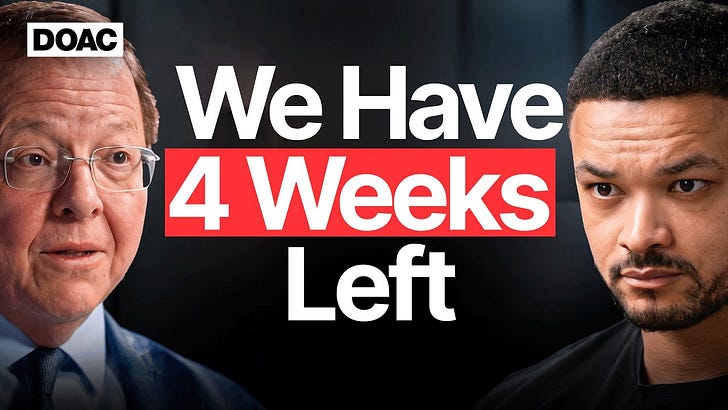
If you’re trying to understand this conflict with any depth, Robert Pape is someone you should be listening to. He’s a political scientist at the University of Chicago who has spent two decades studying the strategic logic of military coercion, and his appearance on the Diary of a CEO podcast is genuinely some of the best public analysis available on how we got here in the Iran conflict.
But here’s the thing: he’s a career academic, and I take issue with some of his analysis… And that’s ok! You can learn from people you disagree with.
Pape’s argument, compressed: the MOU fell apart because the United States violated paragraph one and paragraph five, and Iran responded by striking commercial vessels. I also read the document. I know, crazy, right?
Listen to the full podcast:
To understand why the MOU mattered, you need to understand what Iran did in the opening days of the conflict. Within the first 2 days of Operation Epic Fury, Iran moved to seize and mine the Strait of Hormuz as a deliberate strategic response to an air campaign the IRGC knew they could not match symmetrically. Before February 28th, 120 to 140 commercial vessels transited the strait every day. That traffic represented about 20 percent of global oil supply. Closing it was a form of economic coercion on a global scale, and it handed Tehran leverage that no air campaign could completely neutralize.
Here’s the honest reality of a large-scale air campaign: it can significantly degrade command and control networks, radar systems, ballistic missile launchers, and fuel production infrastructure. Those objectives are real, and they matter. What air power cannot feasibly do (and what real professionals have never claimed it could) is completely eliminate thousands of dispersed coastal defense missiles and drones, some sitting in warehouses, some hidden in caves, etc. It’s a nearly impossible targeting problem. Dismissing the air campaign for failing to accomplish something it was never designed to do is unfair. But it does mean that Iran entered the MOU negotiations still holding meaningful military and economic leverage.
By June, after roughly 110 days of active conflict and multiple rounds of negotiations, the Islamabad MOU was supposed to be the off-ramp. It lasted eleven days before the first tanker got hit.
Thanks for reading Watchtower Intel! Subscribe for free to receive new posts and support my work.
On Paragraph One
Here’s the exact language from the MOU, as disclosed by a senior U.S. official and published in full on June 17th:
“The United States of America and the Islamic Republic of Iran and their allies in the current war are signing this MOU to declare the immediate and permanent termination of military operations on all fronts, including in Lebanon, and undertake from now on not to initiate any war or any military operation against each other...”
The phrase that became the fault line: “and their allies in the current war.” Iran’s argument was that Israel, as a US ally in the conflict, was bound by the Lebanon ceasefire clause. When Israel conducted independent strikes in southern Lebanon in late June — continuing its clearing operations against Hezbollah rocket sites and tunnels south of the Litani River, as it had been doing for months — Tehran cited this as a US violation of paragraph one.
I understand Pape’s technical argument. The language is there. But I think it’s a stretch to call that a US violation… and here’s why.
Israel was not a signatory to this agreement. Neither was Hezbollah. Neither was Lebanon. The Islamabad MOU was a bilateral document between Washington and Tehran. Iran can (kinda) speak for Hezbollah because the IRGC Quds Force largely commands Hezbollah. The United States cannot compel Israel’s independent military decisions in the same way. And everyone at that negotiating table knew that. The “allies” language created an asymmetric obligation from the moment it was written: Iran signed on behalf of a proxy it controls; the US was being held responsible for the sovereign choices of a state it doesn’t control in the same way.
To call what happened in Lebanon a US violation of paragraph one is a defensible reading of a vague and poorly-drafted clause. It is not, I think, a fair characterization of what actually happened. The more honest framing is that paragraph one contained a structural defect from day one. By including Lebanon without getting Israel to the table, the drafters created a ready-made Iranian grievance that was always going to materialize. Whether it was genuinely a US violation or a pretext depends on a factual question about Israeli intent that we do not know. What I’m confident about is that it wasn’t the United States unilaterally choosing to break the agreement.
On Paragraph Five — Where the Deal Actually Died
This is the more important one, and it’s where I think the “US violated it” framing is most unfair.
Paragraph five reads:
“Upon the signing of this MOU, the Islamic Republic of Iran will make arrangements using its best efforts for the safe passage of commercial vessels with no charge, for 60 days only, from the Persian Gulf to the Sea of Oman and vice versa... The Islamic Republic of Iran will conduct dialog with the Sultanate of Oman to define the future administration and maritime services in the Strait of Hormuz in discussion with other Persian Gulf littoral states in line with the applicable international law and the sovereign rights of coastal states of the Strait of Hormuz.”
What Iran did with this paragraph in the days following the MOU’s signing was ludicrous. The IRGC announced that the only “authorized route” through the strait was the northern corridor through Iranian territorial waters. They proposed tolls of more than a million dollars per vessel. And they warned that ships not complying with IRGC instructions would be subject to attack.
Their justification: the phrase “60 days only, with no charge” means the free passage obligation expires after 60 days, after which Iran controls everything. The “sovereign rights of coastal states” language means Iran has the right to define routing, access, and pricing.
This is simply not what paragraph five said.
More fundamentally: the Strait of Hormuz is an international strait under maritime law. Commercial vessels have the right of transit passage through international straits. No bilateral agreement between two countries should unilaterally create a new legal regime for a waterway that affects 20 percent of global oil supply and dozens of non-party states.
When the US and CENTCOM accompanied commercial vessels to enforce basic transit rights, Iran treated it as a violation of the agreement. But the US wasn’t violating paragraph five; it was enforcing international maritime law. Two parties signed the same document and read two completely different agreements. Within eleven days, the first tanker got hit. Then the ceasefire collapsed. Then, on July 7th, the US airstrikes resumed.
Why Getting This Right Matters Today
We are on Day 148. Last night was the first night without announced US strikes since July 11. The Houthis recently fired missiles at Yanbu and Jazan, Saudi Aramco infrastructure on the Red Sea, which has become the primary bypass route for Saudi oil that can no longer transit Hormuz. Saudi Arabia’s East-West pipeline is maxed out at 7 million barrels per day. The UAE’s Habshan-Fujairah pipeline is running at capacity. Those two pipelines are the reason global oil markets haven’t collapsed.
I think Pape makes a compelling argument about the escalation trap. But his framing that the United States broke this deal papers over an adversary that moved almost immediately to use the ambiguity in paragraph five to assert a claim over the Strait of Hormuz that no reasonable reading of the MOU actually supports.
The Watchtower Intel podcast episode accompanying this analysis, including my segment with Scott Ryfun’s show on July 24th, is available wherever you listen. The Diary of a CEO interview wit…