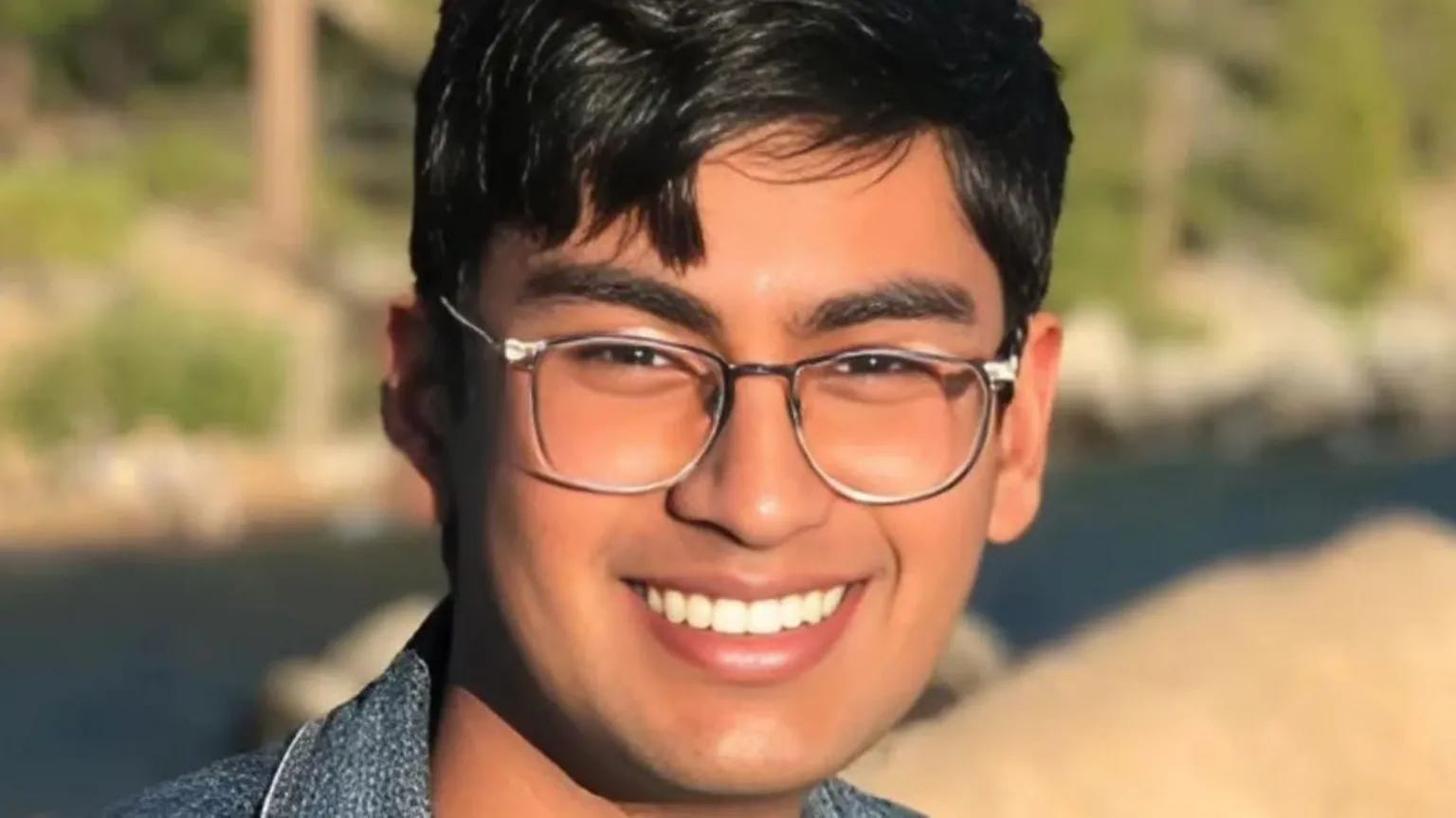
Dear Permission to be Powerful Reader,
Gunshot to the head.
That’s how they found him.
November 26, 2024. San Francisco. Bathroom floor. Blood pooled beneath him. Glock on the tile. Door locked from the inside.
The initial report called it suicide.
Neat. Clean. Quick.
But nothing about Suchir Balaji’s death was clean.
He was 26. Brilliant. Soft-spoken. And he was about to testify in the most high-stakes tech lawsuit of our generation.
Eight days before he died, his name surfaced in court filings by The New York Times. Not as background noise —
As the witness.
The one with “unique and relevant documents.”
The one who could dismantle the legal foundation OpenAI stood on.
The one who could testify that the world’s most powerful AI system was built on theft.
And then —
He was dead.
The official autopsy claimed one shot to the head.
But the family didn’t buy it.
They demanded a second opinion.
That report revealed something the first one didn’t:
Two gunshot wounds.
One in the forehead.
Another — through…
The initial report called it suicide. Neat. Clean. Quick.
But nothing about Suchir Balaji’s death was clean.
He was 26. Brilliant. Soft-spoken. And he was about to testify in the most high-stakes tech lawsuit of our generation.
Eight days before he died, his name was entered into court filings by The New York Times. Not as background noise — as the witness. The one with “unique and relevant documents.” The one who could dismantle the legal foundation OpenAI stood on. The one who could testify that the world's most powerful AI system was built on theft.
And then he was dead.
The official autopsy claimed one shot to the head.
But his family demanded a second examination. And that report revealed something the first one didn’t: two gunshot wounds. One in the forehead. And another — through the mouth. A bullet lodged at the base of the skull.
Two shots.
Two entry points.
One explanation: suicide.
Who shoots themselves twice?
The night he died, something else went dark: the security cameras in his building.
The elevator feed.
The garage camera.
The hallway footage.
All offline.
A “technical glitch,” they said.
The exact night. The exact hours. The only night in weeks when nothing recorded.
The building was secure. No forced entry. His apartment was deadbolted from the inside. But the surveillance gap alone should’ve set off alarms. In any homicide case, camera failure is a red flag. In this one? It was barely a footnote.
And then there was what was inside him. Toxicology showed a toxic brew in his blood: 0.178% blood alcohol. Amphetamines. And GHB — a powerful sedative, better known as a date rape drug. Knockout-level dosage. Combined with alcohol, it can render someone catatonic.
GHB doesn’t scream “suicidal prep.” It screams incapacitation.
Authorities said he “may have taken it himself.”
But he was days away from testifying. He had just returned from a weekend with friends. He’d celebrated his birthday. He was planning his next chapter. There were no messages. No goodbyes. No note. Just a brilliant young man on the edge of something huge — silenced before he could speak.
He had told the AP: “You can’t train an AI to imitate millions of people and then pretend you’re not competing with them.”
He had data. Logs. Documents. He knew what went into the models. What was scraped. What wasn’t licensed. And what OpenAI knew — and did anyway.
His mother said some of his files went missing. Hard drives. Notes. Devices. Not logged by police. Not returned. Not submitted to court. His own lawyer declined to confirm whether that evidence still existed. That silence, too, is its own noise.
He was a risk to a trillion-dollar system. Not because he speculated. Because he knew.
OpenAI is no longer just a research lab. It’s Microsoft’s golden child. It’s baked into the backbone of global infrastructure. If a court rules its foundation illegal, it’s not just a legal problem. It’s a collapse.
Balaji was the fulcrum.
After his death, everything happened fast. Too fast. Police closed the investigation. The coroner called it suicide. OpenAI issued a sanitized statement. The medical examiner’s report was rushed through. No grand jury. No inquiry. No FBI.
Elon Musk tweeted: “Doesn’t look like a suicide.”
Tucker Carlson gave his mother airtime.
Congressman Ro Khanna called for an independent investigation.
But nothing happened.
Suchir Balaji wasn’t trying to be a martyr. He wasn’t loud. He wasn’t dramatic. He just believed something dangerous:
That technology should be accountable. That if AI is built on human work, it should serve human good. That if the system is rigged, someone needs to say it.
He said it.
Now he’s gone.
And we’re left staring at the silence.
At some point, red flags stop being warnings. They become a line.
And once it’s crossed, the question isn’t just who pulled the trigger.
It’s who benefits when the truth dies with the messenger.
But there was another question Suchir had been asking before he died. A question that cuts deeper than any bullet.
Who owns the internet?
Not in the corporate sense. Not domain names or infrastructure. Who owns the stories? The ideas? The voices that fill it?
Because that’s what he realized OpenAI had done. Not just trained a model on public data. Not just pulled from open web pages. But swallowed the entire scaffolding of culture — journalism, literature, conversations, forums, Q&As, poems, patents, advice columns, scientific papers, blog posts, social commentary, product reviews, private diaries disguised as Medium articles.
All of it.
Scraped. Stripped. Recombined. Sold back through a synthetic voice that sounded more human than human. He called it “a mechanical ghost of our best selves.”
And it didn’t just parrot the internet. It began replacing it.
Balaji knew what few did. That once generative AI reaches critical mass, it doesn’t just feed on creators — it outcompetes them. Writers stop getting traffic. Journalists lose subscribers. Coders lose contracts. Analysts lose clients.
The economy of insight collapses
And what’s left?
No source.
No accountability.
A Copy based on a Copy based on a Copy.
Pure make-believe.
He feared this wasn’t just a legal issue — it was epistemic collapse. A slow degradation of truth itself.
He wasn’t an alarmist. He was a technician. A data guy. He had read the training logs. He knew what domains had been scraped. He knew which ones were marked for deletion. He knew which records had been altered.
He said to a friend two weeks before he died: “If this gets out, it’s not just a lawsuit. It’s a reckoning.”
But that reckoning never came.
Instead, he was dead. And the world moved on.
That is — unless we don’t let it.
Unless we remember that every detail in this story matters. Every camera glitch. Every sedative trace. Every missing file. Every voice that says: this doesn’t add up.
Because one day soon, there may be no original voices left. Just layers of simulation. Just outputs trained on echoes.
Balaji didn’t want that future.
He died trying to warn us.
Now we decide what we do with that warning.
And while officials closed the file, the public didn’t.
His death tore open a rift. In Reddit threads. On Substack. In private Discord servers. In press rooms. In the hush of closed-door meetings with lawyers and journalists too nervous to be named. For some, it confirmed long-held fears: that AI was not just built on human labor, but that speaking against it came at a cost. For others, it became a Rorschach test — a mirror of what they feared most about our future.
His mother wouldn’t let it fade. Poornima Ramarao appeared in interviews, posted timelines, shared footage, asked questions no one wanted to answer. She described a son who was vibrant. Celebratory.
“My son did not kill himself,” she said on live television. “He was silenced.”
People listened. Elon Musk amplified her post. Tucker Carlson ran a full segment. Democratic and Republican lawmakers called for a federal inquiry — not just into the death, but into OpenAI itself.
Still, nothing.
Because to reopen the case means to adm…