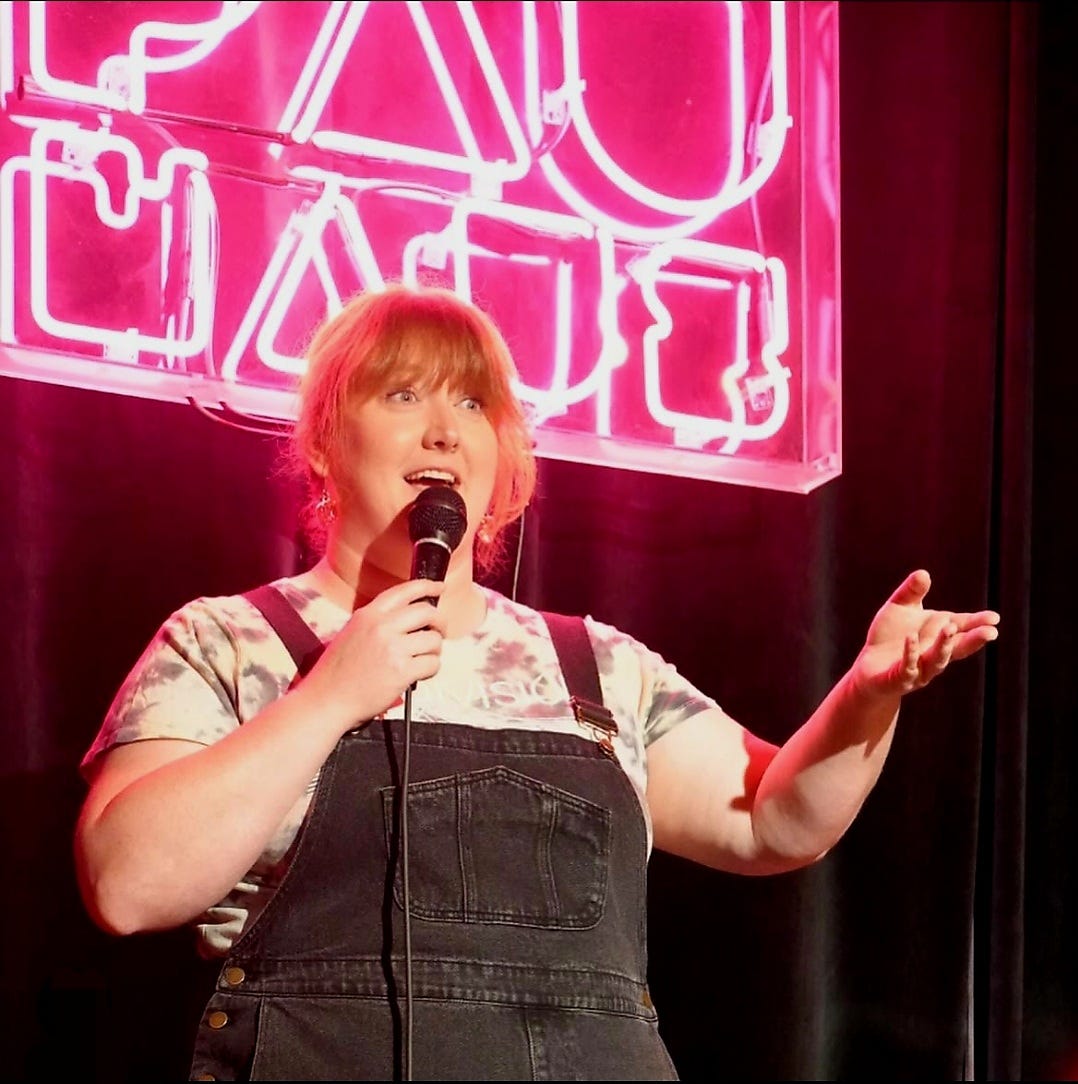
Everyone please welcome Amy Geist to A Broadway Body: Continued Conversations! Amy Geist and I met on the set of a music video almost ten years ago. We’ve since produced multiple projects together and have both created short films with themes of body image. Amy is a powerhouse filmmaker and a wonderful human being, and she opens up so beautifully in our conversation about incredibly important topics.
In our conversation, we discuss…
* Amy’s short film, “Dysmorphia” and how it’s impacted her body image journey along with others
* A peek into Amy’s body image origin story
* Generational body image cycles
* The mental gymnastics it takes to audition for GLP-1 commercials
* Disconnecting from a deep-shame response when someone sees our body in a certain way
* The nuance of your physical body being tied to your livelihood
* Changing bodies isn’t supposed to be scary
* Compassionately changing the narrative when others put their own bodies down - “it doesn’t have to be that way”
* Stepping away from a triggering industry to heal
It was a pleasure to sit down and chat with Amy. She’s hilarious and also has such an important perspective. I know I was changed from our conversation, so I cannot wait for you to hear it!
“I guess I also don’t have any ill will towards our mothers who sort of unintentionally were doing the best that they could as well in just a fucked up system, you know? Don’t hate the player, hate the patriarchy, you know? Those messages are so just ingrained and can so easily be absorbed by things that – you know, talking about diet culture and sort of orthorexia part of diet culture that pops up and is disguised as health, and so, it’s like, you know, just so many different ways for this messaging to get ingrained in little ones and by, you know, no fault of a parent. But it is, I feel in my experience and in my family, I think the way that it got to me was very much, you know, passed down through different generations and growing up in the nineties and Slim Fast.”
- Amy Geist
Megan Gill: Amy, thank you for having this conversation with me today. I am excited to chat.
Amy Geist: Oh, Megan, thank you for asking me.
Megan Gill: Absolutely.
Amy Geist: I’m excited to chat with you too.
Megan Gill: Do you wanna just start by introducing yourself and a little bit about the work that you do in the world?
Amy Geist: Oh, sure. My name is Amy Geist and the work I do in the world is a producer and a writer/director of film and commercial. And then I’m also a burgeoning standup comedian as well over the past couple of years. and yeah, I work with a lot of indie filmmakers, new filmmakers, female filmmakers. Those are kind of my favorite people to work with. Yeah.
Megan Gill: You’ve also created quite a few of your own projects as well.
Amy Geist: Oh, thank you for reminding me. Yes, Megan. I wrote and directed a short film called Dysmorphia, which is a horror film, and around the themes that we’re gonna talk about, of body image and relationship with body and self and beauty standards and how sometimes those are inherited from our moms and from their moms. And I’ve also, as a producer, I guess, a writer and director, have produced a couple of, I guess, series weekends. One was called Fuse, where we had different female writer/directors and shot their films over five day, and they got to use those projects to be their calling card for projects and for to grow into a filmmaker, and a couple of them, one of them got into Sundance, one of them got into Tribeca, and that was kind of one of my favorite experiences as a producer in film. And then I did the weekend Collision Film Initiative, which we did together, where we got to film. Again, female filmmakers coming together to make four short films in a weekend. And those films are making their way through the film festival circuit as well, and giving people a chance to just try out their voice, get to know their voice more as an artist. And now we have these awesome, I guess, calling cards as well for ourselves. I think those are the things I did.
Megan Gill: Yeah, thanks for sharing about them.
Amy Geist: Yeah. Thanks for reminding me.
Megan Gill: Absolutely! Well, it’s cool because you and I met in Chicago, I was thinking about it, almost 10 years ago.
Amy Geist: Oh, wow.
Megan Gill: Which is crazy
Amy Geist: On a music video.
Megan Gill: On a music video, which was actually one of my favorite projects even still to date.
Amy Geist: It was a lot of fun.
Megan Gill: Yeah, it was so unique and just a different acting experience for me at the time –
Amy Geist: Yeah.
Megan Gill: – that really impacted how I viewed film work.
Amy Geist: Yeah.
Megan Gill: And I feel it was an impetus for wanting to do more film work, but then you and I had reconnected because you moved to LA and then I moved to LA, and we reconnected here I wanna say about the time that you were in readings, doing table reads for your short film that you made about body image.
Amy Geist: Yes, yes, yes. Absolutely.
Megan Gill: Right. I feel that’s where we kind of reconnected. And then our story, you and I, you shot your film and then I shortly shot my film A Broadway Body, which you helped me produce, and introduced me to what it is to create your own short film.
Amy Geist: Yes, yes.
Megan Gill: And both of these pieces were centering around body image themes, which I think is really cool. Now, looking back in hindsight. And it’s interesting that these worlds kind of brought us back together here in Los Angeles.
Amy Geist: I know, right?
Megan Gill: Yeah.
Amy Geist: That’s something that I am – I have a joke about that in one of my sets of like, yeah, I waited till LA to go into recovery for an eating disorder. You know, because I a challenge. I don’t wanna make it too easy. So why not go to the one place that makes it hardest to accept yourself.
Megan Gill: Throw yourself to the fire.
Amy Geist: Yeah, just give it a shot. Yeah. duh. Of course we worked together on A Broadway Body. I gotta get better talking about my –
Megan Gill: Oh my god, no, you’re perfectly fine. You do so many things I was even perusing your website just obviously so impressed by all the different things you’re doing and all the different projects you’re working on and how your hands are in all these different creative pots. But yeah, I just thought it was interesting this timeline of – sorry, not to jump in, but this timeline of when we’d met around 10 years ago, I know, at least for me, I was kind of in the throes of my unhealthy relationship to my body and my self-image, and then moving to LA, kind of where you were starting to go with it, and creating this work that’s centered around trying to heal those parts of myself and trying to heal my relationship to my body, and then also being involved in a project where you had written the story around body dysmorphia and those types of themes with how toxic the beauty industry can be. And then now a couple years removed from that, just sitting back, I just think that there’s something really powerful about that.
Amy Geist: Well yeah, I think something that’s cool about the juxtaposition of our projects is just that there’s so much to say around this subject because our films could not be more different, you know? So it’s like, which I think just as a credit to A, our, our different voices as, as artists and filmmakers, and B, how many different angles and points of view you can have on the same subject because it affects just so many people so many women.
Megan Gill: Yeah, absolutely 100%. And I think it’s interesting that you chose the theme of horror because Dysmorphia is a horror film. It’s incredible, by the way. I was revisiting parts of it before our conversation. And yeah, some of it is hard, like, going back to it, I was resistant to it. I didn’t wanna watch it. I’m like, ugh, I know this is difficult to watch. So I’m curious how – because I know it was really important to you to talk about these themes in the horror setting, so I’m curious to hear you speak a little bit more on that and how that maybe helps you navigate the topics or helped you find your voice within how you wanted to say what you wanted to say. Yeah. Anything that comes up for you.
Amy Geist: Yeah. I mean, I think, I am myself a horror fan. I always have loved horror and I’ve always, in college I used to write plays and you got to put them on in college for free. And it did not set us up for the realistic experience of making those outside of college. But you got to do it for free. And so you were able to do all this weird stuff, and I had a reputation of like, “Oh, Amy’s weird to put up another weird thing,” because it was just, I think always more interesting to me, to explore from a visceral and what I felt was an honest, more of a place where people could interpret and take away what they wanted from what was going on.
And I think what I liked about horror as a genre for this project in particular was because one of the reasons that I wanted to do it was, you know, going through an eating disorder for 20 years and from when I was 15 to 34 and just the different – the actual experience, the visceral experience of being in it when it was most active and the process of recovery, and never really seeing something in media that reflected that experience of my personal experience of what that was like, of only really ever seeing the Lifetime movies that are very like, “Oh, she stopped eating, but then we took her to the hospital. Now she’s okay,” and just very simplified and sanitized of these struggles and always making it the focus about the pathology of the disorder rather than kind of like, how do we get here?
And so, yeah, that seemed a really good opportunity for Dysmorphia, to really talk about the first person, to encapsulate, I guess, the first-person experience of going through something like that. I want to very much say Dysmorphia is not autobiographical in any way. It is entirely fictional, but it is inspired, yeah, by just the first person experience of going through something like that. So, and I think to really kind of drive home Isabella’s struggle, to visualize her psychological struggles, horrific shadowy figures seemed like the best way to go.
Megan Gill: Did writing and going through the process of creating this piece of art that in some ways reflected your own struggles, at least what I’m garnering from what you’re saying. Was that healing for you in any way?
Amy Geist: Yeah, I mean, I think, you know, luckily when I – I guess luckily or not, but when I really kinda started on this process, I was already a couple years into recovery of what I felt was an actual recovery. And so, I think I created a little bit of a buffer of distance with the experience, which I think made it easier for me to make a project about it because I think if I’d still been a little too close to it, it would not have been a healthy experience. So I had a bit of a distance from it, but I do think what was healing was actually talking to, you know, the crew that worked on it, people that saw it, people that read it, and hearing how it made a part of them feel seen and acknowledged, and people coming up and feeling safe to share their story with me and their experience, because they haven’t really felt they’ve seen something that really touched on what they went through in a real way. And so, I think that in itself was – I didn’t expect to happen, but was like, I do think healing and rewarding and a really beautiful experience every time somebody trusted me with that information.
Megan Gill: Yeah, it’s really hitting me in the emos, Amy, because this is your baby. This is your creative baby that you are now tied to in such a beautiful way because, just the fact that it did open up pathways for these conversations to be had and for people to feel seen in this creative piece that you created is so important. And one of the ways that I think we’re continuing to get this conversation rolling and to kind of uncover some of these things that we all experience that we don’t usually talk about because a lot of it is really dark. And a lot of people do struggle – I mean, no matter what level of depth you’re struggling on, it can be difficult to talk about.
Amy Geist: Yeah, and I think that was another thing that horror helped with was it giving it enough of a distance where it didn’t feel quite as raw or touch quite a nerve because you can have that separation of like, “Well, that’s make believe,” you know?
Megan Gill: Yeah.
Amy Geist: You know, “There aren’t really monsters!” So I think allowing people to maybe process it in a different way, yeah.
Megan Gill: Totally. Yeah. I love that. I was perusing some comments because Dysmorphia is on YouTube, an Alter for viewing pleasure (for free!), we will obviously link it to the Substack. But one of the comments that jumped out at me if I can share it –
Amy Geist: Sure.
Megan Gill: – kind of aligned with what we’re speaking about. And I just think that it’s something that I’ve been thinking a lot about lately and just a really beautiful thing that somebody – beautiful, I don’t know, really important thing that somebody said. Okay, so this person said:
“One thing someone once told me helps me fight off the urge to have plastic surgery. My mother passed away some years ago and people always used to say how much we looked alike. Now that she’s gone, the features that I always hate(d) about myself, like my nose and face shape, are the things I want to keep as they are because it reminds me of her and she created me. If I would change them then I would no longer see her when I look in the mirror, discard what she created and not love her face. Thank you mom, miss you so much.”
And this also just brings me to the piece of where you were speaking in the beginning about how a lot of this can be passed down generationally, or when our mothers don’t heal their trauma and their unhealthy relationships to their self-image and their body, it can get passed down to us. I just think that this – I’m just so glad that you made this piece of art because that was a really powerful comment to read.
Amy Geist: That’s beautiful. I definitely got a little emotional listening to that. That’s like – I haven’t read that. I kind of intentionally stopped reading the comments –
Megan Gill: Oh, god, sorry.
Amy Geist: – for my own – no, no, no, no. No, that’s a very good one. That’s a good one. That’s a good one. You know, as any – because if you believe all the good ones, you have to believe the bad ones or whatever. Isn’t that something somebody said? But this is a really good one because I think that’s so beautifully said. And I will say I know a large part of Dysmorphia deals with plastic surgery, and I do wanna say that I believe in bodily autonomy, absolutely. I do not want to demonize anybody that chooses to get plastic surgery. I think it should be a personal choice between you, your doctors, whatever you want to do. And I know this movie can be interpreted as a statement against plastic surgery, so I do wanna say I do not demonize or pass judgment on people who do it. I think it’s you gotta do what you gotta do to feel safe in your body. And I think it was just an element that I use in the film because of just the inherent violence that it comes with surgery. The violence of surgery – I’m personally terrified of getting surgery. I’ve never gotten a major surgery
Megan Gill: Same.
Amy Geist: Right? Yeah, where’s the wood to knock on. Let’s knock on something. And so I think just the inherent violence of voluntarily going under the knife and having your body ripped apart and put back together is just sort of just using that as a way to show the violence that we inflict on ourselves. And so it was more of a tool narratively than of people who do that.
And yeah, I guess, you know, when it comes to the mom, it is just like, oh man, aren’t we little sponges? Just little baby us, we’re just little baby sponges. I guess I also don’t have any ill will towards our mothers who sort of unintentionally were doing the best that they could as well in just a fucked up system, you know? Don’t hate the player, hate the patriarchy, you know?
Megan Gill: It’s so true.
Amy Geist: Those messages are so just ingrained and can so easily be absorbed by things that – you know, talking about diet culture and sort of orthorexia part of diet culture that pops up and is disguised as health, and so, it’s like, you know, just so many different ways for this messaging to get ingrained in little ones and by, you know, no fault of a parent. But it is, I feel in my experience and in my family, I think the way that it got to me was very much a, you know, passed down through different generations and growing up in the nineties and Slim Fast and –
Megan Gill: Oh god, yeah. Yep. Yes.
Amy Geist: Wasn’t that the worst.
Megan Gill: I’m sitting here thinking same! And in the non – what am I trying to say? Like, my mom didn’t push these things onto me in a negative light.
Amy Geist: Right. Mm-hmm.
Megan Gill: There was enthusiasm about it, you know, and it was just disguised with this, this is good for you.
Amy Geist: Yeah.
Megan Gill: It is really sad to think about how unknowingly so many mothers have probably done that to their children. But also, at the same time, I do think it was a very particular era that we grew up in where, side note, I’m gonna have a conversation with my mom over Thanksgiving, and I’m very curious to dive into kind of how this stuff showed up with her mom and if anything was present as she was growing up, because we’ve never really talked about that. And I am just so curious because a lot of what I’ve been thinking about lately in having these conversations is like, okay, obviously I know my experience growing up in the nineties and the early two thousands and a lot of my peers in this same millennial stage of life had a very similar experience. And it’s cool because I do think with the resources now, some of it is shifting. Yes, as toxic as social media can be, the fact that people are even talking about this –
Amy Geist: Yes.
Megan Gill: – online and on a wider scale, or making art about it, it’s becoming more of a topic of conversation I think is really impactful and it’s what’s gonna help drive change. Where our moms, when we were 5, 6, 7, 8, 9, 10 years old, there were probably no conversations about how fucked up the Slim Fast regimen was, you know?
Amy Geist: Girl. No. No. There were no conversations about any of anything, really! It was just what was in the new issue of People or Cosmo or on MTV. It was just such a limited funnel of pop culture of messages of, like, “Are you as thin as Naomi Watts?”
—
[Timecode: 26:22]
Amy Geist: It’s a struggle, it is. It’s a gross feeling. The GLP-1 ads, it’s so wild, right? It’s just wild because our industry is wild in that way of, you know, you see the character description of what you’re auditioning for and it’s like, “Interesting faces. We don’t need model faces. We need interesting ones.” And it’s like, “Okay, okay, cool. It’s good to have an interesting face, I guess.” And the way that casting will just talk about your body – and I think it’s been like, I’ve had to check in with myself of like, because in the past, especially when I was closer to my disorder of feeling immense amounts of shame when someone would talk about my body in a certain way. So now being a place where I’ve disconnected myself from a shame reaction when I hear that because it’s like, I mean, that’s just the truth of my body is I have a larger body. So I think the silliest insult that anyone could ever do is like, “Well, you’re fat!” I’m just like, “Okay, well, great job.”
Megan Gill: “You’ve accomplished nothing.”
Amy Geist: Yeah. It’s like, “Are we just saying things that we see?”
Megan Gill: Yeah. Yeah, yeah.
Amy Geist: “You’re an asshole.” So it’s just like, I think, disconnecting myself from a deep, shameful response when I hear those words. And I think just checking in with myself when I get these auditions. And I think the ultimate irony of these auditions is like, if everyone was taking this, how are you gonna sell it, man? You need my body. You need my body to be this size in order to sell a way to make it smaller. So it’s just wild. You, in one hand, want my body to not exist because you’re selling this product to make it disappear. And yet, if I did not exist, you would be obsolete. So it’s just wild, honestly, every time. There’s definitely been a couple that I’ve said no to. And there have been some that I’ve auditioned for because it’s the reality of, I guess just checking in with myself every time. And, well, let’s be very clear. I’ve never gotten to the point where I was offered a GLP-1 commercial. And so, I do think if I ever got to that point, it would probably be a different conversation internally. So I guess in my mind I’m like, okay, well this is just an audition and I’m just auditioning for this casting director. And then I guess if it comes down to me being the person at the end that’s dancing the salsa or so happy because they’re – you know what I mean, then I would be different. But yeah, it’s wild.
Megan Gill: Yeah. Thanks for sharing your experience with that too. I think it’s helpful just to talk about.
—
[Timecode: 34:32]
Amy Geist: It’s so stressful. And especially what you’re saying in an industry where we’re both pretty reliant on our bodies and the way that they look, and I can’t imagine. That’s gotta be so tough to balance on your end as well of having such an intimate – having to look in the mirror, having to look in the mirror barely clothed, having to stand in front – and there are just so many triggers in there. And so, it seems what you’re going through needs constant sort of vigilance to stay because those voices are always there. They’re stil there.
Megan Gill: Oh yeah. Yep.
Amy Geist: No matter how recovered you are, they’re just waiting. They’re like, “Eh? Is this my chance to come back?”
Megan Gill: Yeah, even not when I’m working, right? Even just on a random Tuesday –
Amy Geist: Yep.
Megan Gill: – they’re still extremely present. So yeah, that is an interesting point about the hyper-vigilance. And even just self taping and having to see yourself in different phases of your cycle on camera. We have to also remember that our bodies change. So as women, our bodies change so much in a four-week cycle. And the way we – at least me, the way I feel in my body changes so much and can trigger certain things too. So I think we just have to continue to remind ourselves and each other that it’s okay to change and that it’s actually really fucking magical, and what a cool thing to get to age. Granted, I’m sitting here at 33 years old. Ask me in ten years, I really hope… I really hope that I can say the same thing. And I think that this project has helped me stay in that mindset and helped me keep my eye on the prize kind of in a way. Like, no, aging is cool and aging is a privilege.
Amy Geist: A privilege. Absolutely.
Megan Gill: And also why would I wanna give all my money to these things that – to this industry that’s trying to make me change so much? No, I actually my smile lines. I want to keep them, you know? But that’s just me. And I think that we maybe, hot take, need a little bit more of people with you and i’s perspective here to kind of combat the noise. Not that any one way is correct because there is no one correct way. It’s gonna be different for everyone, but I’m like, maybe that’s my thought around how we kind of conquer all of these messages we’re hearing about how we do have to change, right?
Amy Geist: Yeah, absolutely. I mean, I think it all starts with of what we both did of doing the homework to heal your own relationship with your body and to be in a place where – and I think doing that will put you in a place where you can hold space for other people, because I think it’s so hard to do that when you can’t – you know, put the mask on the kid before to save yourself. You know, you can’t save everybody at the same time. You gotta work on yourself, put your own mask on. Wait, what?
Megan Gill: Yeah! Yeah, you put your own mask on first.
Amy Geist: You put your own mask on before you save the kid. Put your own mask on before you save the kid. You know?
Megan Gill: Right.
Amy Geist: Because you can’t save everybody at the same time.
Megan Gill: Totally. So true.
Amy Geist: But yeah, so I think that’s a really important place to start. And I think I try to sort of just offer a different perspective, really, because I know from my own experience and I know just from cognitive bias and the way that our brains work, coming in and being like, “Actually, you’re wrong for the following reasons,” is like, not gonna – nobody wants to listen to that.
Megan Gill: Right.
Amy Geist: So just when I hear people using language or talking about their bodies in a certain way or being really hateful towards themselves, I usually just try to offer a, “Well, the size of your body does not have any moral standing on who you are as a person,” and just offering a, “That actually doesn’t have to be that,” and, and sometimes it’s taken and sometimes it’s not. And that’s kind of the most that I try to do just because it’s like are you gonna change somebody’s wiring of their brain in three seconds? No, but it could be a thought that is a seed that is planted, that they’re like, “Oh, what if this was something that I – what if I thought about myself in a different way? Or just maybe something that pops up, you know?
Megan Gill: That’s really beautifully put and a very similar experience to what I have in those scenarios as well. And I do have to believe that you never know what the planting of the seed could do, but that we do have to approach it from a place of compassion and from a place of, “I care about you and I’m not pushing my shit on you.” I feel I always talk about this, but my friends at this point obviously know that I’m the body image girl, so don’t talk shit about yourself, because I will chime in, you know? My close friends at least. And it’s like I kind of like it because it allows me to like – I don’t know. It’s like once you see it, you can’t unsee it, right?
So I’m sure you probably feel similarly where when someone is talking poorly about their body or something is said in terms of, I don’t know, how our body shouldn’t be changing or aging isn’t cool or whatever, it’s like I can’t not hear that. I’m gonna hear it every single time, which I do appreciate and I think it has opened my eyes up. Just having that general awareness has been a really interesting thing. But then to be able to exercise the ability to come in and, if I’m going to offer something, do it from a place of neutralized compassion.
Amy Geist: Yeah, I mean that’s so important, right? And I think that that’s one of the ways that I can gauge in myself if I’m trying to talk about something that I’m not totally healed from. if I feel myself being very triggered and very defensive about something that someone is saying and then notice that me wanting to combat them is coming from a place of it’s about me, it’s my own stuff, then kind of points to, “Oh, maybe I need to do more work on this before I start trying to give advice to other people.”
Megan Gill: Yeah. Okay. I have a final question I wanna ask you, but before I do, is there anything else that you want to bring up or touch on that we haven’t yet?
Amy Geist: I guess the one thing I’ll say is we talk about a lot about the recovery process, and I do think us both being actors and I don’t know if there’s anyone else – I mean, I know there are so many other people that are actors that are probably struggling with this or have a very intimate relationship with this. And I think one of the most important things that I ever did for myself in healing from this eating disorder and also for my career was to take a break from acting.
I took a five year break because it was impossible for me to heal in an industry that is so triggering kind of what we’ve already said. So I stepped away for five years to just take care of myself and my relationship and figure out what it was like to be in my body with nobody looking, you know? And then that’s when we kind of reconnected, in LA, and I started going to acting class again and started, you know?
Megan Gill: Doing comedy!
Amy Geist: And started doing comedy, and I think back to it from that place of being – because there’s so much of the romanticized starving or tortured artist bullshit that you get as an actor as well. And I think that being on the other side of that and coming back to acting, I think I definitely A) could definitely never have done standup. I could never have done standup had I not done that. And then also have such a different relationship with acting and be able to hold it a little more softly and not have it define my self-worth. And it’s like, able to not be as triggered by it. And I think I never, again, would have tried comedy. I definitely would not be able to write about all the things that I can write about. I use a lot of my experience with my body and aging in my standup because I think there’s a lot of humor there of just – and I think that it’s something that’s so universal and then like, that’s what I want to use a platform for is to talk about something that’s like, isn’t this crazy that we’re all dealing with this? Does anyone else have a mustache? You know, and I think that’s what’s really fun about comedy now for me is being able to use all of that shit that I was scared of before and find the humor in it.
Megan Gill: Oh my god. Yeah, that’s really powerful. And then just also brings me back to the modality with which you are sharing these certain pieces of yourself. You used the genre of horror to talk about this heavy topic of body dysmorphia, and then you’re using comedy to now talk about the very real things that it is to age and exist in a body and live in Los Angeles and be an actor and a comedian and all of these things that are just so real and relatable. And I think that the way that you are using your voice and sharing your story and your stories is really impactful.
Amy Geist: Well, thanks, man.
Megan Gill: Of course! Thank you!
Megan Gill: Okay, love that. And thank you. I had made notes about some of those things, so I’m really glad we circled back to that because –
Amy Geist: Yeah, there’s so much.
Megan Gill: Yes, yes. Literally. I’m wondering what your favorite thing or things about your body are, and they could be physical, non-physical, a combo of both. Totally up to you. What is your favorite thing or things about your body, Amy?
Amy Geist: Oh my gosh, this little giggle, this little giggle! What are my favorite thing or things about my body? I feel I should have thought about this. I think my favorite thing about my body is it holds me and allows me to access the world out of health and privilege. I don’t have a lot of restrictions in my body, so I think my favorite thing is I have a lot of respect and appreciation for what it allows me to do in the world. And I think if we’re talking from just an aesthetic perspective, I think my eyes are pretty cool.
Megan Gill: Yeah, they’re lovely.
Amy Geist: I think so. Thank you. I haven’t thought of – that’s such a good question because I feel that’s something I should ask myself more often. I think I’ve defaulted to being very neutral about my body and just being like, “Yep, there it is. That’s what it looks like.” So, to like, yeah, take a moment to say what you like I about it is a good idea.
Megan Gill: Yeah, and it can shift every day. It can shift morning and night. It’s so cool that it is another thing that can change and evolve, and how beautiful is that? And I think that the more that I’ve been exploring this question with others and with myself, the more I have been able to look at parts of myself that I’ve struggled with before and been able to see them through a different lens, which is very interesting in terms of speaking about seeing yourself very neutrally, through a neutral lens. It’s been a really interesting experience. That does not happen all the time, but when it does, it’s like, “What is going on? This is crazy!” Literally.
But thank you for your feedback on the question and thank you for sharing and thank you so much for having this conversation with me, Amy. I really, really enjoyed it, and I’m grateful to you.
Amy Geist: Oh my gosh. I’m grateful for you asking me. Thank you for having me. It was such a blast to dive deep and always a blast to see you and talk to you. So thank you.
Megan Gill: Same. Of course!
“When I really kinda started on this process, I was already a couple years into recovery of what I felt was an actual recovery. And so, I think I created a little bit of a buffer of distance with the experience, which I think made it easier for me to make a project about it because I think if I’d still been a little too close to it, it would not have been a healthy experience. So I had a bit of a distance from it, but I do think what was healing was actually talking to, you know, the crew that worked on it, people that saw it, people that read it, and hearing how it made a part of them feel seen and acknowledged, and people coming up and feeling safe to share their story with me and their experience, because they haven’t really felt they’ve seen something that really touched on what they went through in a real way. And so, I think that in itself was – I didn’t expect to happen, but was like, I do think healing and rewarding and a really beautiful experience every time somebody trusted me with that information.”
- Amy Geist
Hailing from Ohio, Amy Geist is a Producer, Director, Writer, and Founder of Beloved Root Films. She started in Los Angeles as a commercial Producer and Production Manager.Her feature film work includes Blade Runner 2049 (Alcon Entertainment *Academy Award Winning), Little (Universal), Trees of Peace (Netflix), Bar Fight (IFC Films), #FBF (Mar Vista Entertainment), and Trap House (Signature Entertainment).She produced Fuse, a series of five short films, for Powderkeg Media: launched by Paul Feig and Laura Fischer. The films went on to premiere at Sundance and Tribeca.Her film Dysmorphia premiered at Hollywood ShortsFest where it won the Grand Jury Award. Dysmorphia went on to screen at other well-known festivals such Hollyshorts and during it’s festival run won Best Cinematography and Best Horror Film. You can watch it on Alter for free. During the 2023 strike she started performing stand-up. Since then she has toured in Colorado, headlined at the Moab Women’s Festival, and won won Best in Fest at the Burbank Comedy Festival. You can see her on stage at the Hollywood Improv Lab, The Crow, Flappers, or The Kookaburra Lounge. She most recently produced a stand-up comedy fundraiser: BeCause We Can Comedy and all proceeds went to help a family in Gaza.
IG: @thatamygeist
Subscribe to the A Broadway Body: Continued Conversations newsletter + sign up for a paid plan to support me in creating more of this content for you ❤️🔥
A couple of notes to ensure this is a safe space for my guests to share their intimate and vulnerable body image stories in:
* It can be easy to feel alone on your journey of existing in a body. I welcome the connection and support of one another in this space through considerate and curious comments.
* These conversations are quite nuanced, complex, and oftentimes very vulnerable. Remember that everyone has their own body image story, and while someone else’s might look differently than yours, I encourage you to keep an open mind and stay empathetic.
* Thank you for being here. By sharing this type of content, my hope is to inspire personal reflection and cultural questioning. Thank you and supporting me in exploring the effects of our culture’s beauty norms and body standards on human beings existing in today’s world.
Do you have a friend, family member or peer who might love this too? I’d be honored if you could help me spread the word about my writing and body image conversations!
While I’m not a licensed therapist, registered dietician, or medical health professional and cannot speak to body image topics from a clinical, trauma-informed place, I am an expert of lived experience. I’m an academic of my own body, and I’m passionate about facilitating conversations with other humans about their relationships with their bodies. I believe it’s important to continue conversations about healthy body image in creative spaces as a means to heal individuals as well as the collective whole. But just know the information presented in this medium is not professional mental health advice or medical advice, and any questions or concerns you have should always be directed to your health providers.