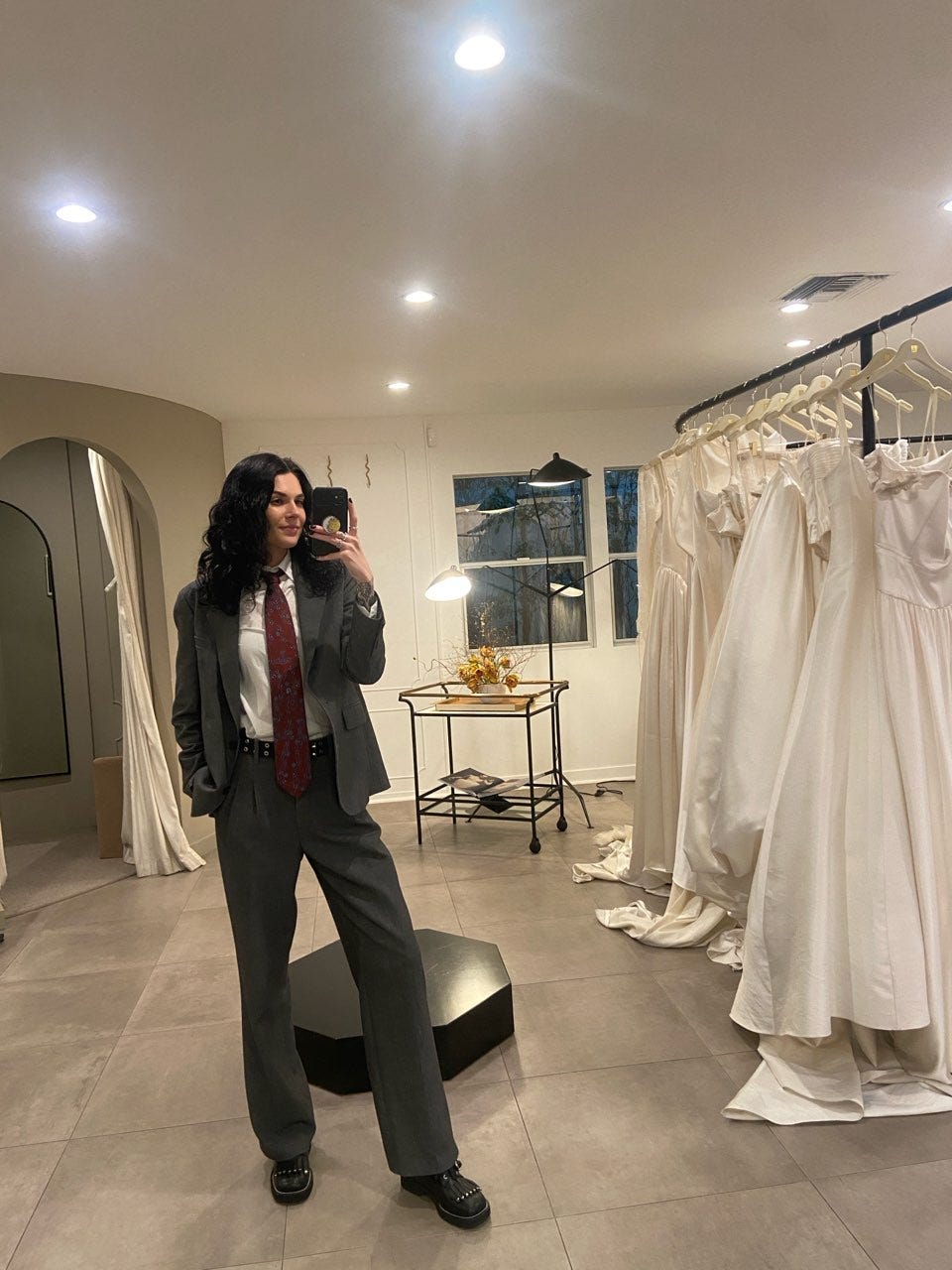
Everyone please welcome my sweet friend Destiny Allen to A Broadway Body: Continued Conversations! Destiny and I have known each other for a few years now (spoiler alert: she’s dating two of my besties), and being an expert in the field of bridal fashion, I was so excited she agreed to have a conversation with me.
Destiny is making waves in the way she shows up as a bridal consultant. She works at LOHO, which literally stands for League Of Her Own, and she also has big plans of opening her own shop one day that caters to all types of people who are getting married. (Bridal suits? Yes, please!). I know that what Destiny creates is going to be much needed in our world, and I can’t wait to see the incredible lives she continues to impact!
In our conversation, we discuss…
* How empowering brides despite their preconceived notions about their bodies helps Destiny to connect to her own body image in a helpful way
* Shutting down body shaming in bridal appointments
* Your wedding dress needs to fit you - not the other way around
* Her goals of opening her own shop that provides bridal suits to the queer community
* Wearing clothes that reflect our personal style
* The origins of Destiny’s body image story and dealing with body image bullies
* Reminding yourself how incredible your body is, first and foremost
* Finding the hope in the intersection of young people, body image, and social media
I cannot wait for you to hear our conversation!
“ I think that’s the beauty of fashion and why I fell in love with it too is because find pieces that make me feel confident, and I’ve stopped trying to fit into this box of what people think I should be wearing. I’ve moved past that, and now I’ve truly found myself. I’m also like, “Oh, if I don’t feel good wearing dresses and skirts, I don’t have to wear them.” I can wear what I want. That makes me feel the best in my body.”
- Destiny Allen
Megan Gill: Hi Destiny!
Destiny Allen: Hi!
Megan Gill: I’m so excited that you are here having this conversation with me today. Thank you for joining me!
Destiny Allen: Yes, of course. I’m excited!
Megan Gill: So do you wanna start by just introducing yourself, who you are, and a little bit about the work that you do in the world?
Destiny Allen: Yeah, so my name is Destiny. I’m a bridal stylist, so I’ve been styling brides for about nine years now. So it’s been a minute since I’ve been in that area. And by styling, I mean finding dresses for the brides, because I feel people hear styling and they think I do hair and makeup, and I’m like, absolutely not. So just the actual fashion of it. So that’s kind of what I do.
Megan Gill: Very cool. And also I can only imagine how that ties into what we’re here to talk about today, which is the overarching theme of body image, because I have never been married myself, but I have ideas in my head and have experienced being around my friends on their wedding day, and your dress is a big, important piece of the puzzle of feeling really good about yourself and being in your body on this big, exciting day where you are on display in front of so many people, friends and family, and you really just wanna be able to, I can imagine, feel your best so that you can not be in your head and just be really present and enjoy your special day with your people and the person that you are getting married to.
Destiny Allen: Yeah, definitely. So I feel like there’s a lot of pressure around having to change your body for your wedding day. There’s so much stress behind it. Every bride is like, “Oh, but I’m gonna lose 10+ pounds and I’m gonna be this and this,” and I’m like, “You do not have to do that.”
I think my biggest thing in bridal when I hear someone say, “Oh, this would look good if I lost this much weight,” I tell them that that is not their dress because they need to feel beautiful in the dress the way they are at this moment. So I think that’s huge. I don’t wanna hear anyone say, “When I change my body, then it’ll look good.” Then it’s not the one.
Megan Gill: Oh my gosh. I love that.
Destiny Allen: There’s a lot of pressure with moms. That’s a big thing, the family dynamics. A lot of moms put the pressure for people to lose weight, which is crazy to hear because my mom is the most supportive person. So it’s so bizarre to hear a mom say, “Oh, when she loses weight, it’ll look better.” It’s a crazy thing. It’s mind blowing. So, yeah, I feel I’m also a little bit of a therapist as well, because I wanna make sure the energy’s good. So I feel there’s a role where I have to protect my bride at the same time as styling them.
Megan Gill: Yeah. Yeah. Which is, I think, what sets somebody like you apart from just maybe the average stylist and having that awareness going into – is it called a bridal session or the bridal appointment where they’re trying on the dresses? It’s an appointment?
Destiny Allen: Yes.
Megan Gill: Okay. Can you tell I’ve never been down this road before?
Destiny Allen: That’s okay. That’s okay!
Megan Gill: But I would want to have somebody like you working with me, but I can only imagine, especially in Los Angeles, the amount of mother-daughter dynamics that come through. And I just wanna point out that it’s really amazing that you are showing up the way you are and that that is so top of mind for you. I know when I approached you about having this conversation, that was something that you shared with me, and it’s just so important because you’re helping to break those generational cycles. Even if a mom wants to say that, you chiming in or offering your perspective on it to the bride or whatever it may be, could really change the trajectory of someone’s thought process about their daughter’s body or about their own body, honestly. Because right, it’s this concept of I need to, whether it’s lose 10 pounds or do X or do Y to be happy, at least I believe is never going to give us true happiness, right? We have to accept where we are and work to find the joy in where we are right now.
Destiny Allen: Yes, very much so. I think I love just being that voice for these brides because none of their friends or family are saying that to them. They’re just kind of being like, “Oh, yeah wear undergarments,” or, “When you do lose 10 pounds…” you know? It’s such a fucked up thing. And I’m like, “No, no, no, no. You are perfect the way you are right now, and you have to feel confident in what you’re wearing. So this is not your dress. We’re gonna move on and find the one that makes you feel that way.”
But yeah, I don’t know. I’ve been in bridal for so long, and I think so many people have said negative things about me and my body that I think it’s so inspiring for me to flip that and be the person that is empowering for people to feel beautiful in their own skin because I’ve had so many people try to put me down. I wanna do the opposite for brides and just women in general.
Megan Gill: Yeah, which is incredible and I feel that’s one of the many ways that we can take the adversities we face or, you know, the tough situations with whoever’s telling us these things, because I’ve been there too, and flip it around to change the narrative and to help other people see that there is a different way to view these things.
Destiny Allen: Yeah, absolutely.
Megan Gill: Yeah, and also just thinking about the piece of you guiding the brides who are feeling like, “Oh, well this dress would be perfect if I lost 10 pounds,” or whatever it may be, guiding them to understand that, no, then that dress isn’t for you because it doesn’t fit you in a way that makes you feel good, and then finding the dress that does fit you well as you are today is such an important concept for women dressing themselves say-to-day as well. I think that is something that I think a lot of women get hung up on, myself included. The understanding that the clothes are supposed to fit us. We are not supposed to fit this garment that we think we need to fit into for XYZ reason.
Destiny Allen: Yeah, exactly. I think that’s the beauty of fashion and why I fell in love with it too, is because I find pieces that make me feel confident, and I’ve stopped trying to fit into this box of what people think I should be wearing. I’ve moved past that and now I’ve truly found myself. I’m also like, oh, if I don’t feel good wearing dresses and skirts, I don’t have to wear them. I can wear what I want that makes me feel the best in my body. So that’s why I do bridal. And sometimes I have days where I’m like, “Why do I do this?” Because you get so many different energies in the store, and sometimes it’s crazy. But I get the brides where I’m like, “This is why I do this.”
Because, you know, I think my favorite thing is when a bride comes in super insecure, super nervous, super shy, and then by the end of the appointment, she’s crying because of how beautiful she feels. And she’s thanking me for the experience and I’m like, okay, this is why I do it. Because she came in so nervous about who she is and dresses and not being able to find something that she likes because of body issues, and then I’m able to help her – it’s a journey – flip it. So I think that’s why I love it so much. I mean, like I said, I have moments, but it’s really just to get women to feel beautiful within their own skin.
Megan Gill: Which is really transformational because then hopefully that woman that you impacted in that way is able to then walk into dressing rooms on her own and maybe feel a little bit more confident or have more of an understanding of the types of garments to look for that she’s attracted to, that she wants to wear, that are calling to her.
Destiny Allen: Yeah, I mean, we all have our things about our bodies, and I think that’s very normal. I always have thoughts back, because I think my body issue started back in middle school. I think if somebody didn’t say anything to me about my body, I wouldn’t have insecurities. It’s so crazy to see it. People would come up to me and be like, “Are you anorexic? You look like you’re anorexic. You look sick. You’re too skinny. Eat a burger,” you know? All of the things that I feel people don’t think about with thin people has happened to me.
Even in the bridal space, back in Maryland, I had a curve bride look at me and she didn’t even wanna work with me. I didn’t even get to say hi to her yet.
Megan Gill: Whoa.
Destiny Allen: And that sticks with me. Isn’t that crazy how somebody so insecure comes in of her insecurities, she looks at my body and doesn’t wanna work with me, without me even being able to say hi to her. I think that type of story makes me feel stronger to be able to like, I don’t know – little nabs, jabs that, I’m like, wow, that’s crazy to think that you looked at me for one second and said, “No, I won’t work with her,” because of my body type. Isn’t that crazy?
Megan Gill: It’s wild.
Destiny Allen: That’s the thing too. I’m like, I could have given her the best experience and I could have been her bestie by the end, but she didn’t even gimme a chance because of the way my body is.
Megan Gill: Right, which is so wildly unfair to you.
Destiny Allen: Yeah.
Megan Gill: And it’s unfortunate because I think it does stem so much from just, like you said, societal conditioning. Where did those people that were approaching you and making comments about your body out of left field, where did they learn it from? Unfortunately, just the way that our culture is as a whole. And also I think it’s important to point out, on your end, as being someone in a thinner body that it’s happening both ways too. Because I think a lot of times we’re just a little bit more aware of, of course, people in bigger bodies have a hard time dealing with people commenting on their bodies. I think that’s just something that culturally, as a whole, we have a general awareness of.
Destiny Allen: Yeah.
Megan Gill: But it’s like, it can go either way. And I’m not trying to categorize thin bodies and plus size bodies.
Destiny Allen: Right.
Megan Gill: No matter what your body is, you probably deal with something of the sort.
Destiny Allen: Yeah.
Megan Gill: Which is also really sad that we’re all struggling in these ways and yet we’re still attacking each other or still placing judgment on somebody without even trying to understand their story or who they are or what they’re about, or how they approach their work.
Destiny Allen: Right. Yeah, it’s such a crazy thing. We were just born this. This is just our bodies. We should be so grateful that we have legs and arms. It’s so crazy to judge someone by the way their body looks. I’m like, well, we’re healthy. That should be something to appreciate.
But yeah, no, I feel I’ve been so even shut down if I try to – I just even remember talking to friends in high school and just being shut down because of my struggles because it’s so opposite than other people’s struggles and they belittled me in that way, by me being like, “You know, I really struggle with being so skinny. I wanna gain weight.” It ends up being a joke to a lot of people. So, you know, you kind of stop talking about it because people think it’s funny because that’s — you know, I guess the American dream is to be thin or whatever, but I’m like, “No, you guys, I struggle so immensely with my body as well.” That’s a huge thing.
It’s so interesting that, on the other spectrum of things, people just shut it down because they think it’s not their issue, so they don’t understand it.
Megan Gill: Right, there’s no empathetic thread there to have an understanding because, at least I believe, our society has ingrained this ideal into us through the beauty industry and through beauty standards and diet culture and all of the things. This piece has come up in recent conversation, and I think it’s such an important thing to touch on and to talk about, and I’m really glad that you’re sharing about it today because it breaks my heart, and it’s so unfair for you to be dismissed like that. It’s like, no. That’s part of the reason why I want to do this project and talk to just a bunch of different people about their body image story, because we all have one, and I think that a lot of peoples’ get dismissed or get disregarded because of the way society categorizes what their body looks like, which is just incredibly unfair.
Destiny Allen: It really is. Yeah, it’s tricky, and I think at this point in time, I have grown so much from all of the people that have commented on my body, and I think it was way worse in Maryland, where I’m from. For some reason it was constant, even just when I was just working my job, I would have moms being like, “Oh, I need to feed you.” It would be constantly someone once a day at least saying something.
Megan Gill: Oh, my god.
Destiny Allen: It’s miraculous that I even stayed in the industry because it was kind of like, “Oh, I’m here to empower women, but they’re bashing me down.” So it’s such an interesting thing, but I think that’s what makes me so much stronger is I made it through all of that, and I’m still working on loving myself. I think everyone is. I think that’s something that’ll forever be worked on, but I really do love who I am, and I am appreciating and loving my body now way more than I ever have. So it’s nice that I’m still in the industry and have made it through.
13:10
Megan Gill: Yeah, I 100% agree because it might be easier to just take the easy way out sometimes, right? And not face these things day to day. At work specifically, hearing comments about your body all the time at work in an industry where you are helping other women. It’s not about what you look like, it’s about what the women – you know, it’s not even about what they – well, I guess it is about what they look like, unfortunately. because that’s just what it is when you’re looking to find your wedding day attire, also about what you feel like, but it’s just so, so wild. And I can relate to that in a sense, but it’s kind of different, I feel like, because my body is on display a lot of times in my work. But I do feel you on the fact that, at this point in my life, I have learned to just have an understanding and have empathy for the people that are saying these things. Granted, it’s a little bit more understood in my industry because if I’m fit modeling in front of people, it’s like, well, you don’t have the right necessarily to comment on my body in certain ways. It’s a very nuanced, fine line, but it’s, yeah, just wild to hear that you were faced with so much of that. And you’re like, whoa, whoa. This is not about me. What’s going on here?
Destiny Allen: Yeah. And you know, I can always understand, everyone would be like, oh, well that’s their insecurities. That’s why they’re talking about your body. I’m like, yeah, I understand that, but it doesn’t take away the pain when somebody’s commenting on your body. I can understand that they have something they’re not happy with in their life, but it still stings a little.
And you know, I think ever since, I said, middle school like, and then in high school for me, Snapchat was becoming a thing, and I had a girl – I would play with the guys at lunch, basketball and stuff. And I had a girl circle my body post it and say, “Oh my god, why is she so skinny?” And posted it everywhere, and I am not a quiet person when it comes to that. So I, of course, I didn’t even know her. I had to add her on, gosh, Instagram and message her and be like, “What the fuck is that?” Like, I kind of confronted her, of course, and she just kind of was like, “Oh, that wasn’t meant in a mean way. I meant that in a nice way.” And I was like, “No, it’s just because you’re being confronted right now. Let’s be honest here.” I was like, “Take that shit down and fuck off.” You know? It infuriaterates me, because also how embarrassing to have your body circled and posted all over and then have multiple people send it to you and be like, “Just to let you know this is happening.” It traumatized me.
Megan Gill: I can imagine, especially as a young, young person, I don’t wanna say kid, you’re in high school, but still it’s like our brains aren’t fully developed yet. We’re figuring out who we are, we’re figuring out how to exist in this odd, bizarre social climate that we’re just stuck in for four years plus, whatever. Oh my god. I’m so sorry that that happened, and I’m so glad – I mean, it sucks because you shouldn’t have to take on the emotional labor of having to confront this person, this kid, for doing this. But I’m glad that you did. Ugh.
Destiny Allen: I think that’s something that I’ve never been scared of is speaking up for myself, but it doesn’t take away the fact that it tore me down, but it’s such a crazy time too. I worry so much about the kids growing up now. because the fact that social media was just like – Instagram was brand, brand new in high school. Now the social media is crazy. So I feel so for the kids that have to grow up with social media as the main, gosh, it feels a life source for these people.
Megan Gill: Yeah. Oh, for sure. And especially because not only is there content that we’re viewing on social media, right, but the fact that social media was used in the sense of the story that you just told, it was used to bring some somebody down, to make somebody feel they should not be existing in the body that they just have just because they have it. Genetics, I don’t know, so many factors make our bodies the way that they are.
Yeah, it’s crazy. And you know, that affected – I stopped playing basketball at lunchtime. I stopped because I didn’t want to be stared at, circled, and posted. So I just like, I mean, I just stopped playing and that sucks because that was something I really enjoyed. So interesting that it has that much of an effect on people.
Megan Gill: Yeah. Oh. For sure, and it makes a lot of sense too. And there are things in my story that I can trace back to, as well, as far as not fully expressing who I was or who I wanted to be, or wearing the things that I wanted to wear because of the comments people were saying about me. And I don’t think people realize, especially kids, I don’t think they understand how much of an impact the things they do or say has sometimes, and I am hopeful that – I mean, it’s two-sided, right? This whole social media climate that is now our norm down to kids that are, what, five, six years old with cell phones? Wild. I don’t know. But even middle school, high school, whatever it is I think that it’s cool on one hand because there is so much good content out there, right? And some of these kids could, or young people, could see the good side of the internet and the good side of social media and the people that are out there being body positive or body neutral, or talking about eating disorders. I didn’t even understand what an eating disorder was truly until I was older. The educational piece of social media is so lovely, but then at the same time, it’s so scary, like you were saying. I worry too about the young people too because it’s like, god, there’s so much opportunity there for, for negative impact.
Destiny Allen: Yeah. There’s just so much pressure to look good on your Instagram, and I think that’s taking away from being present, but it also puts the pressure on these young kids to be somebody and edit and make sure that they look good for, I don’t know, the kids that they’re surrounded by. It’s just sad.
Megan Gill: I agree.
Destiny Allen: Middle school is the worst year of everyone’s life. I feel everyone’s growing into puberty, but they’re also being so hateful and horrible to each other. And then we all have this trauma that sticks with us from these years.
Megan Gill: It’s so true.
Destiny Allen: It always has to do with our bodies. That’s why I love – I’m so proud of you for doing this platform because this is. This is good for the kids that are struggling, if they stumble upon your podcast, to be able to listen to this and feel like, “Okay, yes, I have a beautiful body and I need to love myself.” It’s a hard thing to do, but these are the types of things that are tools for us to feel good.
Megan Gill: Yeah. I appreciate you sharing that. That is part of the impetus of doing this. And I think it’s tough sometimes because when we’re younger, we don’t really understand it. Or at least I didn’t understand it or understand radical acceptance of this is the one beautiful body I get no matter what happens to it, she’s the only one I got, and it’s so much more peaceful to pour love into her than to talk shit to her. And I think that part of the puzzle is maybe more difficult for young people to understand, but young people are also fucking smart. So who am I to say that the more we get different people’s take on body image out there, or people in different sized bodies talking about body neutrality or how they’ve worked really hard to come to a place of acceptance and ultimately, whether it’s neutrality or love or whatever, your relationship to your body is this healthy place in terms of how they view their bodies and how they exist in their bodies and how they treat them. Yeah, I think that we could start to get these kids on track sooner. It took me so long to even kind of recognize what the hell was going on, right?
Destiny Allen: Right.
Megan Gill: But also, I did grow up in the age of social media, so MySpace was big in middle school. Facebook was big halfway through my high school career. And then it was still like, you know, up and coming when I was in college. So that’s interesting too because I’m like, well maybe there just wasn’t enough education around me or around like, you know, my generation and then your generation and now it’s just an inundation of TikTok, Instagram education everywhere. Oh gosh. I don’t know. It is terrifying. But ultimately I have to try to see the good in it and just hope and believe that, I mean, not just me, obviously. It would be incredible to have an impact on as many people as we possibly can here with this project, but I just know that a bunch of influencers are out there also.
Destiny Allen: Maybe that is – yeah. I mean, see both ways, but I think naturally it took me forever too to realize, “Oh, I just need to lift myself. I gotta stop putting myself down.” It puts you in a depression hole, you’re just bashing yourself constantly and that’s not good for your body. You’re not feeding it at all. It’s quite the opposite.
So though I still have my insecurities, I love her so much more now. Okay, this is my body. She does amazing things. I am okay. I need to just sit with that. It takes a lot of work though. That needs to be talked about, how much work it is to shift the mind to go from negative to positive. It’s hard. But it’s possible. And I think that – yeah, I don’t know. I don’t know what my tools would be to get there, because I think bridal really helped me in some ways, being surrounded by women talking about their bodies every day. I think me feeding other brides and making them feel good in their own bodies somehow shifted me to make me feel good in my body. Oh, you’re so cute.
Megan Gill: That’s extremely impactful. Truly, it’s almost like – because I have an understanding of what you mean. When you’re put face to face with it and you’re forced to challenge the way you are thinking and then also challenge the way that people around you are thinking, you’re forced to see another way.
Destiny Allen: Yeah, I’m like I can’t feed these brides this advice and not follow it myself, because then it wouldn’t be genuine. I think it flipped a switch in me and I think I’ve been feeling it way more lately in what I’m saying.
Megan Gill: It’s so cool because I also don’t think that we talk enough about, obviously, all the different jobs that are out there and all the various ways that different career paths can have such an impact. And I obviously knew I was having this conversation with you, but talking about this more in depth is just so beautiful and lovely. Because a lot of people that come into contact with you probably don’t even know the ways that they’re being impacted, maybe they do, or maybe they’re just not expecting it, but it’s like, oh god, that’s so, so important, and I’m so glad that you’ve just flipped the script for yourself, put in the work to flip it for yourself so that you can show up for the people that you’re supporting in this way.
Destiny Allen: Yeah. It’s such a beautiful thing and sometimes they know, because I’ll cry with them, sometimes. It’s rare because I’ve been in bridal for so long, so I see tears a lot. But sometimes it’ll send goosebumps up my body and I’ll just tear up with them. It’s also rare for brides to cry nowadays, but a lot of times they, a lot of times they don’t, but sometimes they do. And it’s very powerful when they do because the entire group will cry with them.
Megan Gill: Oh my god.
Destiny Allen: And me too. Sometimes I will cry with them, and it means a lot when it does happen. If you see any tears coming from your eyes, it touched me in a different way, which I love. And I love when I get a queer bride because I never get queer brides. And I think that’s what’s so special about the work I do at LOHO, because LOHO stands for a League Of Her Own. I resonate with that because I’m very edgy and covered in tattoos and I’m in a throuple and I’m different. And I love when I get a queer bride that comes in. because I’m like, “I’m gay too!”
Megan Gill: Yeah. Yes. Yeah.
Destiny Allen: “I can relate to you!” Let’s start out with that because then it makes them feel comfortable immediately. And instead of feeling shy and being like, “Oh my fiance, she,” and I’m like, “Me too!”
Megan Gill: “I get it!” Yeah. Yeah. Oh, oh my gosh.
Destiny Allen: I know, you know, if I get engaged I’m probably going to be nervous to go shopping at different places because there’s still a tradition behind it, unfortunately.
Megan Gill: And I can imagine being faced with that initial judgment because you also just don’t know who you’re dealing with anywhere, really, right? So what a lovely surprise for the queer brides to walk in and for you to be the one helping them find what they’re gonna wear on their special day.
Destiny Allen: Yeah, it’s the best.
Megan Gill: It’s incredible.
Destiny Allen: Those are the ones that really stick with me because I don’t get a lot of them at all. It’s gotta be one out of a hundred. I don’t get a lot.
Megan Gill: Really? Oh my gosh!
Destiny Allen: I don’t think queer people get married often. I think there’s just, there’s so much more behind that. But it just warms my heart when I get two fiances in my shop that are shopping together, and are the ones that pull tears outta my eyes for sure.
Megan Gill: Yeah.
Destiny Allen: Yeah. But that’s also my goal in bridal is to have my own shop and have more of a comfortable space for queer people as well. I wanna have a section for bridal suits.
Megan Gill: Yes!
Destiny Allen: And I want to have a section for the edgier brides. And of course I’ll probably have some classic looks too, because I wanna make sure I have a good mix of everything. But I think we need a spot for bridal suits, and I think that is my overall goal is to provide that and just a space to feel people can be themselves. That’s huge.
Megan Gill: Insanely huge for them to show up and know that they are going to be met with kindness and respect, right? These baseline things that you would hope would be offered everywhere, but I am not sure are. Oh my god. I think that that is so needed and so important and exactly where I can see you heading, and I’m so excited for you and so excited for all of the people that one day you are going to be able to show up for.
I was also thinking, as we started this conversation I was like, oh, their wedding dress. And it’s not always necessarily a wedding dress that people are choosing to wear on their wedding day.
Destiny Allen: Yeah.
Megan Gill: It’s also exciting that we’re – you know, whether you’re queer or not, no generalizations – moving away from maybe a more traditional garment, that people are being able to express themselves.
Destiny Allen: Exactly. And my doors are gonna be open for all people, non-binary, gay, queer, lesbian, everybody, straight people, of course, are welcome into my shop. I feel I’m a person that is – you know, I’m a very genuine, down to earth person, but on the outside I’m covered in tattoos. I have an edge to me. So sometimes I feel like I don’t have a place, you know, in certain environments that I’m not receiving judgment. So I wanna make sure that I’m that place for brides, grooms, whatever, to just feel good and they’re not scared to come into my shop. That’s a very normal thing for brides to feel very scared and nervous to come shopping. So I think I just, yeah, I don’t know. I wanna bring that warmth. It’s gonna take a while, but I’ll get there one day.
Megan Gill: You will absolutely get there. And even just thinking of how you were mentioning that you present more of an edgy appearance to people who maybe don’t know you, and when people think about, you know, brides, they think white, lacy, floral, very, for lack of a better term, feminine, very girly, feminine vibes. And how maybe there are some brides out there that want an edgier look or an edgier dress or an edgy pants suit. And why is that not more widely normalized, you know?
Destiny Allen: Yeah. Yeah, and I think that’s why I appreciate LOHO so much. Christy brings in the fashion and the edge. Such an inspiration because this is the only shop that I’ve worked at that I felt I could feel myself. I’ve been in bridal for so long and, you know, I’ve bounced around different shops, and a lot of the other shops are very traditional and girly, and I’ve felt the pressure to wear dresses skirts. I love that the owner is just like, wear what makes you feel comfortable and who you are. She’s not pressuring me to wear a dress.
For example, my last shop, I think I had an event to go to for the bridal shop, and I was like, “Oh, I need to find something to wear. I don’t feel comfortable wearing a dress. I think I’ll have to look for a pants suit.” And the owner of the shop was like, “It wouldn’t kill you to wear a dress. You work in bridal.” And I was all, “Excuse me?” I was so thrown off. I didn’t even go to the event. I was like, you won’t have my support at this event because you’re not supporting me and who I am.
Megan Gill: Yeah.
Destiny Allen: And I think that’s what I was looking for when I found LOHO. I was like, oh, thank god.
Megan Gill: Thank god.
Destiny Allen: I can wear a suit and tie to work. I feel like, you know, I can kind of pull in my masculine energy too, and she appreciates that and thinks it’s cool that I’m bringing in my own fashion, which I’m like, okay. This is where I’m meant to be.
Megan Gill: Yeah, I fucking love that. I think it’s super important because, hello, fashion, expression, it’s so individualized and it’s so up to each individual person how they want to express themselves and the clothes that they want to wear and feel good in. And it’s so counterintuitive to think that working in this industry that preaches that, but to then be like, “Oh, well you need to wear a dress,” if that’s not something that you vibe with, it’s just not, not it. That’s not the vibe. What are we doing here?
Destiny Allen: No. A lot of judgment coming from all sides too because I would keep getting tattoos and she’d be like, “Oh, another one?” I’m like, yeah, I’m gonna keep covering myself too. It’s gonna keep going this is just it, girl. I’m gonna be covered in tattoos. It’s just not the typical stylist look because I think it throws a lot of people off. That’s kind of why I love doing this too. because I’m not, I am not the typical bridal stylist that’s all proper and a little dress. I am a little different and I appreciate that.
Megan Gill: I love that. Okay, well one day, one day when I am engaged…
Destiny Allen: You will come to me and I will be there for you.
Megan Gill: Exactly. Maybe by that point you’ll have your own shop!
Destiny Allen: I will!
Megan Gill: I can’t wait because I’m like, yeah, I can imagine the nerves. I would feel I would wanna trust the person that’s helping me to find this, A of all, very expensive, B of all, very important, C of all, garment that I’m going to be wearing on one of the most important days of my life. I feel there has to be a lot of trust there, and especially in a city Los Angeles, I know I would be extra on my guard. And looking for someone that, you know, someone who is someone who is kind and open to hearing me out and isn’t just gonna push certain things on me.
Destiny Allen: Right, yeah.
Megan Gill: Or isn’t gonna push a weird body image narrative on me, because I’m also curious to know how many women that have shopped around for dresses have experienced that. I don’t know if that’s a thing. I don’t know if it’s happening, but I would imagine that it possibly is.
Destiny Allen: I think it is. Yeah, I hear it a lot. And it’s crazy. People will come to me and just be like, “Oh my gosh, you were amazing thank you.” And I’m like, I feel I am just doing what I’m supposed to do. It feels crazy that their experience at other shops were so horrible, because this is a special moment for brides. They’re finding their wedding dress. I think the person helping you should be just as excited. It’s so bizarre when I hear horror stories coming from other places. because I’m like, “Really? I’m so sorry. That is awful.” But that’s what I’m here for. And I’m here to pull dresses in for brides because. Most of the time, this isn’t something they try on every day to know what fits right. So I’m here to pull in the wild cards and I love finding that wild card that the bride is like, “Oh my gosh, I had no idea that this is the direction I would go in!” It’s crazy.
Megan Gill: Yeah. Oh, this is also another interesting thing. I am thinking this whole concept of flattery, right? And certain body types that think certain silhouettes are more flattering or less flattering. Are there ever times where you maybe present a bride with a silhouette that she didn’t think she would feel good in and it ends up being the one?
Destiny Allen: All the time. I think that’s something that brings me so much joy too, because they’re able to pick five gallons to try on before they come in, off the website. Most of the time it’s not gonna be in those five that are the one because they don’t know. They don’t know. They haven’t tried on wedding dresses, like I said, so they don’t know the different shapes and details and all the things.
So my favorite thing is when I pull in the dress. I always say, they whisper to me the dresses. I’m always like, they whisper at me. I’m like, they pull me in and when I pull it in and they try it on, it’s so fun to see them light up, compared to all the other dresses they’ve tried, there’s just a different glow that brides have when they put on their dress. It’s incredible.
Megan Gill: Another round of chills coming right up.
Destiny Allen: I’m always like, it’s like dating people because there’s so many beautiful people in the world, but it needs to feel right. It’s based on a feeling that you have in the dress, and that is about your confidence. And just see when you envision your wedding day, can you envision yourself in this gown? And it just brings all kinds of emotions with it.
Megan Gill: Ooh, I think that’s huge. The fact that you are saying it’s about how you feel and it’s a feeling. Because I think so much of body image and clothes – I talk about this with one of my girlfriends all the time about how I’m just trying to wear clothes that I feel good in. Yeah, sure, I wanna like what I see when I look in the mirror, but do I feel good in it? Like with a wedding dress, I would wanna feel good, so good in that dress that I could move around in it, I could dance around in it, I could do all of the things that I wanna do on my wedding day comfortably.
Destiny Allen: Mm-hmm. Yes.
Megan Gill: And not kill myself over it, right?
Destiny Allen: Yeah. Yeah, it’s beyond, and I think that’s the hard part. Social media brings in a whole nother thing with bridal shopping because you get lost in all of the TikToks of the brides posting all the dresses they didn’t choose. So they feel they need to hit a hundred shops.
It’s not a logical decision. It’s not based on logic. So I think I have to kind of guide brides through that to be like, “Hey, I’ve noticed in this dress that you’re pointing out the straps, the waistline, the fabric, but in this dress, you didn’t point out anything, you just said, I love it. It was just based on a feeling. You’re not picking pieces apart on it. You’re like, I love this dress. And it was an immediate reaction.”
So I think it’s nice for me to be able to watch body language. That’s kind of what I’m also there for is to watch their body language and then tell them how they’re feeling because sometimes they can’t do it for themselves. It’s very hard. I have to be like, “This is actually what you’re feeling and thinking, and I need to point that out to you,” because it’s also what I’m, what I’m here for.
Megan Gill: That’s so cool. It makes so much sense, you are the reflector for them because also it’s so hard making these big decisions on our own. Seems so difficult and sometimes overwhelming. So to have a trusted source there that intuitively has worked with so many women now at this point, and just you understand these little pieces of what goes on and how it goes, that is so beautiful and so cool.
Destiny Allen: It’s so fun. It’s such a game to me, it’s a psychological game where you have to figure out what will make them feel the most beautiful, and yeah, it’s a different journey each appointment, which I love having. You just don’t know what you’re walking into. It’s so much fun not knowing and not having the same thing over and over and over. It’s very different.
Megan Gill: Yeah. That’s so cool. And I’m just thinking how many different lives you get to impact too. Oh, they’re so lucky to have you! I feel we talked about an array of incredible things. But my last question for you is I’m wondering what your favorite thing or things about your body are. They can be physical; they can be non-physical. It can be a combination of both. Just kind of whatever comes top of mind for you.
Destiny Allen: Oh my gosh, that’s such a cute question. Okay. Well, I love – I feel this is gonna sound a little silly, but I love my arm of tattoos.
Megan Gill: Not silly.
Destiny Allen: I only have one of them right now. My other one will be filled eventually. But I love showing off my sleeve of tattoos. It is probably my favorite thing. Yeah, I feel that’s probably my absolute fave. I think that was my automatic response. I got this beautiful artwork on me, and I love to show it off, and it also helps me not feel so insecure about how thin I am, naturally thin. But also I forget about my insecurities when I am covered in tattoos, which is kind of amazing. So that’s probably one of my coping mechanisms is tattoos.
Megan Gill: Because you’re able to add art and make something that people maybe tried to convince you was not good or worthy or beautiful, so sadly, and you get to make it you and a reflection of your expression too.
Destiny Allen: Yeah, I like that. Definitely. I think it’s funny because our bodies are already art pieces, but I like to add more art onto my art piece.
Megan Gill: I love that. I love that! Yeah. And just the expression piece of it too, the extra creative piece of it, I think is so lovely.
Destiny Allen: Yeah. I love that.
Megan Gill: Yeah. Well, thanks Destiny. Thanks for having this conversation with me. It was really lovely!
Destiny Allen: Thank you!
Megan Gill: Of course!
“ I think naturally it took me forever too to like realize, “Oh, I need to lift myself. I gotta stop putting myself down.” It puts you in a depression hole, like you’re just bashing yourself constantly, and that’s not good for your body. You’re not feeding it at all. It’s quite the opposite. So I still have my insecurities. I love her so much more now. “Okay, this is my body. She does amazing things. I am okay. I need to just sit with that.” It’s a lot of work though that needs to be talked about, how much work it is to shift the mind to go from negative to positive. It’s hard, but it’s possible. I think bridal really helped me in some ways, surrounded by women talking about their bodies every day. I think me feeding other brides and making them feel good in their own bodies somehow shifted me to make me feel good in my body.”
- Destiny Allen
With nearly a decade of experience as a bridal stylist, I’ve dedicated my career to helping brides feel beautiful, confident, and completely themselves. As an edgier queer person, I want to be that safe place for brides that don’t feel seen. At LOHO Bride—an unconventional haven for the non-traditional bride—I bring my love of fashion and my deep belief in body positivity to every appointment. I’m passionate about creating a space where every bride feels comfortable in her own skin and celebrated for who she is.
If anyone would like to schedule an appointment with me, they can reach me at Destiny@lohobride.com or they can schedule on the website and request me: Lohobride.com.
Subscribe to the A Broadway Body: Continued Conversations newsletter + sign up for a paid plan to support me in creating more of this content for you ❤️🔥
A couple of notes to ensure this is a safe space for my guests to share their intimate and vulnerable body image stories in:
* It can be easy to feel alone on your journey of existing in a body. I welcome the connection and support of one another in this space through considerate and curious comments.
* These conversations are quite nuanced, complex, and oftentimes very vulnerable. Remember that everyone has their own body image story, and while someone else’s might look differently than yours, I encourage you to keep an open mind and stay empathetic.
* Thank you for being here. By sharing this type of content, my hope is to inspire personal reflection and cultural questioning. Thank you and supporting me in exploring the effects of our culture’s beauty norms and body standards on human beings existing in today’s world.
Do you have a friend, family member or peer who might love this too? I’d be honored if you could help me spread the word about my writing and body image conversations!
While I’m not a licensed therapist, registered dietician, or medical health professional and cannot speak to body image topics from a clinical, trauma-informed place, I am an expert of lived experience. I’m an academic of my own body, and I’m passionate about facilitating conversations with other humans about their relationships with their bodies. I believe it’s important to continue conversations about healthy body image in creative spaces as a means to heal individuals as well as the collective whole. But just know the information presented in this medium is not professional mental health advice or medical advice, and any questions or concerns you have should always be directed to your health providers.