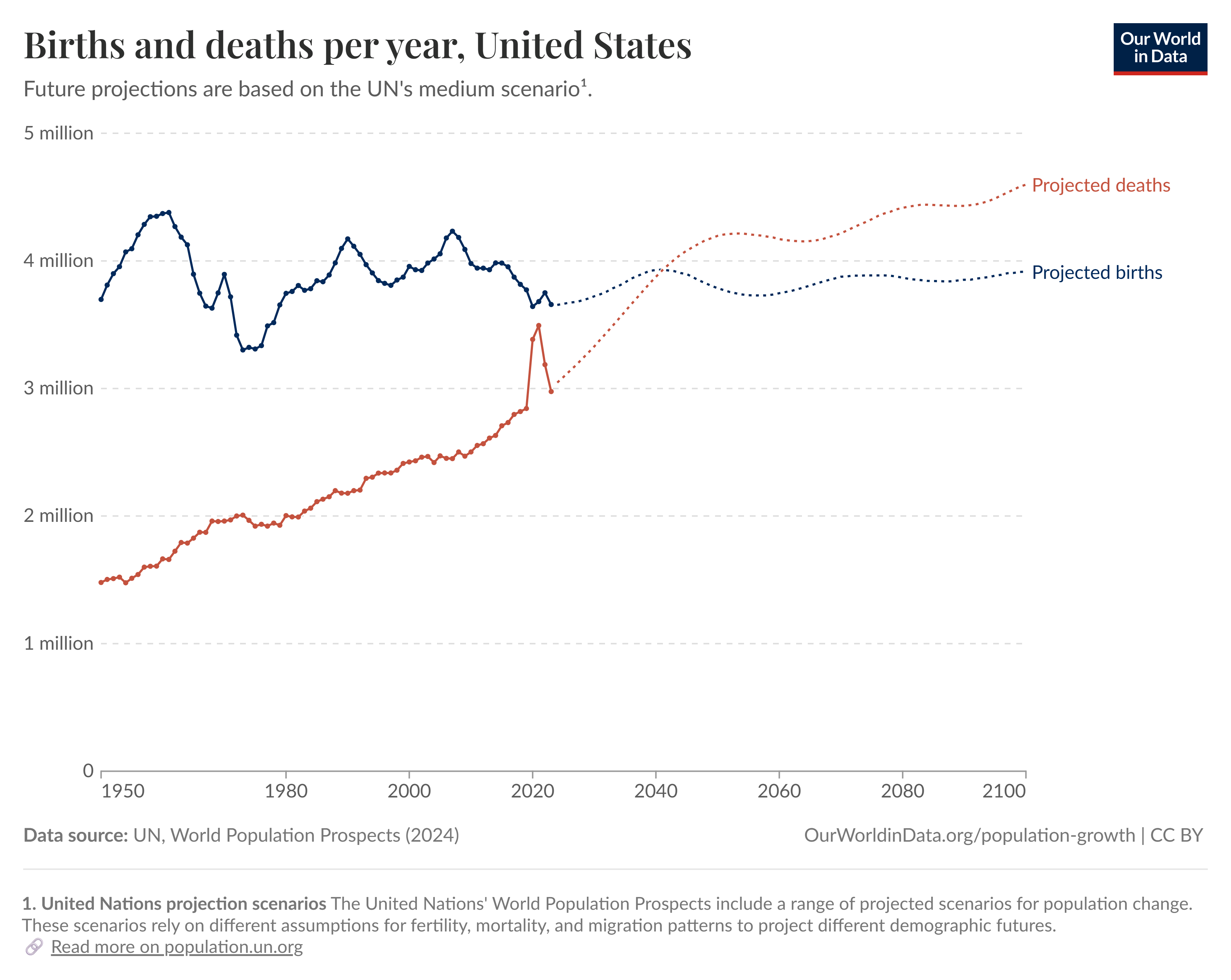
Two different pieces — one from the left, one from the right — showing that wishful thinking will not get the Democratic and Republican parties in the United States through the public finance difficulties brought about by demographic realities. No, I’m not talking about immigration (legal or illegal… which also won’t fix the problem.) By all means, tinker around the edges for now. Because hard choices are coming, whether people like it or not.
Episode Links
NY Times op-ed, 23 Feb 2026, Nicholas Bagley and Robert Gordon: Mamdani Will Need to Change How He Governs
Mayor Zohran Mamdani of New York, in his inaugural address, offered a pledge to create a government “where excellence is no longer the exception.” He now must do so while closing a $5.4 billion deficit, in a state where the governor rejects higher taxes on the rich.
Big budget gaps are not uncommon in American cities. Nor is New York’s high cost of living — one reason that California, New York and Illinois top the list of states with declining populations over the past five years.
If blue-state governors and mayors want to get serious about delivering excellent public services, they will need to do more than battle billionaire elites or embrace abundant housing and energy.
They will have to push back against a core constituency within the Democratic Party that often makes government deliver less and cost more: unions representing teachers, police officers and transit workers.
Bloomberg, Matt Levine, Money Matters, 26 Feb 2026: The DOGE Doubt Trade
This product exists. It is conventionally called a “bar bet.” You can walk into a bar in the right part of Texas, say “I’ll bet anyone $1,000 that Elon Musk won’t do the thing he said he’d do on the timeline he promised,” and someone will stand up and say “them’s fightin’ words” and take your bet. And you will negotiate the terms and odds and resolution method, and in six months you’ll check back in and he won’t have done the thing and you’ll make $1,000. And you will get to say to the Musk fan on the other side of the bet, “nyah nyah nyah nyah nyah,” which is what you really wanted.
Of course there is a market structure problem, which is that you have to find the right bar and then laboriously negotiate the terms of the bet, so you can’t actually pour your life savings into Being Skeptical About Elon Musk’s Promises. Or you couldn’t until recently. But now we have prediction markets, which are centralized electronic exchanges, regulated by the US Commodities Futures Trading Commission, for coordinating bar bets. Here’s a Wall Street Journal story about a guy who can justifiably say “nyah nyah nyah nyah nyah”:
Alan Cole put his life savings, all $342,195.63, into a prediction-market wager. … Until Elon Musk’s Department of Government Efficiency came roaring into the nation’s capital last year, he was largely a plain-vanilla investor or, as he puts it, a “normal, conventional Wall Street Journal-reading adult.”
But Musk’s boasts and his eager fans brought an unusual opportunity into the burgeoning U.S. prediction markets: People willing to bet that the world’s richest man would transform and shrink the federal government.
Cole took the opposite position, one he didn’t see as a gamble at all. If federal spending in each quarter of 2025 exceeded federal spending in the fourth quarter of 2024, he would win big. …
From Cole’s perspective, even if Musk cut government contracts and shrank the federal workforce—which he did—he couldn’t meaningfully dent Social Security and Medicare benefits. And that left no plausible path for cutting overall federal spending. ...
The key feature of the prediction market offered on the Kalshi website was that it measured federal spending in annualized, seasonally adjusted nominal dollars. To win, Cole didn’t need spending to stay above a past projection. He just needed federal spending to go up, as it almost always does.
He made like $128,000, or 37%. Notice the features of this product:
* If you have a view like “federal spending will go up,” it is immediately obvious whether and to what extent the market incorporates that view: The market price just is the market’s expected probability of that happening.
* This product reflects only one fact, whether federal spending goes up or not.
* Investor psychology will affect the price at which you get into the trade — if Musk’s “eager fans” think he will cut federal spending, then you will pay a relatively low price for the spending-will-go-up contract — but not the price at which you exit, because the trade resolves: Eventually, spending either goes up or it doesn’t, there’s some resolution mechanism to establish the fact, and if it went up you get paid. Tom Gara wrote on Threads: “He knew that it’s basically mathematically impossible to reduce federal spending, but he also knew Elon fanboys are often morons.” With Tesla stock, that is a problem; with prediction markets, it’s an opportunity.
It is the opposite of a stock investment.
I guess the point I would make here is that this is still somewhat childish. The stock market exists to allocate capital to productive businesses, and those businesses are irreducibly messy. You do not decide how to allocate capital by understanding one isolated fact about a company’s business; you have to figure out which facts are important and then do your best to understand all of them. Financial markets are not bets on individual facts; they are bets on the economic consequences of those facts.
Prediction markets are a “truth machine”; they let you isolate a fact and make money by being right about it. In many ways this makes them less useful: They don’t fund economic growth, and they are imperfect hedges to real economic risks. But sometimes they do give you the satisfaction of being right.
WSJ, 25 Feb 2026: The Tax Nerd Who Bet His Life Savings Against DOGE
WASHINGTON -- Alan Cole put his life savings, all $342,195.63, into a prediction-market wager. He insists he’s not really a betting man.
Cole is a 37-year-old tax economist with Ivy League degrees, a mortgage and a young child. Until Elon Musk’s Department of Government Efficiency came roaring into the nation’s capital last year, he was largely a plain-vanilla investor or, as he puts it, a “normal, conventional Wall Street Journal-reading adult.”
But Musk’s boasts and his eager fans brought an unusual opportunity into the burgeoning U.S. prediction markets: People willing to bet that the world’s richest man would transform and shrink the federal government.
Cole took the opposite position, one he didn’t see as a gamble at all. If federal spending in each quarter of 2025 exceeded federal spending in the fourth quarter of 2024, he would win big.
….
From Cole’s perspective, even if Musk cut government contracts and shrank the federal workforce -- which he did -- he couldn’t meaningfully dent Social Security and Medicare benefits. And that left no plausible path for cutting overall federal spending.
“It’s almost like the government has, you know, 19 elderly employees for every actual employee,” Cole said.
The key feature of the prediction market offered on the Kalshi website was that it measured federal spending in annualized, seasonally adjusted nominal dollars. To win, Cole didn’t need spending to stay above a past projection. He just needed federal spending to go up, as it almost always does.
This was far different, he decided, than other prediction-market options. Some of those are equivalent to betting in the already efficient sports-gambling market. Others are susceptible to competition against people with insider knowledge, like gambles on whether Lady Gaga will appear during the Super Bowl halftime show.
Cole gradually amassed more than 3% of one particular $12 million federal-spending prediction market. He spread risk across several sub-bets, structured so he landed in the red only if spending declined by more than $50 billion. He wasn’t betting against Kalshi itself, just against people betting on Musk.
….
The government published the final 2025 figures Feb. 20. It wasn’t even close. The lowest spending quarter in 2025 was $66 billion above the bet’s target level. Cole collected $470,300, for a profit of more than $128,000, or 37%.
“There’s a little bit of that feeling of vindication,” Cole said.
Our World in Data: Births v Deaths
Our World in Data, 5 Jan 2023: How many people die and how many are born each year?
The world population has grown rapidly, particularly over the past century: in 1900, there were fewer than 2 billion people on the planet, and in 2025, there were around 8.2 billion.
Two metrics determine the change in the world population: the number of babies born and the number of people dying.
….
As the number of deaths approaches the number of births, global population growth will end
How do we expect this to change in the coming decades? What does this mean for population growth?
Population projections suggest annual births will remain around 135 million in the next two decades before declining slowly in the second half of the century.
As the world population ages, the annual number of deaths is expected to continue increasing in the coming decades until it reaches a similar number as annual births, at which point the world population will stop increasing.
The annual number of deaths is then expected to surpass the annual number of births. This is when the world population will start decreasing.
United States
Japan
France
South Korea
United Kingdom
China
Related Posts
STUMP - Meep on public finance, pensions, mortality and more is a reader-supported publication. To receive new posts and support my work, consider becoming a free or paid subscriber.