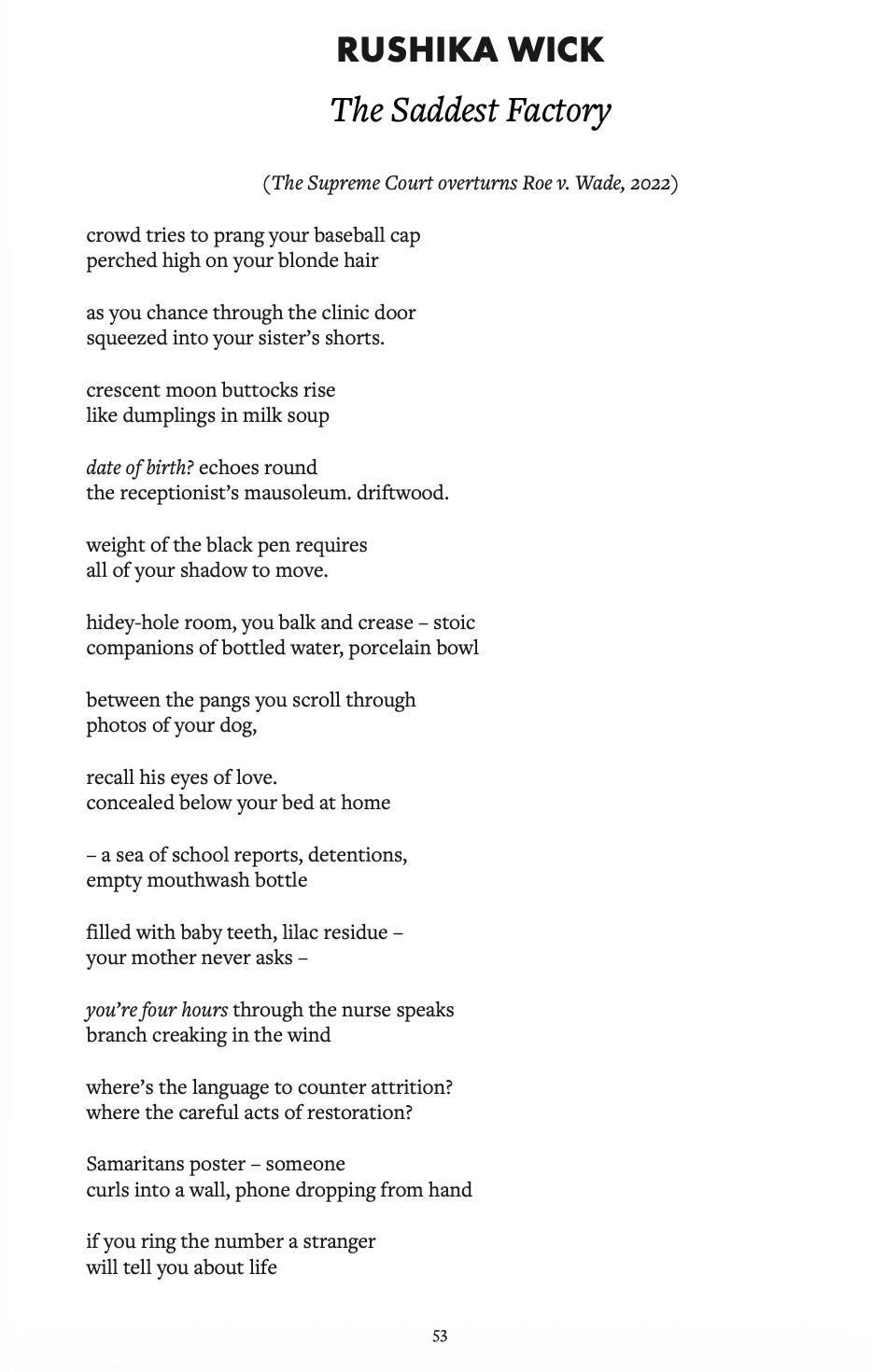
Some poems don’t so much argue but stand their ground.
Rushika Wick’s The Saddest Factory enters Issue One’s Section VI - A Furious and Tender Reckoning at the point where fury turns inward, where political catastrophe is no longer abstract but lived in the body, minute by minute. Written in the aftermath of the US Supreme Court’s overturning of Roe v. Wade, the poem refuses spectacle. What I love most is that it embodies the events. It attends to the logistics of harm: the waiting room, the pen, the form, the phone in the hand. What is stripped away here is not only rights, but language itself.
The power of this poem lies in its refusal to reduce grief to slogan or symbol. Wick understands that damage often arrives quietly, through clipboards and posters, through polite questions that echo like mausoleums. The speaker moves through a system designed to be neutral and efficient while everything inside them is unravelling. Even tenderness, the remembered eyes of a dog, the domestic relics hidden under a bed, feels fragile, smuggled in against the steady pressure of attrition.
The Aftershock Review is a reader-supported publication. To receive new posts and support my work, consider becoming a free or paid subscriber.
Section VI gathers poems that reckon with harm without abandoning care. Wick’s poem is furious not because it shouts, but because it notices. It asks the hardest question in the room: where is the language for restoration? The poem leaves us with the knowledge that too often there is none. Only the number on the wall, and a stranger on the other end of the line, trying to explain how to go on.
This is a poem that understands survival as something procedural, bodily, unfinished, and insists that attention itself is a form of resistance.
You can buy Issue One here:
Here’s Rushika reading it below, too:
The Aftershock Review is a reader-supported publication. To receive new posts and support my work, consider becoming a free or paid subscriber.