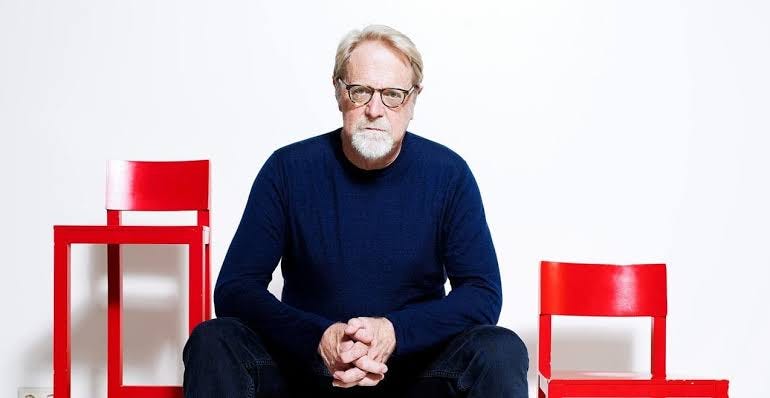
I wanted to share this great interview I recorded this week with one of my favorite writers, Jonathan Taplin.
Jonathan Taplin is a writer, producer, and Director Emeritus of the Annenberg Innovation Lab at the University of Southern California. He's had an amazing career as outlined in his book The Magic Years and recently published a new book, The End of Reality, about the failure of our "great thinkers" to prepare us for a humane future.
In this podcast, we talk about the failure of the 1960s that directly led to our culture of despair and he offers some small ways we can resist - and survive - the coming crisis.
Our theme music is by Policy AKA Mark Buchwald. (https://freemusicarchive.org/music/policy/)
Transcript
John Biggs
Welcome back to Keep Going a podcast about success and failure. I'm John Biggs. Today on the show we have Jonathan Taplin. He is a writer, film producer, Director Emeritus of the Annenberg Innovation Lab at the University of Southern California, and the author of two of my favorite recent books, The Magic Years, which was about your life, in amid all these rock and roll stars, and then we have the end of reality, which is about Facebook, Metaverse, crypto, and Mars. Welcome, Jonathan. Good to be here, John. Yeah. So I wanted to the premise of the show is basically about failure. And I think the two books sort of lead up to each other in the sense that The Magic Years was about a very, very special time in history, culture was changing culture changed to a degree that was probably unheard of in recent memory. And then when we come up to now we come up to the End of Reality, we sort of see that high watermark, and then the receding of that culture in the form of social media, which to a degree has destroyed almost everything that you talk about in the magic years, would you is that? Is that a correct statement?
Jonathan Taplin
Yeah, I think so. I mean, you know, Peter Drucker famously said, culture eats strategy for breakfast every morning. And essentially, what he meant was that you can have all the great strategies of how you're going to change the world. But if the culture is not in supportive nothing's going to happen. And so if you think about the 60s in that sense, culture, led politics and ate politics for breakfast every morning. In other words, if you think about 1963, the guy I worked for Bob Dylan, although I wasn't working for him at that point, went down to Mississippi, to Greenwood, and sang it. Voting Rights rallies for the Student Nonviolent Coordinating Committee were a kind of daring thing in the sense that that same town a year later, three civil rights workers were murdered by the Klu Klux Klan. And in the sense that that happened, and nothing happened politically for another three years. In terms of voting rights do so in the sense the culture was out ahead of the politics. And in that sense, the culture played a very important role. I would argue, and I do we in the end of reality that since about 1999, or 2000, the culture has taken a knee holistic turn. So you have the rise of gangster rap. You have the rise of gangster television, in the sense of The Sopranos, leading to the wire leading to match down Breaking Bad succession. In other words, series that all of the important TV series was essentially about bad men struggling for power in a world with no morals whatsoever. And so if you have that for, say, 15 years from 2000, to the winter of 2015, and into the 2016 election, it doesn't surprise me that a bunch of people say, Well, maybe we need Tony Soprano to be president. In other words, you get a Trumpist gangster-type figure, becoming the ruler because you think you need somebody to kick ass and take names on. So that's one element. And of course, the other element is a culture of fantasy and escape, which of course starts in the late 70s with star words, and leads you into a world in which say Marvel the Marvel Cinematic Universe is all about fantasy. You know, it's not tied to anything real. And if you think about the four characters in The End of Reality, Elon Musk, Mark Zuckerberg, Peter Thiel, and Marc Andreessen, they are all deeply involved in fantasy culture. Elon Musk would like us to give him $10 trillion to send 50 people to Mars. You know, Mark Zuckerberg has invested 3 billion 4 billion in this thing called the metaverse in his business plan is that you will spend seven hours a day with a virtual reality helmet on and your life will not be tied to anything real. It will be a complete fantasy world. You know, if you want to, if you admire Tony Stark and the adventures in The Avengers, then you can be Tony Stark, and you can rent Tony Stark's house and put on Tony Stark's, you know, suit and fly around and so, and Marc Andreessen, he wrote this article last week. Yep, calling him techno-utopian. And it is so filled with b******t that I cannot even imagine. He says, you know, decentralization harnesses complexity for the benefit of everyone. Centralization will starve you. Well, he owns the most centralized NFT platform in the world OpenSea, which has 90% market share. He's an investor in Facebook, which is a monopolist in social media. He says, markets prevent monopolies and cartels, total nonsense. That social media space is monopolized by two firms, Elon Musk, and Mark Zuckerberg. You know, he says, We believe in competition, he doesn't believe in competition at all, we believe in the truth. These mechanisms of social media have been used to spread disinformation on a level that nobody has ever imagined that could be. So um, you know, somehow these people believe that if they say something, you know, they're they're the Uber Munch. They’re straight out of Nietzsche’s playbook, and they ended. And, you know, it verges into fascism, when you get to Thiel and Musk, who have a political point of view, that's pretty damn strong right now. You know, and so. But let's be clear, in terms of your themes of failure, we are headed towards failure. There's just no doubt in my mind, that we are headed towards something that could be incredibly dangerous for humanity. One of the leaders of the AI revolution, gave an interview in Wired last week, and he said, look, he said he was involved in the use of AI for new drug discovery. And he said it's pretty damn good. You know, they said, what it would take just a slightly warped human being to decide that he should use AI to build a bioweapon. And the same technology that he's using on drug discovery could be used for bioweapons. You know, and, and so I think, you know, we're in a, we're in a dangerous place, and nobody's willing to admit to failure, and we're right in the middle.
John Biggs
Is there precedent for this, or is this unprecedented?
Jonathan Taplin
Well, you know, you probably saw Oppenheimer, right? The movie. And there is a point of course, when Oppenheimer has finally witnessed the test, at ALMA Goro, of the bong and he all of a sudden comes to the realization question of what the hell have I done? What have I created? Now that he didn't think about that beforehand? It is kind of scary to me, you know, but needless to say, it informs the whole last half of the movie, in some sense, he then sets out to stop us from creating the next level, bomb, the hydrogen bomb, and needless to say, runs up against the defense establishment, and they trash him. So, I mean, I guess that's the best lesson that I could think of. The problem is that the people who are financing this are like, Marc Andreessen, they never in their lives could imagine that anything that technology has done could do anything wrong. He's early on his essay. Andreessen writes, We believe there was no material problem, whether created by nature or born technology that cannot be solved with more technology. Yet, here Andreessen is the largest investor in autonomous weapons in the country. In other words, he builds most of the software for autonomous weapons. And, you know, I don't know…