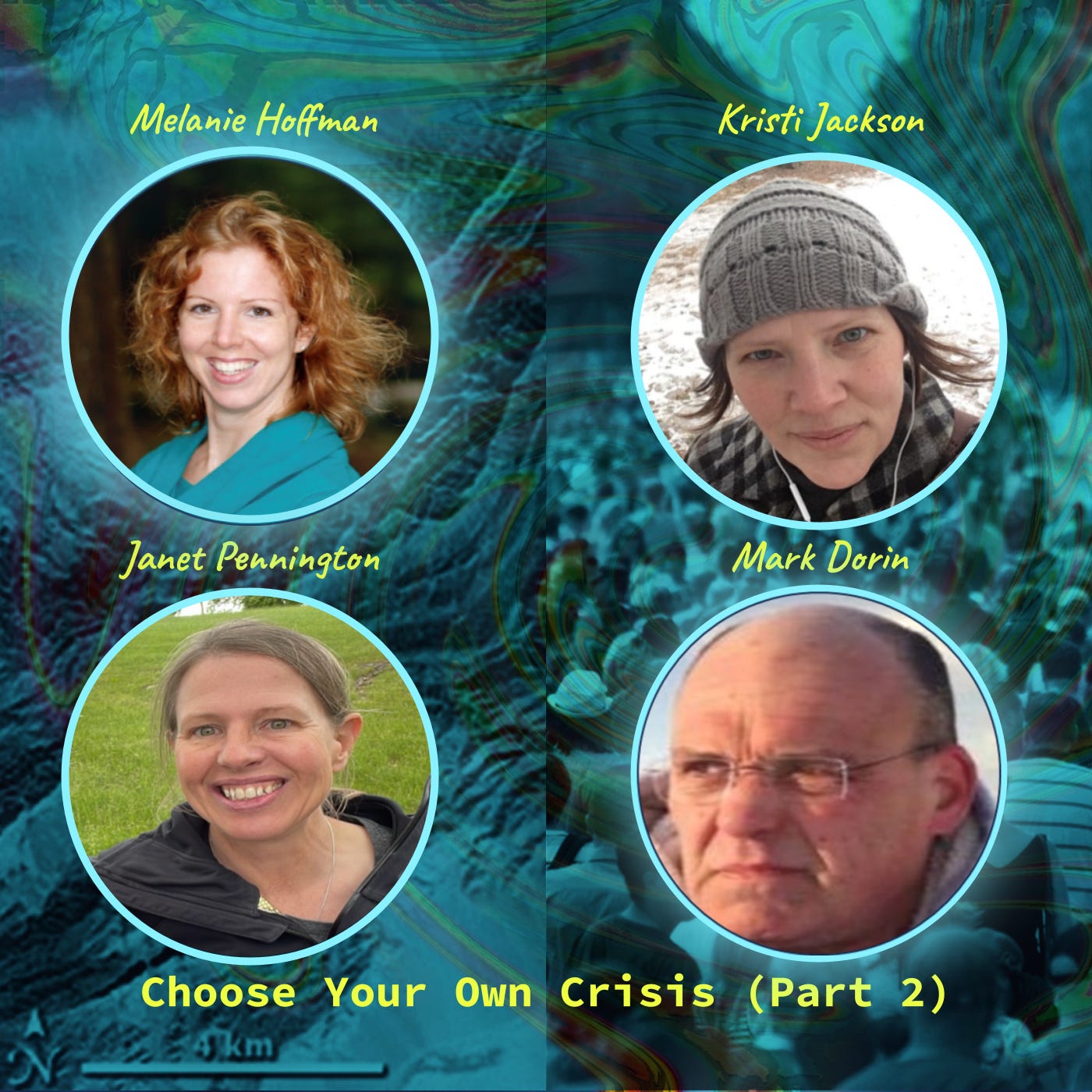
Welcome to “The Gravity Well,” where you break down complex ideas into manageable insights. Your mission is to seek wisdom from elders, individuals, and communities who care for our natural resources. In this episode, you hear about the importance of community, the role of leadership, and the need for grassroots activism in addressing social, environmental, and economic crises. Key topics include the failure of current leadership to engage with the public, the necessity of returning to the rule of law, and the potential of models like Donut Economics to guide us towards a sustainable future. Join us as we explore how to foster humility, accountability, and community care in our efforts to create positive change.
Recap and Welcome to Janet, Kristy and Melanie (and later, Mark)
Alex:
Welcome to The Gravity Well, where we break down heavy ideas into small buckets anyone can handle in our work and at play, we seek wisdom and elder well. We seek the wisdom of elders, excuse me, individuals and communities that share their knowledge and care for our water, air, land, life and resource needs. Caring for our homeland is our guide.
Jenny:
Thank you, Alex. Welcome Melanie. Welcome, Janet. This is a really exciting day for me to have. As I’ve told Melanie, when we first met back in March of last year, really felt at home when I met Melanie and was introduced to the Alberta Talks and AEN team. Janet is someone that I’ve had the opportunity to volunteer with a few, oh geez, at least a handful of times now. And always grateful to hear your insights and see your support in social media and in that space of trying to, as Melanie highlighted, address the concerns that our government is not sharing with the public and potentially some barriers as well. That is what we want to do, make sure that we are touching on the real world, things that are happening, excuse me, right here in Alberta where we live.
But I’m going to back up the bus a little bit and give you two, a little bit of insights as to where we’ve gone over the last five weeks. And then I’ll let Alex do the same, and then we’ll go ahead and do our round table of questions with you, and allow you an opportunity to introduce yourselves Properly as well. Just quickly, I’ve attached a file at the top of this meeting, and that is sort of the running tally of what we’re learning as we go. In our first week, we discussed why we are doing the gravity well, that we want to rebuild community and bring people together in crisis and do that in little buckets at a time. We understand that we have heavy issues that people are facing, and we want to make sure that we have fit-in “bite-sized pieces that anyone can manage” as the goal.
That’s our goal. And then we talked about our agreement. We spoke with our positive intelligence coaches. I meet weekly with some coaches. Thursday morning, which is nice leading into these conversations to be kind of grounded in that. They helped us come to we need a community agreement. We ask that this is a space for respectful listening and exchange of ideas in the best interest of the public and our planet. And that’s of everyone involved. Anyone in the chat or on the stage, the tools of this room, there is an opportunity, if you hold down your phone, you can do some emojis. It helps the conversation move along if somebody, perhaps we can’t hear each other, whatever, something, if something’s running too long, you can do a little gif and offer a funny way of just helping us come back together.
We think this is a call to action. That’s one thing. Melanie’s asked some amazing questions as we’ve gone along through this process, rooting us in what are we trying to do. For us, the big thing that we see this room being is a space to help people take responsibility for themselves. We’re not here to hold responsibility for the issue. Let me give an example. We had a conversation recently with a friend, Brad Chapin. He spoke to us about behavioral health and safety, and I had a close friend afterwards mention that she didn’t learn anything. There was nothing offered at that time. She didn’t get the answer. She was after I said to her, well, as a matter of fact, we’re going to read Brad’s book and we’re going to do it in Angie’s room and walk through what we learn.
I said to her, you’re going to have to be okay with this being a learning process for me as well. It’s this understanding that we can’t know all of the answers to things. And what I liked about Colin Smith’s comments in our meeting with him is that anybody who’s telling you that they know all the answers is probably not understanding the problem to the degree that it is, myself included, right? I learn every day a little bit more. Anyway, that’s a bit of stage. We did our community agreement. I’m going to try and be quicker with these other ones. I talked about Brad a little bit. We talked about our fears. That was the reason why we met with Brad because we appreciate that this is an understanding that being empathetic requires us to get past our fears and try to listen to people.
We talked about that. I’ll leave those notes with you and the audience. And then we met with Regan Boychuk to talk about how we source information. He helped us understand that we need to recognize media as a centralization process that works in the best interest of corporations and special interests. It does not work in the best interests of humans. We need to look at it objectively, and we need to be looking for data that substantiates what we read and that it is under the understanding of good faith. It’s meant to help serve us. And then as I said, we met with Colin and spoke about the laws of the land. We’re going to explore that conversation some more today, which I’m excited about. And really from Colin, we discussed that this opportunity to build a shared identity and have some fair and fast outcomes, we need to, I’ve heard people say, oh, Jenny, things take time.
Well, we unfortunately aren’t dictating the time here. I think this is trying to make sure that we appreciate the pace is not necessarily being dictated by us and our leaders for that matter, and emergency preparedness. This one was really special for me. Last week we spoke with my husband and a gentleman from Northwest Territories. Thank you Mike Westwick for joining us. What an incredible, I’m going to let Alex speak more about that when he does his, but the big thing for me is having a common system. Having the system right sized, and expanding a system is not a good strategy. It’s good to sort of plan for the worst. That’s one thing that Chris is good at. And then finally, the communicating. Communicating not only within your organization but for anybody that could be touched outside of your organization. Anyway, I’m going to stop there. I’m going to let Alex do the same, and then we’ll get to you two. Thank you so much for your patience.
Alex:
Yeah, wow. That was a pretty precise summary, Jenny. I won’t try and give my translation of the same thing. Yeah, there’s a lot to take in each interview and the level of trust and respect that all of our guests have given us so that they could be open and answer some of the questions that we had and ask their questions. It’s humbling, and I think it’s an amazing thing that we’re setting out to try and do. And I also want to thank you all for being able to contribute in the ways that you will choose to over time. One of the things that I’ve learned through the first five episodes is that there has been a common misunderstanding that each episode is supposed to arrive at a certain conclusion when it just arrives at better questions. And sometimes people have said, oh man, how’d you learn that you’re smart?
Or whatever. I’m only smart enough to know that I don’t know anything and that I have a lot of questions about the world. I want to better understand it so that I can help do my part to shape it locally in my family, my community and beyond. I’m leaning on exp…