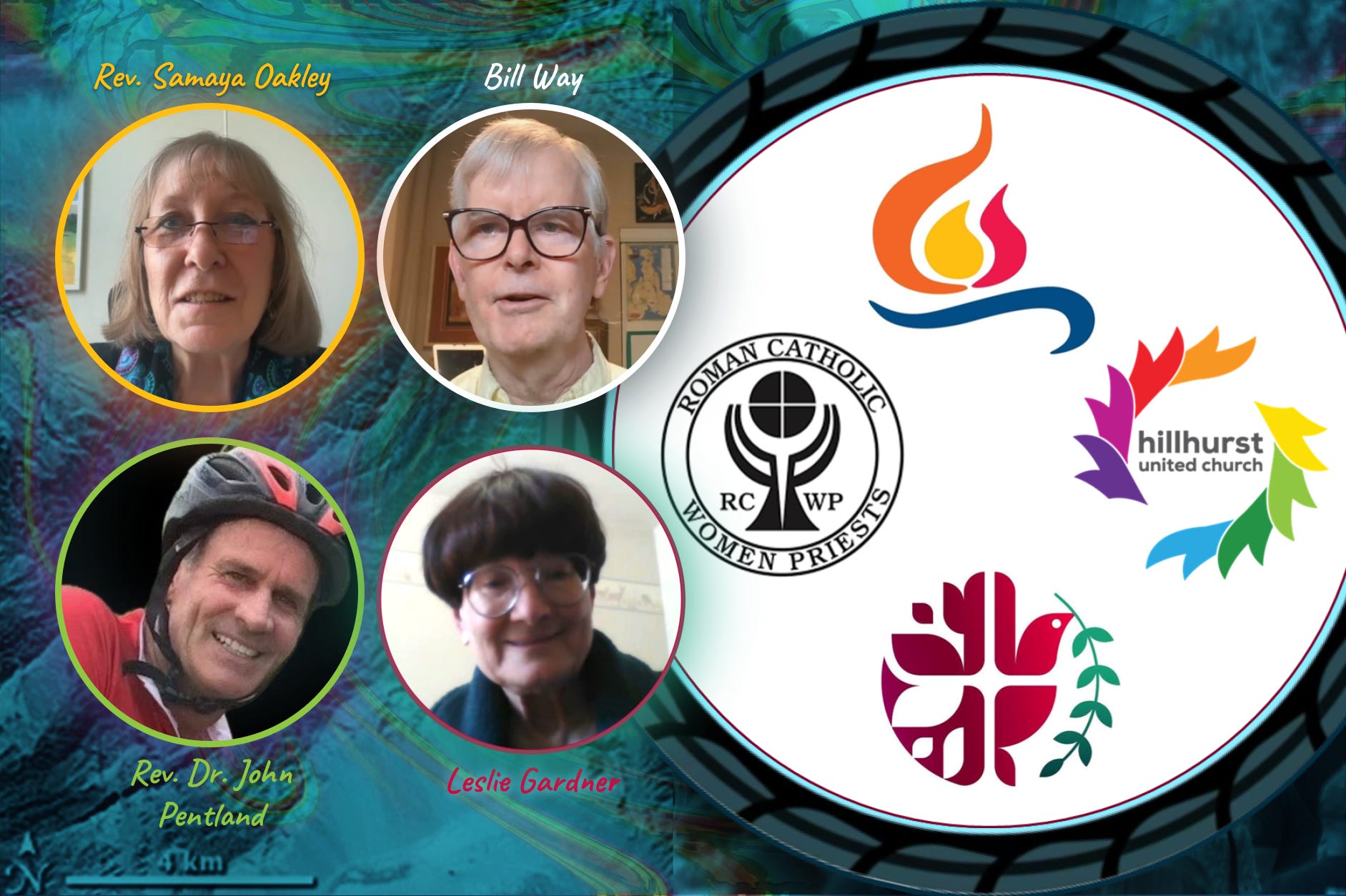
“Faith Leaders Across Alberta Oppose” features four leaders of the Alberta faith community with diverse Christian backgrounds who describe their spiritual journeys, articulate commitments to pluralism, and explain why more than 200 faith leaders signed a public letter opposing a recent Alberta government–backed Christian gathering that sought to shape policy through a narrow, right‑wing religious agenda. Across the conversation each of them stress the importance of inclusive public life, interfaith respect, and the “inherent dignity of every person,” warning against privileging one religious voice in policymaking and calling instead for leadership grounded in hospitality, social and environmental justice, “preference for the poor,” abundance rather than scarcity, and everyday spiritual practices that help people respond to rising fear, polarization, and separatist politics with courage, love, and shared responsibility for the common good.
Key themes which emerged throughout the four separate discussions are best summarized by Reverend Dr. John Pentland: hospitality, spirituality, social justice, and risk. Now is the time for faith leaders, all leaders really, to take risks. It has never been more important than right now.
Additionally, plurality is explained throughout this conversation. The importance of seeking different views and multiple outcomes. Not seeking one unified goal.
I am happy to hold more conversation with these leaders or others who support or have signed the letter of opposition. Here’s the full transcript to assist your listening.
Introductions to The Gravity Well and Alberta Faith Leaders
Jenny (00:00:04):
Welcome to the Gravity Well podcast with me, Jenny Yeremiy. I host the Gravity Well to celebrate and share the stories of people looking to empower others with the knowledge and skills required to reestablish stability in our communities. My mission is to work through heavy issues in conversation and process in order to lighten the load.
I acknowledge that I live on the traditional territories of Treaty seven and Metis Districts five and six. The treaties and self-governance agreements established by indigenous peoples are created to honour the laws of the land, maintain balance with nature and give back to uphold reciprocal relationships.
This knowledge and intention are what guide the Gravity Well conversations. I ask for genuine dialogue, real hearts, and openness to different perspectives. This is your invitation to find common ground with me.
Positions taken by participants, either individually or collectively, do not necessarily represent those of the Gravity Well.
This podcast is dedicated to the natural world, our children, nieces, nephews, grandchildren, and all future generations. The Gravity Well is on YouTube and streaming wherever you get your podcasts.
If you like what you see and hear, remember to like and subscribe!
Thank you so much for joining me, Leslie. I’m super pleased to have Leslie Gardner in the studio today. We are today speaking about spirituality and about the recent meeting that the provincial government had with some specific religious leaders and just to break down this issue and opportunity together. Leslie, can we start with a little bit about you, your spiritual journey and what brought you here today? Thank you.
Leslie:
Sure. Thanks, Jenny. I’ve had varied exposure to different religious organizations in my life. Started off Anglican and then as a kid in the country with a Baptist church and then as an adult, became Roman Catholic and I’m now participating in congregations that are Evangelical Lutheran Church in Canada. I’m also part of a group here in Lethbridge who started what we call the Lethbridge Inclusive Catholic Community Fellowship led by a woman priest.
Jenny:
Fabulous. And remind me, Leslie, when we spoke earlier, you were mentioning you do studies at the University of Alberta, is that correct?
Leslie:
Yes. Yeah. I’m also part of a community around St. Stephens College, which is a theology college on the campus affiliated with the University of Alberta and had its roots in the United Church. And we’re still very much involved with the United Church, but it’s also much broader than that in the master’s programs and demand programs that we offer.
Jenny:
Incredible. Thank you for all that work. What a journey. Anglican, Baptist, Catholic, now evangelical and united. That’s wonderful. You’ve dabbled in everything Christian, is that right?
Leslie:
Not exactly, but lots of influence from important people that you meet, influencers of various kinds, people you admire. What do they have to share with you? And I’ve been really fortunate there.
Bill:
Hello, everyone. My name is Bill Way and I lived in Alberta for 50 years in Calgary and now I’m five years on Vancouver Islands. My spiritual journey is pretty interesting. I was born Catholic and was brought up to go to church and be a good boy. Around my years in high school and university, I joined a folk choir and I started singing at church. That little tiny version of the Catholic church really appealed to me and we had families that we raised with each other’s children and a really good community. And in that journey, I met a lovely lady from the United Church and my wife’s father was a minister. She was a preacher’s kid. I was Catholic. There’s lots of things that weren’t good about this, but basically that just kept adding to the diversity of my spiritual background. We raised our kids with a concept called double belonging, which means that our kids were too young to know that we’re going to go to church at the Catholic church at nine and then we’re going to jump in the car and we’re going to go to the United Church at 10:30.
They just think that’s what people do. By the time they got to be teenagers, they’d kind of had enough of church. We just sort of did that. And I got more and more involved with the United Church. I actually, without becoming a member, I became secretary of the Church Council. I was on the committee that hired and fired ministers and I continued on with the music too. I was in the choir in the United Church. Interestingly enough, this strange phenomenon called the Roman Catholic women priests came into my life. Not only did I just jump back into the Catholic church, I loved the fact that the RCWP movement abandons a lot of the things about the Catholic church that I don’t like, like exclusivity. In the past, I’d say 10 years, I’ve been an active member of RCWP Canada. About my spiritual journey, it includes my travel.
When we were travelling together, we have travelled to Turkey, to Thailand, to Guatemala and in all of these places, the dominant religion is not the one I was brought up with. And I just learned, you know what? There’s plenty of pathways to a spiritual life. There’s nothing exclusive about it. And the more you kind of hold onto a belief and say, “This is my truth and you better accept my truth.” That is like a bell ringing in my ear saying, “You’re actually not in the right path at all. “ In a nutshell, I’ve gone from Catholic to United. Now I’m back to a new version of Catholic.
Jenny:
Incredible. And I love how you said you, well, first of all, the double belonging, providing space for both of you to continue that faith journey and then eventually wrap around to something that was merging the two ideas together in a sense. It’s so neat. And I love the idea of the dropping some of the things that you didn’t like about the one faith that you were raised in and being able to carry forward a message that you still can get behind. Wonderful.
John:
My name’s John. I am the lead minister at church in Chicago. I grew up in Ontario and moved out here in serving a rural parish for four years where I learned a lot. And then a suburban church in Southern Calgary for 10 years and three years at Calgary, an area United Way. A nonprofit in the city where I learned a lot about how the cities are connected to the great people that a…