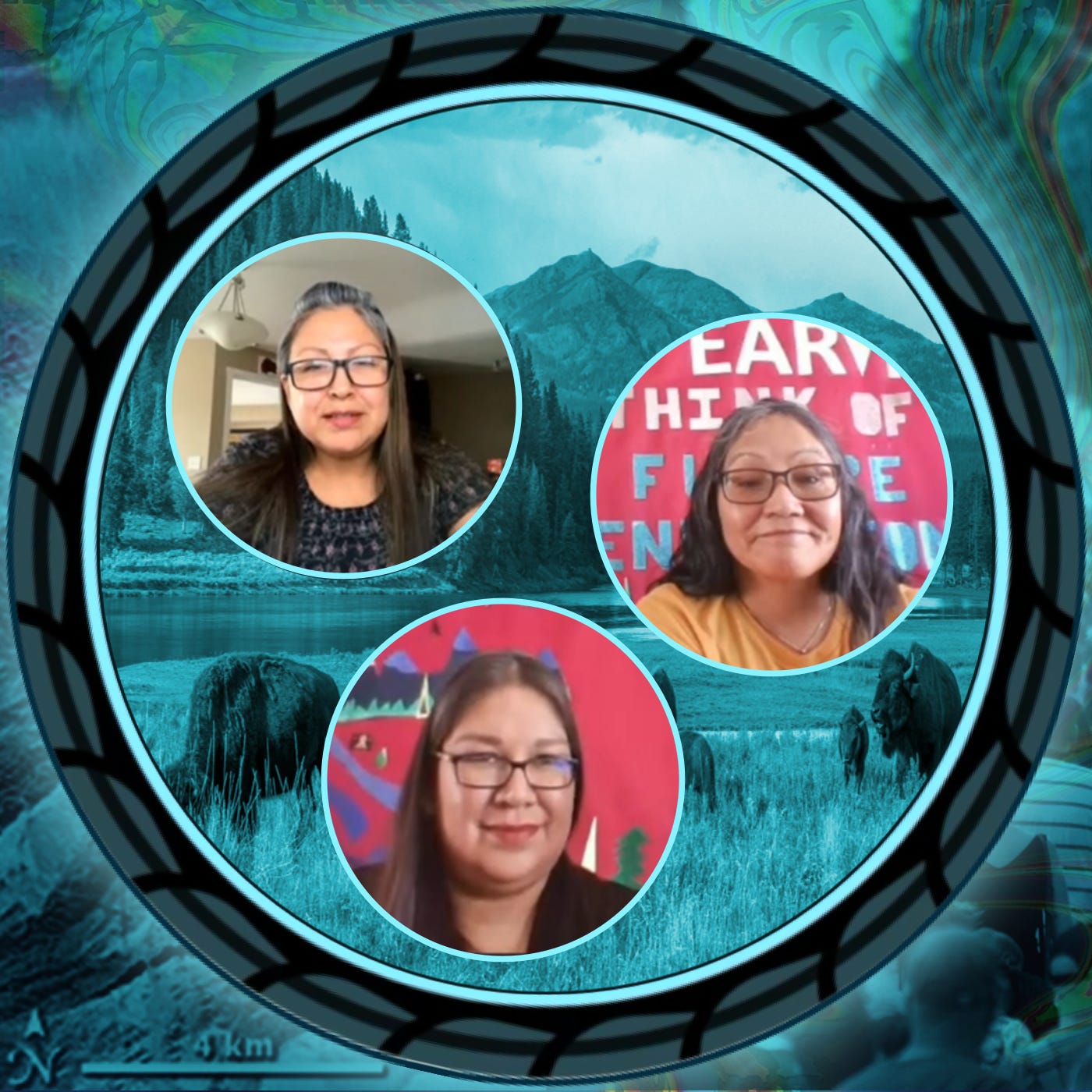
To kick off Season 2 of The Gravity Well podcast, I am joined by Edna Ann Fairbrother (Little Moustache), (Wynonna) Inez Smith, and Nicole (Weasel Woman) Johnston of the Mountain Valley Child Society. They explain the more than a decades long fight against the expropriation of mineral resources (gravel and coal) and water from the Piikani Nation, in southern Alberta. Nicole, Edna, and Inez discuss the impacts of coal mining on their communities, highlighting the lack of proper consultation and the environmental and cultural consequences. They stress the importance of preserving water, biodiversity, and future generations, advocating for informed decision-making and community involvement. The episode underscores the need for collaboration and continued efforts to protect the land and its inhabitants.
Edna, Inez, and Nicole Introductions
Alex:
Welcome to The Gravity Well Podcast with Alex and Jenny. Here you break down heavy ideas with us to understand their complexities and connections. Our mission is to work through your dilemmas with you in conversation and process making our world a better place for all.
Jenny :
We acknowledge that we live on the traditional territories of treaties, 4, 6, 7, 8, and 10. The ancestral homelands of diverse First Nations, Inuit, and Metis. Peoples whose ancestors have walked this land since time immemorial and whose histories, languages, and cultures continue to influence our vibrant communities. We pay respect to indigenous people through our ethical relationship building efforts. Our community agreement asks for genuine conversations, real hearts, open minds, and different perspectives in conflict. Let’s rely on our six W system and live participant feedback. What matters most is finding common ground.
Alex :
We dedicate this podcast to our children, nieces, nephews, grandchildren, and all future generations. The gravity well is on YouTube and streaming wherever you get your podcasts. Join us at thegravitywell.net.
Jenny:
Welcome, welcome. Happy New Year, if I can say that in February. I’m grateful to have the Mountain Child Valley Society with me today. I’ll let everybody do a proper introduction in a second here. This is our first episode of the year. We’ve been busy since November. These ladies especially have been in the courtroom, on the streets, helping organise our communities in southern Alberta with respect to coal and water safety, quality and security. It’s been a lot happening that’s been thrown at us. We’re going to take some time to dissect what it is, what the problem is, what we’ve been dealing with, and then we’ll get into some ideas around what comes next, what we’re doing together from this work. I’m just going to quickly introduce myself. I’m Jenny Yeremiy, I am a geophysicist by background and I worked in the oil and gas industry for 22 years.
Jenny:
I started in development, I was drilling oil and gas wells and then started looking at liability: the cleanup of oil and gas sites. In 2020 I was really proud to have the opportunity to work with the money that was injected into the industry to address the abandonment and reclamation work in the province. As it turns out, I was a lobbyist for indigenous led closure work in the province. I’m really proud to say that in fact in all three provinces, that was something I was advocating for. With that understanding, here I am doing this podcast trying to make sure that people understand the issues that we have on the landscape and who are the faces of the battles that we’re having to try and make sure that we preserve our water and our biodiversity and our communities. I’m going to stop there. Nicole, you’re first on my screen. If you wouldn’t mind introducing yourself please and we’ll go from there.
Nicole:
Okay. Hello, my name is Weasel Woman. My English name is Nicole Johnston. I am from the Peigan Reserve, the Peigan Nation located east of Pincher Creek. I am indigenous advocate. I do some work. Started doing work up here in Calgary regarding issues that dealt with the indigenous people here in the city. And I started doing that work all on my own, whereas if I saw something regarding our issues, I went directly to the main source to have it dealt with. That’s the kind of work I started doing on my own plus the school part of it. Seeing what was happening back home and the work that I did, I just put it together and started moving forward to inform as many people as we can about this issue because not a lot of people I knew knew about it. I knew we had to get the word out there and I started helping in that way with events we put up and the walks we had across Pincher Creek for McLeod, Lethbridge, and just info sessions. That’s what I’m doing now and still having, I got a lot of focus on three big issues right now. My plate’s full.
Jenny:
Yes, ours all are, absolutely. Thank you for all the work you do, Nicole, and we’ll get into that a bit more. Edna, do you mind going next? Please.
Edna:
Good afternoon and Happy New Year, I’m really glad we’re the first ones of the year to be on your podcast. I’m really glad that we met on that first rally. My name is Edna Fairbrother Little Moustache. My first name is Centre Pole Woman. I became involved in the Grassy Mountain way back in 2015. I was doing a lot of the research for Mountain Child Valley Society, but I wasn’t a member per se, but I was a member per se. During this time here, I would like to share some history in regards to this. I know the young ladies here have some really valuable information to share about what we’ve been doing. We’ve been, not to take up too much time, but we’ve been handing out and as I have been handing out information packages and we’ve been going home to home and talking with people and we’re really well received, mind you we’re on a meagre.
Edna:
It means no budget. We do what we can. We’re informing people, our family as well. We took the information from our Chief, chief and council responses, highlighting some important points in the responses. We included our letter from MCVS in response to these AER documents that were being read out loud by our nation. We also have been talking to other people and in the community here and just spreading the word and just making them aware of what is in the letter to take the time to read it, give them the information and take the time to read it. I know it’s quite lengthy of the document, like the six page letter and it’s hard to read, but we are helping them along and we just take out important points. We’re just basically informing our people and trying to get our survey pushed out for as much information as we can of the lack there of the information that’s coming from the community because we know we don’t have that community consultation. And I can go further and further, but I’ll give Inez the opportunity to introduce yourself. And it’s good to see you guys. Good to see you Nicole.
Jenny:
Wonderful. Thank you so much. Edna. Yes, Inez, please go next.
Inez:
Hi, my name is Wynonna Inez Smith. I’m from Piikani Nation and a recent graduate of the University of Lethbridge. I’ve been a part of the Mountain Valley Child Society since 2021. That’s when the group first was formed.
Jenny:
Do you mind offering, what did you study at the University of Lethbridge?
Inez:
I studied psychology and minored in indigenous business management.
The Leadership of Edna, Inez, and Nicole Throughout the Grassy Mountain AER Hearings
Jenny:
Excellent. Right on. Thank you so much. Yes, I had the opportunity to listen to some of what you both offered Nicole and Edna during the first hearing in Pincher Creek. If you don’t mind, I’m just going to back up a bit and let everybody know what’s happened here and you’re welcome to correct me where I air, but we had, at the beginning of December, there was a public hearing that was made available for the public in Pincher Creek. It was open to anyone who was willing to speak for or against the project and it was limited to the Grassy Mountai…