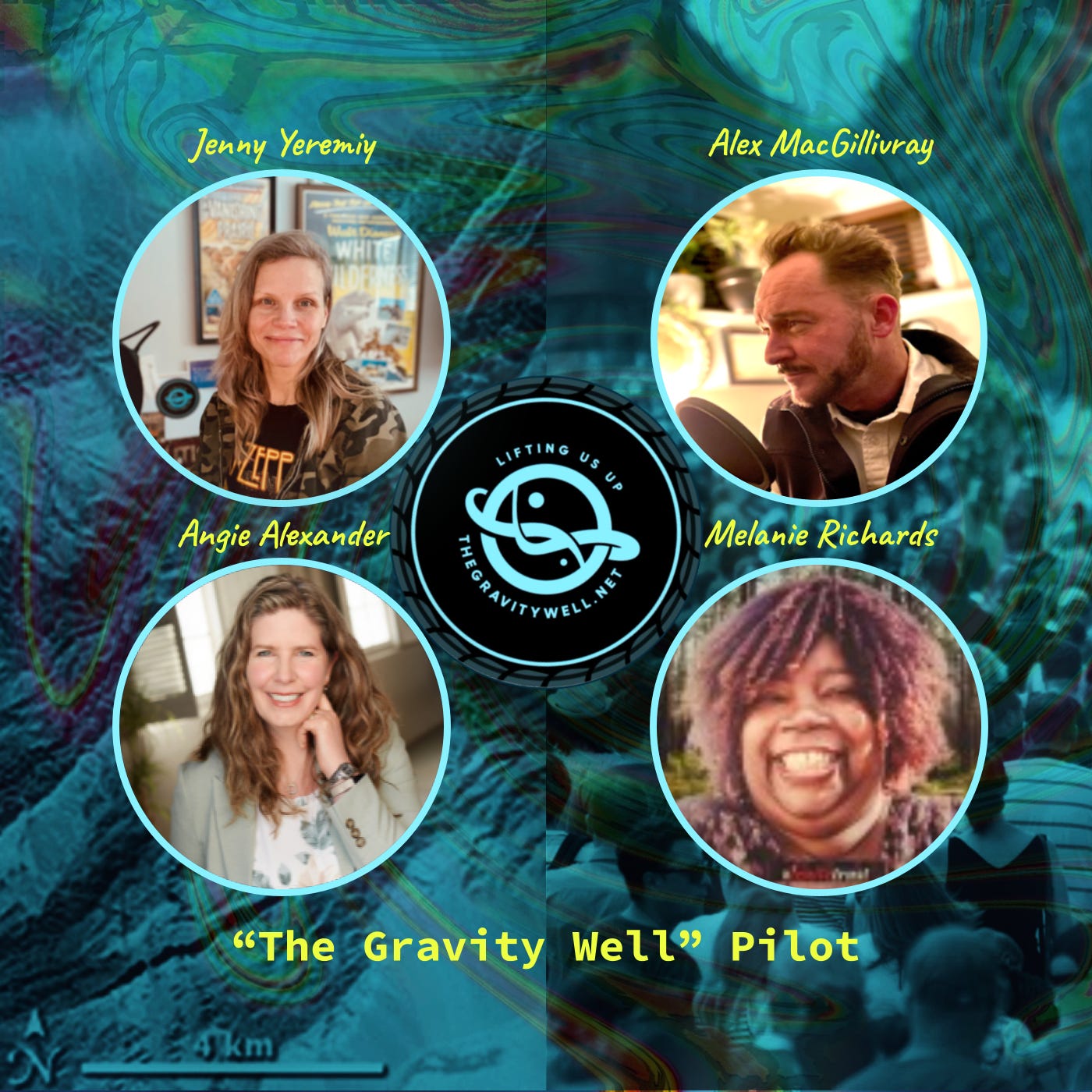
Welcome to “The Gravity Well,” a podcast where hosts Alexander MacGillivray and Jenny Yeremiy tackle heavy ideas in manageable segments. They aim to provide information, ideas, and skills to positively contribute to listeners’ lives. The podcast was born from a conversation during an election campaign, where the hosts realized the importance of preparing for potential negative outcomes, much like the Apollo missions. They emphasize the need for community rebuilding and fostering a collaborative mindset rather than opposition. The hosts discuss the importance of respectful behavior, understanding different perspectives, and creating a safe space for open dialogue. They also explore their own personality traits and how these influence their collaboration. The podcast aims to address various crises by opening dialogues and encouraging contributions from diverse viewpoints.
About Your Hosts
I, Jenny Yeremiy, am a geophysicist and liability (oil and gas site clean-up and restoration) expert turned social and environmental economic activist.
Alexander MacGillivray studied Arts, is a jack-of-all-trades, an independent researcher and has a passion for bringing people together to learn and communicate big ideas.
In this first episode of The Gravity Well, I draw learning and inspiration from two thought leadership branding coaches trained in Positive Intelligence — Angie Alexander and Melanie Richards. Angie and Melanie share their recommendations for defining the ground rules of The Gravity Well community.
I have known Angie since our time at Apache Canada. Angie and I never worked directly together, but peripherally, she has been a steady ally in the roller coaster of our oil and gas careers. She and I had lengthy careers in oil and gas development, Angie as a reservoir engineer and me as a geophysicist. Geophysicists like me work with geologists to identify drilling locations and abandonment recommendations. Reservoir engineers like Angie work hand in hand with a production engineer to determine the economics and producibility of a well or oil field.
Angie and I have identified shortcomings in the executive leadership style — a traditional “command and control” approach that does not allow for debate. Angie became a coach to leaders to support their transformation to Sage Leadership, her coaching brand is based on the Positive Intelligence training system created by Shirzad Chamine.
In the fall of 2022, Angie could see I was struggling with putting myself in public view. We met for coffee and she invited me to her weekly conversation. Have a listen to my first conversation in Angie’s Clubhouse Room. I was hooked the moment I joined Angie’s room as a regular, Thursday morning, 8 AM MST in Clubhouse. Thank you, Angie and my fellow Sage Leaders!
About The Gravity Well Podcast Season One
Alex and I agreed all issues in Alberta are on the table and couldn’t decide where to start. We agreed to take the DelftX Creative Problem-Solving and decision-making course to create a structure and flow to the conversations. Have a listen to the season one program outline here.
Welcome and Introduction to The Gravity Well
Alex:
Welcome to The Gravity Well, what we’re trying to do is tackle heavy ideas in small buckets that anyone can handle. My name is Alexander MacGillivray. Jenny and I have joined forces to bring you information, ideas, and skills with the goal of positively contributing to your insights.
Jenny:
Thank you, Alex. As you said, thank you, Angie, for noticing that we have the welcome message in our chat. We included that for everyone. Alex and I have spent the last four months working together. He and I met at the doors, it’s, I’ll be clear, the doors means, well, during the election when I ran in the election this year, last year, I door knocked. I had the opportunity to knock on Alex’s door, and I had been messaging consistently before and leading up to it that we were in the Apollo 13 moment that we needed. This province needs to put all of its resources on the table and have a discussion about how we’re going to do all the things we want to do. That was my message for months.
Jenny:
And people would hear it and say something interesting about it. But it wasn’t until I started talking to Alex that he said, yeah, but why Apollo 13 was successful? It was because of Apollo 11, and what he meant, I said, “Go on.” Alex said that it’s just like if you follow Michael Phelps, they anticipated negative outcomes and made plans to adjust based on those potential outcomes. For example, if we ran out of oxygen, what would we do? If, we were feeling a pressure change, how would we adjust if we were off trajectory, how would we fix direction? And because they took the time to do that because they took the time to learn what-if scenarios, they were ready when Apollo 13, they were faced with the Apollo 13 moment. That’s the opportunity I saw when I first reached out to when I first met Alex.
Jenny:
It was, “Wow, this is someone that just added a whole new dimension to my thinking”, and it helped me. I was like, wow, I’m reaching out to that guy no matter what happens out of this election. That was probably the best conversation that came out of it. It’s just been like that ever since. I would say that it’s just the way Alex is. He operates with a good heart. He has a good intention, and when he challenges me on something, we’re able to work through it because we both were operating from that place of best intention. That’s why we’re working together. And then what the purpose of this conversation is to, we want to rebuild the community. We have what I feel is a big gap in society where we have, we’re expected to take positions or be in camps and work potentially on opposite sides of the table. All of these things that we say, and it’s expected that we’re in opposition to each other, and that’s not where we need to be. We need to think in terms of “we’re all in this together” type of thinking. Yeah, please go ahead, Alex, add to that. Thank you.
Alex:
Thank you. Yeah. There’s a common saying when people just want to deflect, they say, “There are two sides to every coin, black and white, zero in one, these binary systems of thinking. But they are forgetting there are three sides to a coin. There’s the edge, and that edge is crucial. The edge is what holds the coin together, and it’s these dichotomies.
Jenny:
We’re all in this together.
Alex:
What we’re seeking to do is learn from other people who have varying views and who normally would be dichotomised in terms of opposing sides, and just kind of maybe make an attempt to bridge some gaps and creatively find a way to compete with each other rather than in competition solely that we make a difference over the long term. I mean, it’s a shot in the dark, but it’s worth a shot.
Jenny:
Yeah. Yeah. I like the idea of winning with each other. This concept is that we’re stronger together. Like I said, you give me more view of how I’m seeing something and others, I see Colin is in the audience. Thank you, Colin, for joining. Colin has been an amazing ally that Alex has now had the privilege to meet. Excited to be working with him.
Alex:
It was very nice to meet you, Colin. I’m sorry we didn’t have more time to chat.
Introduction to Angie and her Sage Leadership Crew
Jenny:
We’ll have Colin on in a few episodes. This is exciting to be building things with real people, with real connections. I can speak a bit about Angie. The reason why we have Angie and Melanie here today, and Carol, thank you for joining us, as well, is to speak with this group that I’ve worked with. Angie has a room in Clubhouse. Angie, when you are done with your dinner please pop your Clubhouse link into the chat somehow or tell me how to do that for you, I can do it. But yeah, Angie hosts a clubhouse room on Thursday mornings. I started in that, geez, I guess it must be just over a year, I want to say a year and three months, maybe a year and two months ago. But it’s been such a steady reinfo…