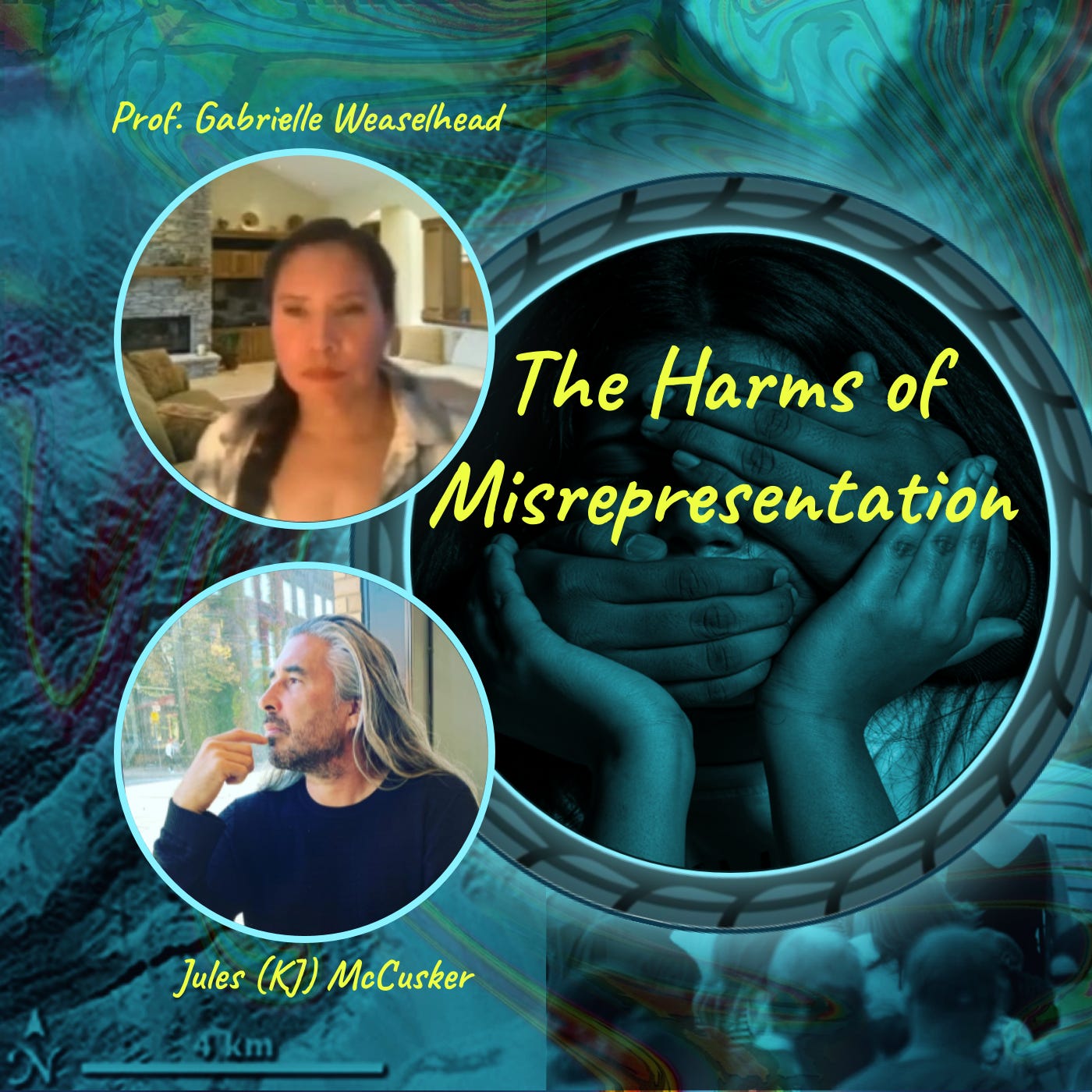
A must watch, this episode of The Gravity Well Podcast delves into the complexities of cultural appropriation and misrepresentation, particularly focusing on Indigenous identities. I acknowledge the podcast’s previous missteps in vetting guests and aim to rectify the situation by inviting Gabrielle Weasel Head and KJ McCusker (Jules) to discuss the impacts of misrepresentation. Gabrielle, from the Kainai Nation, and Jules, half Inuit and half Dene, with a background in Indigenous studies and community work, share their insights on the violence and harm caused by cultural appropriation. They emphasize the importance of ethical relationships and understanding one’s identity. The conversation highlights the need for genuine engagement with Indigenous communities and the dangers of superficial understanding through quick courses or certifications. The episode concludes with a call for deeper, more respectful interactions and a return to land-based knowledge and practices.
Welcome and Introduction to Gabrielle and Jules
Jenny:
Welcome to the Gravity Well Podcast. Here we break down heavy ideas into small buckets that you can handle. Our mission is simple. Help us work through your dilemmas in conversation and process. Together, we and our community will face your dilemmas and make the world a better place for all beings. In the spirit of truth, I acknowledge I’m a settler on Stolen Blackfoot Tree Seven and Metis District Five and Six territories. I take reconciliation by seeking the wisdom of elders and individuals who aim to restore water, air, land, life, and community. A healthy living relationship with the Earth and each other is our guide. Okay, I’m pleased to invite both KJ and Gabriel to the discussion today. I’m going to give a little bit of background for folks before I get into this. So we had a guest on our show. I did make our public announcement in our interview with a guest last week, I’m just going to hit the highlights of it.
We had a guest we dedicated four episodes to and didn’t adequately vet the guest, misrepresented both him and the community that we were intending to represent. I aim to host authentic conversations with members of the community that we’re discussing, and so we apologize for the error that we made and we’ve gone to the effort of taking down the material. We’re doing our best to make that right. And so I’m here with two people who have offered to help us work through what misrepresentation is. We’re going to start with just what is it. Then we’re going to get into what does it do? And then we’re going to talk about how we can move forward together and some ideas that we’ve already worked through. Again, I’m grateful to be for the Blackfoot Confederacy community has allowed us to rectify this and move forward in a way that’s beneficial for all of us. So grateful. If you wouldn’t mind, Gabrielle, you’re first on my screen. Can you please introduce yourself, offer a bit of your background first, and then you’re welcome to get into helping describe misrepresentation and cultural appropriation for us. Thank you.
Meet Gabrielle & Jules and Their Introduction to the Problem of Misrepresentation
Gabrielle:
Oki. Hi there. My name is Tsapinaaki Gabrielle Weasel Head. I am from the Kainai Nation, also known as Blood Tribe, which is part of the Blackfoot Confederacy. I work as an associate professor in indigenous studies with Mount Royal University, and I was born and raised in my community in my nation, the Kainai Nation, I’ve just consistently been off of my nation now for about 14 years. So I’ve been residing in Mo now the city of Calgary for 14 years. And yeah, so I am happy to be invited here to speak about some of the issues and why this, I believe, not just why I believe this is, but the rise of what we would refer to in Canada as “Pretendians” and how I’ve grown up. And you never really heard about these things because I don’t know if anybody ever heard about that or ever listened to that one Barbara Mandrell song about how she was Country When Country Wasn’t Cool.
Jenny:
Yes, I love that song. Yeah.
Gabrielle:
Yeah, I was Indian when Indian wasn’t cool.
Jenny:
Oh, wow. Yeah. That’s fascinating.
Gabrielle:
Now this is, yeah, this is something, I mean, I can speak a little bit more about it, but first I’d like to just pass it over to KJ to introduce himself. I’ll just stop there.
Jules:
Thank you for the introduction. I do appreciate being asked to join you both. My name’s KJ McCusker, I go by Jules, and I was born in Edmonton, and raised in Calgary, I’m pretty familiar with the native scene there because I grew up in it. The career path that I’ve taken was a creative director, and I was studying, actually at Mount Royal College. I was doing Indigenous studies there. That’s when I hit on a lot of the systemic issues with residential schools and family values, which drove me into a brand new pocket of communications work. I worked in Missing and Murdered Indigenous Women and on the Kizhaay Anishinaabe Niin Project, which is used almost nationwide in some ways, but mostly in Ontario, and it’s a reformation program for violent men to try and understand where their violence comes from and help ’em become better humans. “I am a kind man” in its essence, and I’ve been doing that work for, gosh, pretty close to 15 years.
I’ve been pretty entrenched in working with Indigenous communities and territories and stuff. My last big stint was helping develop anti-suicide related work in Fort Severn, which then brought me to understand that cultural values need to be instilled in the school and need to begin in kindergarten, and seeing that our cultural misunderstanding of what we consider to be traditional behaviour as opposed to learned behaviour from residential school, these are clashing within communities and causing a misunderstanding of who we are from an indigenous point of view, from a cultural point of view. Culturally, I was taken from Edmonton Royal Alex, I was left abandoned in the hospital, and then I was registered through foster care and adopted out to a non-native family. My father was not given the opportunity to take me back to his community, and it took me 25 to 30 years to get to where the hell I came from.
That’s been a long journey. I’m from Fort Simpson. I’ve yet to reconnect with my family there, but that’s where I’m from. My grandmother’s from Nunuvut, and my father was half Inuit and half Dene, but they’re, they’re Dene citizens of Fort Simpson. The main thing, that theme that you’re talking about, I wrote an article for the Toronto Star regarding my philosophies on how taking and replacing us with someone who’s not who we are is a form of violence. And I guess the idea was that when you try and misrepresent yourself as a part of our communities, it causes a rift and it creates a ricochet effect, and that ricochet effect is a form of violence. And that’s where my sort of thesis lands there on taking our identities. And I’ve seen this since I was a kid. I mean, you mentioned that you’ve not seen that type of thing, but I remember going to Powwow was even in Chiai Man during Chiai days, and this white dude would show up in a full buck skin regalia and a chief address and painted red, and everyone sort of just treated him like a tourist.
But that action alone is just so ridiculous. At the time, I would watch elders not do much about it and just kind of laugh it off or shrug it off. People would make fun of them. But then that grew. I mean, we saw the Sacheen Littefeather misrepresenting us on an international stage. We saw Buffy Saint Marie misrepresent us for countless years. And this brings us back to what you were just hitting on, where the information that you gather from that person who does not come from our communities, that information is enormously flawed. And it’s that misrepresentation is now reverberating through the chambers of academia, and it’s reverberating through justice, it’s reverberating through governance, it’s…