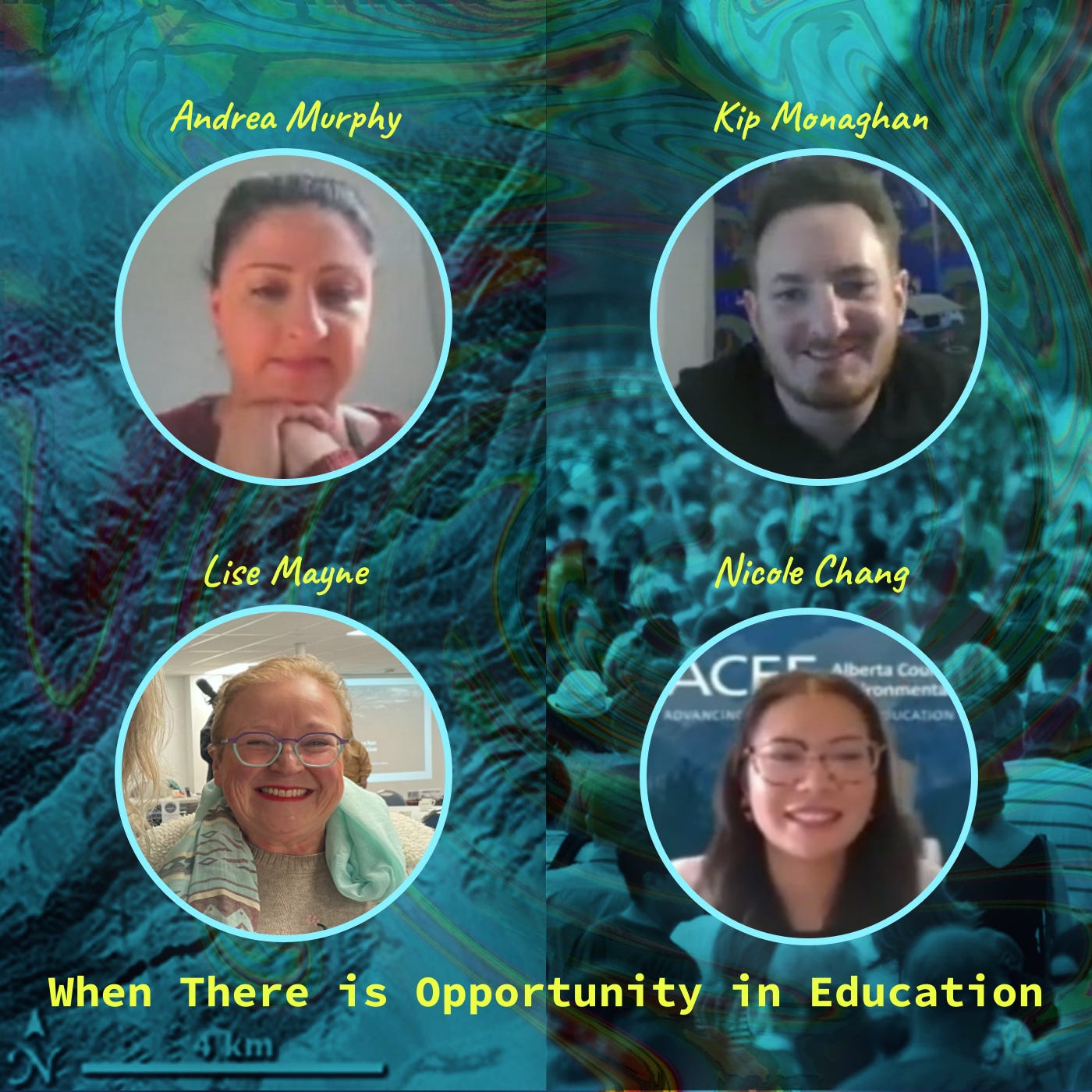
This week, The Gravity Well welcomes members of the Alberta Council for Environmental Education (ACEE). Hosted by Alex, a self-taught jack of all trades, the podcast features guests like Nicole, an environmental education coordinator, and me, a former geophysicist turned environmental advocate. The conversation highlights the importance of environmental education, the role of social work in addressing climate disasters, and the need for a hopeful, solution-focused narrative to combat eco-anxiety among youth. The guests share their personal journeys and professional insights, emphasizing the power of community action, indigenous knowledge, and the need for systemic change to create a sustainable future. The episode concludes with a call to action for individuals to find their unique contributions to environmental stewardship and to foster meaningful connections with nature.
Welcome & Alberta Council for Environmental Education (ACEE) Introduction
Alex:
Welcome to The Gravity Well where you, and we, break down heavy ideas into small buckets, you, and we, can handle your mission. Our mission is simple. Help us work through our dilemmas and your dilemmas through conversation and processes. Together you, we, and your community will face dilemmas and make the world a better place for all. In the spirit of truth, I acknowledge I’m a settler on stolen Blackfoot Treaty Seven Territory and Metis District Five and Six lands. I take Reconciliaction by seeking the wisdom of elders and individuals who aim to restore water, air, land, life, or community, a healthy living relationship with the earth and each other as our guide.
Jenny:
Great. And you’re going to do an introduction of yourself?
Alex:
My name is Alex. I’m a jack of all trades, master of none, autodidact by nature, self-taught. I have an arts background, a background of 21 years in private security, special events, and crowd control as well as construction. I like to be the dumb guy and learn from the experts out there and ask questions when I find them to be poignant. With that, I open it to Nicole.
Nicole:
Hello, my name is Nicole. I am an environmental education and engagement coordinator with the Alberta Council for Environmental Education. I have a background in environmental sciences as well as in formal education, and I’ve had the opportunity to really pull those two fields together in what I’m doing today.
Jenny:
Excellent. I’ll hop in next. I’m just going to give a hat tip to Kip. Kip, thank you for bringing us all together today, and when you get to your introduction, you can expand on what I mean by that. We’re here with a group that is all committed to ACEE — the Alberta Council for Environmental Education. I met all of these wonderful people helping Kip pull this great wealth of knowledge and people committed to environmental work forward. It’s been a really great experience for me. The thing that I really appreciated about it, Kip, is that simple questions really provoke these big thoughts. I’m going to go back to what brought me in and why I want to speak about green jobs.
I have always had a strong sense of justice as a toddler. I think my parents would say, I was talking about fairness a lot. “That’s not fair” was a big thing for me as a toddler. I’ve always been rooted in that social justice. I always felt the need to stand up for the little guy, if you will. And I also was really tied in with the environment, reflecting on it. I went to summer camp. I loved going camping and ended up becoming a camp counsellor. I was part of student council, I was in public school sports and I was in public theatre. So I did a lot of things that were community-based and environment-based, and that sort of just carried through my life. My husband’s also an environmental scientist, so I’ve had that in my corner as well, but I became a geophysicist.
I did that just out of luck. Meaning that I just took it because it seemed interesting, not that I thought it was going to lead to a career, but it brought me to Calgary and brought me into the oil and gas industry for 22 years. My conclusion from that work was that I wanted to help people understand the big challenge that we have ahead of us and be able to have these difficult conversations so that we can solve big problems quickly. How we do it is when we take a lot of differences of opinion and come together to solve things that are quite simple when you break it down to what we need in our basic life.
That’s a lot for me. Thank you very much. Nicole, can I flip back to you just for a second, just to give you a little bit more colour about what you’re doing in environmental work. Thank you.
Nicole:
Absolutely. What brought me into it, I’ll jump into that one as well, is actually growing up in the north in Yellowknife, Northwest Territories, I was very actively outdoors all the time. That sparked my passion for nature in the outdoors. And when I grew older and had to figure out what I wanted to do, that passion was still there and I decided to follow it. Because when we’re spending so much of our time in our careers, it should be something that we genuinely enjoy.
I thought I would try that out and it took me on a few twists and turns. Along the way I really got or gained a passion for environmental education working with organizations like Parks Canada or [Alberta] Environment and Parks. I work with the public a lot and really see either the lack of education available, possibly a lack of understanding because it’s not being delivered in a way that is understandable or easy to understand for the general public.
I think something that I really became passionate about was being able to provide that education. I actually ended up getting a degree in education to be able to firsthand get into schools and help students. We are bound by the curriculum and formal education. I decided to make the jump to ACEE just almost two years ago now and work really more deeply in that environmental education field. Now what I get to do is actually work with teachers who are in those formal classrooms and support them in their journey to incorporate more environmental climate sustainability education into the curriculum. It’s giving them the supports that they don’t generally have and providing resources and professional development and access to knowledge and experts in the field so that they can now disseminate that information to the students and then the students can help or start to make informed and educated decisions as well. Being in the education field, it’s been amazing. It’s been frustrating. It’s been something that I’ve really enjoyed and hope to continue to do. And working with ACEE has really allowed me to do that within the environmental field as well.
Jenny:
Awesome. Kip, do you want to follow up with that? Maybe that’s fluid.
Kip:
Sure. “Hi” everyone. My name is Kip. I am Nicole’s coworker at the Alberta Council for Environmental Education. I’ve been lucky enough this year to take on our new Green Careers program. So that’s actually how we’ve all got connected together, meeting these wonderful speakers here. Everybody, except for Alex is a new person to us here, or has been involved in the program going into schools and talking to high school and junior high students and letting them know what they can do, letting them know what career possibilities are out there and what the future could hold for them and how they can work, being a green professional into whatever they decide to do.
I feel very lucky to be doing this. I think just letting students or the general public have a little bit of clarity as to what is possible, what we could be doing is really important. I feel like when I was in high school there, there wasn’t really anything like this to let me know what was a possibility. It’s been really great. I’ve been really lucky to connect to all the different people that I have so far, and I’m looking forward to hearing more about other people’s jobs and what the future has…