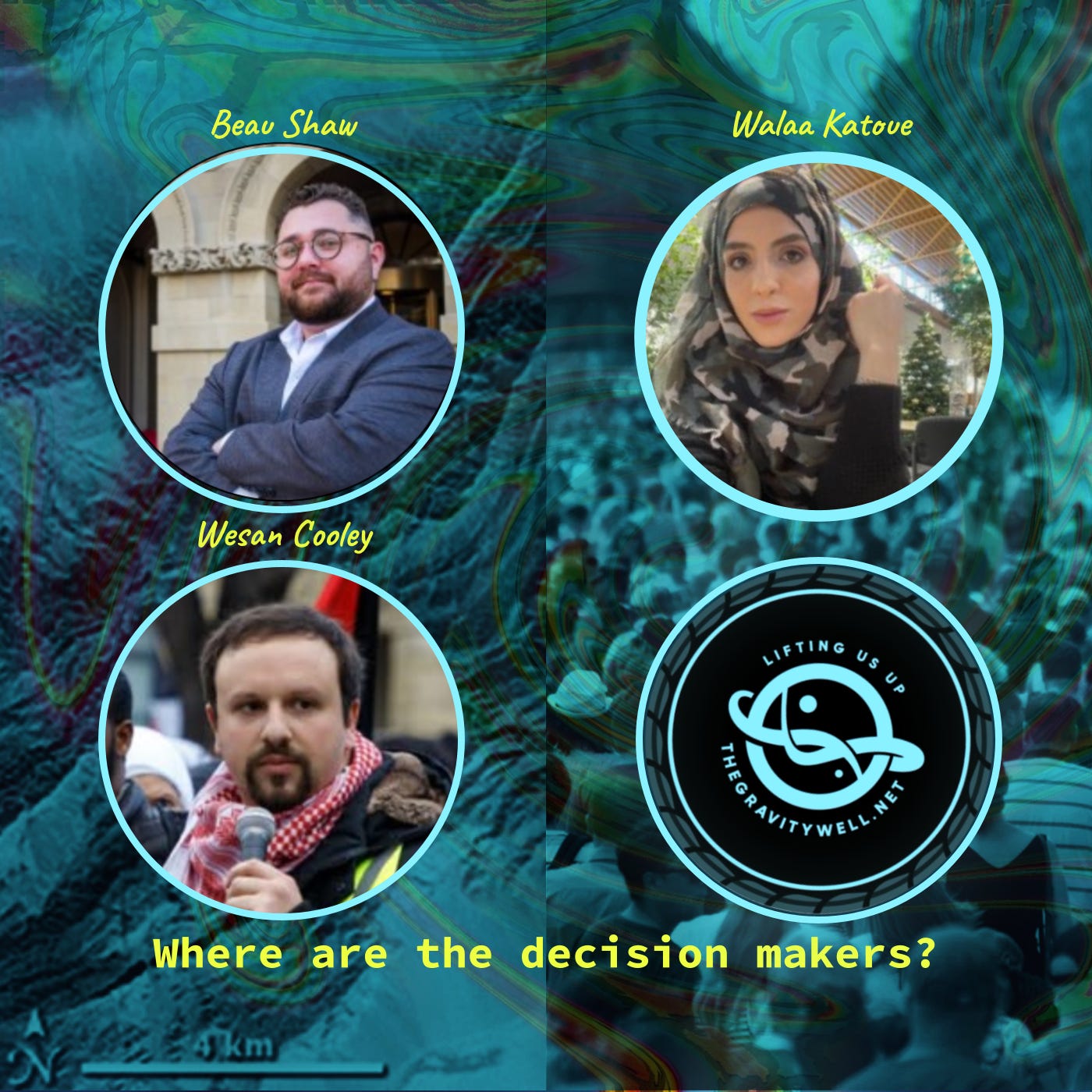
In this episode, I host a conversation with Walaa Katoue of the Watermelon Foundation, Wesam Khalid of Justice for Palestine, and Beau Shaw of Independent Jewish Voices, activists advocating for Palestinian rights. They discuss the ongoing occupation of Palestine, the impact of colonialism, and the importance of global solidarity. The guests highlight the severe conditions in Gaza and the West Bank, drawing parallels to indigenous struggles in Canada. They emphasize the need for an arms embargo and sanctions against Israel, and call for a reevaluation of global structures that perpetuate oppression. The conversation underscores the power of grassroots movements and the critical role of individual actions in driving change. Join us as we explore the complexities of resistance, the importance of truth and reconciliation, and the collective effort needed to create a just world.
Welcome to Wesam, Walaa, and Beau
Jenny:
Welcome to The Gravity Well where you break down heavy ideas into small buckets you can handle. Your mission is simple. Help us work through your dilemmas and conversation and process. Together, you and your community will face your dilemmas and make the world a better place for all. In the spirit of truth, I acknowledge I’m a settler on stolen Blackfoot Treaty seven territory in Metis districts five and six lands. I take ReconciliACTION by seeking the wisdom of elders and individuals who aim to restore water, air, land, life or community. A healthy living relationship with the earth and each other is our guide.
I’m thrilled to have a couple guests here that have been leading the rallies for Palestine in Calgary. Please introduce yourself and your organization and a little bit about your background. Thank you.
Wesam:
Sure, my name is Wesam Cooley. In my activist work I go by the name Wesam Khalid. I am a member of Justice for Palestinians Calgary, which is a group that was formed in 2009 here, a community-based activist group to support the Palestinian call for boycott, divestment, and sanctions against the Israeli Apartheid government, and to support the Palestinian liberation struggle as a whole. I’ve been involved in Palestine activism for about 15 years, since my undergrad days. I know Walaa from way back. Being an activist around Palestine for that long, you witness a lot of horrors, but I have to say these last eight, or nine months have been the most horrifying that we’ve seen, certainly in my lifetime. We’ve been quite active over the recent period especially.
Jenny:
It’s incredible. The amount of energy it must take to do this every week, especially like you said, with how hard the information is to take it is tremendous. I am grateful to you both. Please take the time and introduce yourself, Walaa.
Walaa:
Thanks for having me. My name is Walaa Katoue. Like Wesam said, we go way back to our bright-eyed and bushy tailed university days. We thought the world was our oyster and we could conquer it all. It’s rather strange to be cognizant of how much time has passed since those days and how entrenched this all still is. My background is in psychology and I have been advocating for Palestine for as long as I know.
I’m not Palestinian myself, but my children are. I did it before them, for the Palestinians, and now I do it with that extra little bit of…I want them to know their home, their heritage, and their land.
This year, or the past year, since October, we co-founded the Watermelon Foundation for Justice. It’s a organization in Calgary, but we do have members from coast to coast, and it’s about advocating for Palestine, advocating for the rights of Palestinians here, and abroad, promoting their culture, the language, everything that is Palestine that they’re trying to erase. We want to keep it and make it known. So thanks for having me.
Jenny:
Yeah, incredible. Wow. Thank you so much. I haven’t heard your story before, it is wonderful. Thank you. I’m going to offer a little bit about how I came to you guys just to help frame my background for you and for others. I was in the oil and gas industry and I was a Geophysicist. I worked on the front end of the business and created “a bunch of opportunities” if you will. The way the industry is set up is you hand those off. You have a group of people that are part of development, but asset retirement is separate and you don’t look at it. It’s always been separate.
During Covid, I got offered this opportunity to look at it very closely, and I had already been connected to [liability] because I was at a startup company when oil prices came out and started to think about this mess that we were leaving for the future and how it was becoming bigger in my mind.
Jenny:
I was following it, and got this opportunity and started to realize how many problems we were creating that I wasn’t fully aware of what I was contributing to. I took a course and it asked me to “define the problem”, and I realized that it wasn’t just an industry problem, it included the regulator, and it included the government, and, oh my god, it includes stakeholders. That means this includes everybody. Holy smokes. Then I started to realize that this isn’t just an energy transition, this is a social transition. This is, wow. For me, 2022 is when I came into full understanding. I was chatting with one of my coworkers, it was a person that I had known for quite some time. He went to school with a friend of mine. We were talking about the looming or impending Ukrainian war, and I’m of Ukrainian background and people were saying, “Oh yeah, it’s going to happen.”
And I said, “Yeah, I hope not.” And [his] answer was, “Well, it will help oil prices.” At the time when I heard it, it’s something that we’ve said. I’ll be honest with you, it’s something that I heard a lot in the industry that this conflict is going to help. We are safe, our jobs are safe. And then it sunk in for me because I’m of Ukrainian background. It was one of those moments where I couldn’t just think “whatever”, it was, “What? We can’t be wishing for this.” Then when the war started people started saying, “Why is this is not in Ukraine, but it’s okay in the Middle East? And I thought, “Oh man.” This is how I came to understand. When this war broke out, right away, it was a David and Goliath situation. Same thing as Ukraine.
This is an army that Isreal boasts about having, [against] an innocent group of people that is trying to resist something atrocious. I’m speaking from a place of ignorance. I hope you hear that I am doing my best to understand, and I’m grateful for your rallies. I know Ronnie from Independent Jewish Voices. I met her at a climate rally just leading up to that. When she was saying she was attending this, I felt safe that I knew somebody that also understood this in the same way I did, especially of Jewish background. It really helped me understand that this isn’t a racist thing, as we’re told it is.
I think that’s enough from me. I would like to ask some questions. I’ve offered segment for us where we can talk about these statements that are made and these are in no particular order. Some of the things, I’ll start with the first one. When people say something like, this is a 6,000 year old story…
The Myth of the Palestine-Israel Conflict is Ancient
Wesam:
This isn’t some ancient thing, ancient hatred of peoples or anything like that, I do think it gets painted in that way by people who want to push a certain narrative around what’s happening in Palestine. I’ll tell you the way that Palestinians look at it, and I think for most of us who stand in solidarity with the Palestinian people, this is roughly a 75-year-old conflict. This goes back to basically the settler colonial project that Imperial countries, predominantly Britain, imposed upon Palestine. There’s a lot of history there, that isn’t really this ancient race hatred thing. It’s actually not between Arabs and Jews, at least. I would say there is more of an old race hatred that plays into this story, which is Eu…