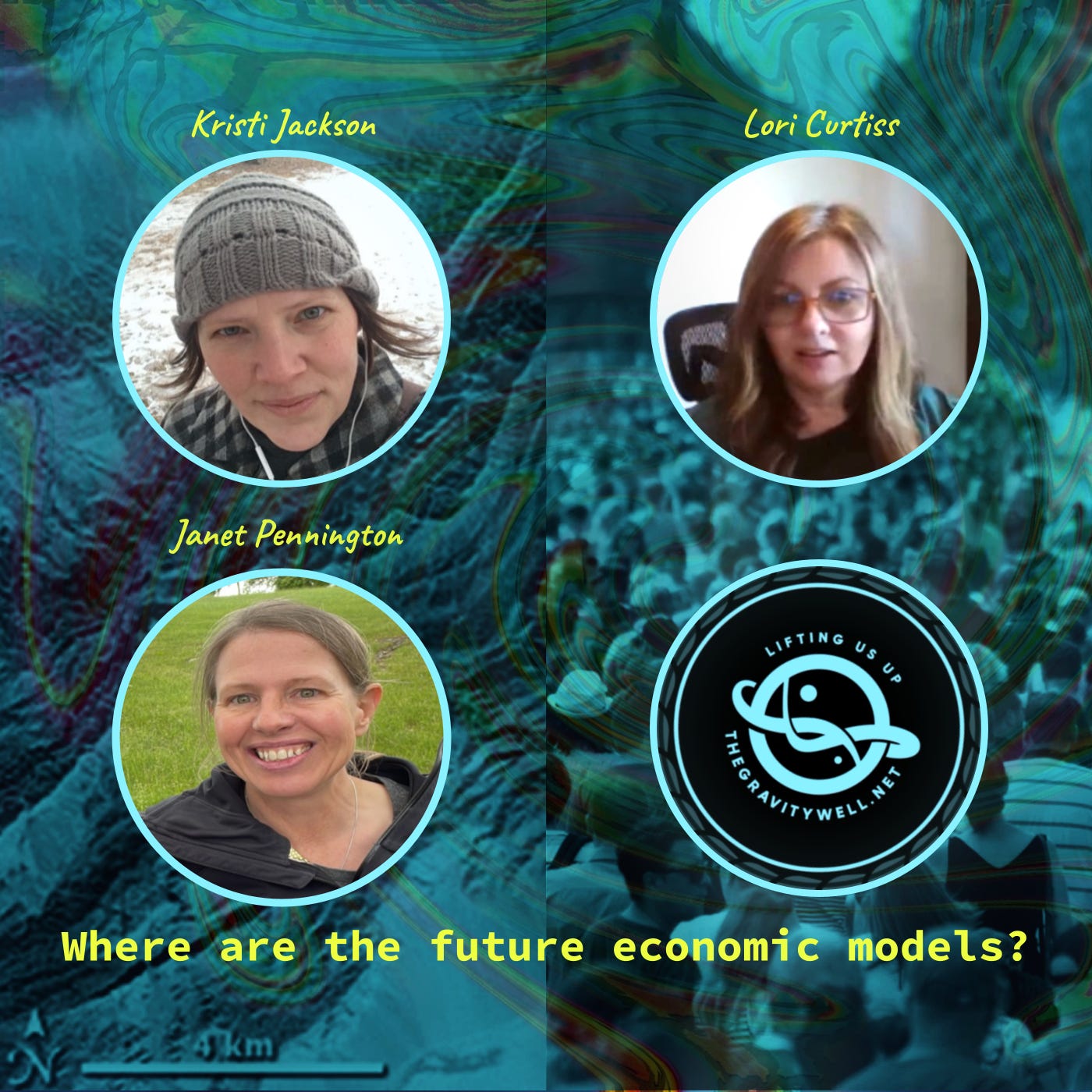
The Gravity Well podcast delves into complex issues, breaking them down into manageable discussions. Hosted by Alex and I, the show aims to foster collaboration and address global dilemmas through conversation. Episode 19 acknowledges the historical and ongoing impacts of colonization, emphasizing the importance of reconciliation and environmental sustainability. The hosts and guests, including financial psychologist Lori Curtiss of @money maker mindset and activists Kristy Jackson and Janet Pennington, discuss the economics of happiness, the detrimental effects of globalization, and the need for local, sustainable practices. They highlight the importance of community, local economies, and the psychological aspects of financial decisions. The episode concludes with actionable steps for supporting local initiatives, advocating for political change, and fostering a sense of belonging and responsibility within communities.
Welcome Lori and Re-Welcome Janet and Kristy
Alex:
Welcome to The Gravity Well, where we break down heavy ideas into small buckets anyone can handle. Our mission is simple to set aside our differences and collaborate with others through conversation and processes. Together we can face our dilemmas and make our world a better place for all.
Jenny:
In the spirit of truth, I acknowledge we are settlers on the stolen Blackfoot Treaty Seven and Metis Districts Five and Six Territories. We take Reconcili-action by seeking the wisdom of elders and individuals who aim to restore water, air, land, life, and community, a healthy living relationship with the earth and each other is our guide. Welcome to the stage, Alex. I think you’re leading us off today. Why don’t you tell us what we’re talking about?
Alex:
Hi, my name’s Alex. A little bit of my background, mostly Arts and construction, a little bit of volunteering in private security, Jack of all trades, master of none, but autodidactic. I just love to continue to learn and that’s my lifelong pursuit, perpetual education as it were. Jenny and I met when she was door-knocking when she was running for office back last May 2023. We had a good conversation. We chose to stay in contact and take some education at DelftX, University of The Netherlands, in analytics, specifically. This is the process that we used to interpret information and ever since we’ve been just working alongside each other trying to figure out a way to apply these analytics to solving problems. The topic-specific is the video that was sent to all of you regarding the Economics of Happiness and environmental sustainability.
Jenny and I look forward to any of your contributions or interpretations of the video in a round table. We would also like people to limit their comments to three minutes so that everyone else has a chance to speak, talking stick method, and then we’ll do wrap-ups and roundups and everything like that. Everyone’s takeaway is not only from the video but the conversations and where people can find you, and who you are if you want them to find you. You don’t have to give that information, but if you’d like to get a little bit of promotion or establish some contacts with any of the listeners, that would be much appreciated. With that, let’s continue and I’ll pass it off to Jenny.
Jenny:
Some of you might know these faces by name. Kristy and Janet joined us in round one of The Gravity Well when we talked about choosing our own crisis. That episode was dedicated to defining what we see as the crisis that we’re facing in the world. Out of that conversation came some great takeaways. One was that we’re in a crisis of relationship not only with each other but with the earth. We put humans above the environment. We don’t think about the things that just come to us through our system, through our economic system. There’s a lack of fairness in what we see in the world. There’s an absence of rule of law that came from Mark Dorin, no trust in the government or information system that was Alex’s contribution to that conversation. Our leaders aren’t taking responsibility.
We don’t feel the problem, or the people who care about the problem, are represented by our leaders. Lastly, this lack of good faith goes hand in hand with trust. Those are the key takeaways of that discussion, and this is a follow-up to that because one of the pieces in that is Kristy brought forward the donut model. It’s similar to what this video offered us in this idea of a vision of the future in terms of the economy. I’m really grateful for that. And then we have a totally different perspective here. My good neighbour introduced me to her sister Lori. Lori, I’ll let you introduce yourself properly, but Lori is a financial psychologist. Lori has a company called A Moneymaker Mindset. Her goal is to take the fear and mystery out of finances and money. Allow yourself to discover and understand your memories and biases to gain insight into the financial choices that you make. Interesting to have your perspective.
I sent Lori the video. Thank you, Kristy. I believe it was you who brought this video forward for us. And then Lori asked to meet, and I watched the video and I thought, “Oh wow, that’s quite the information-sharing session” potentially for you. I appreciate you participating despite that big eye-opening offer that we gave. I can see Lori on my screen next. Lori, if you wouldn’t mind just unmuting and introducing yourself. Thank you.
Lori:
Hi, thanks Jenny. Yeah, I think my comment was it was “a little bit heavy”, but I got through it, and that was good. A little bit about myself. My name is Lori Curtiss. I currently live in Calgary, but I was born, raised, and spent most of my life in the Peace Region of Northern Alberta. I have a bit of a unique and deep understanding of the challenges, but the opportunities of living in the north are. I started this business A Moneymaker Mindset because I want to help people understand why they make the decisions they make with money and how we can cultivate habits to make better choices, to be more confident about our finances. And that’s after 20 years of being a certified financial planner with one of the banks. this was a leap of faith to lose, to leave my job and try this completely new idea. Thanks for having me.
Jenny:
You are welcome. Kristy, you’re next on my screen, please.
Kristy:
Alright, thank you. I’ve just been a long-time activist, I suppose. I was around for Occupy and Idle No More. My Facebook site still mentions the Wet’suwet’en people and all the actions that we had there before COVID-19 happened. I’m interested in the next big movement and I think it could be questioning the economy or I would like it to be because it’s such a basic thing. Our whole society is built around quarterly profits. That’s our only goal. We could have a system with goals around it, like staying within the planetary boundaries and supporting everybody as much as possible. Ensuring everybody has enough to live and we could do that with the resources we have. It’s just a matter of sharing. One thing I will say about this video, it’s 13 years old or so. What excites me is the Donut Economics. Kate Raworth, an economist from the UK, released a book called Donut Economics just before Covid. It’s fresh, a new idea, and I feel like people could rally behind this new model and demand from our leaders that they acknowledge that there are limits that we want to live within. I’ll leave it there. Thanks.
Jenny:
Yeah, fantastic. Thank you so much. It’s a bit disheartening that it’s been 13 years since, but I think there is a lot of knowledge in that we know what the problem is. We’ve answered all the Five Ws and now we’re into the How. I think it’s a great time to bring this video back to the surface and have this discussion. Thank you so much for bringing that forward. Janet, please introduce yourself to us.
Janet:
Thank you very much for the opportunity to gather with the four of you and your broader audience with The Gravity Well. I think thi…