An AI discussion of the article "The Architecture of Plasticity: How Digital Clay is Reshaping the Artificial Mind", by William L. Weaver at https://williamlweaver.substack.com/p/the-architecture-of-plasticity
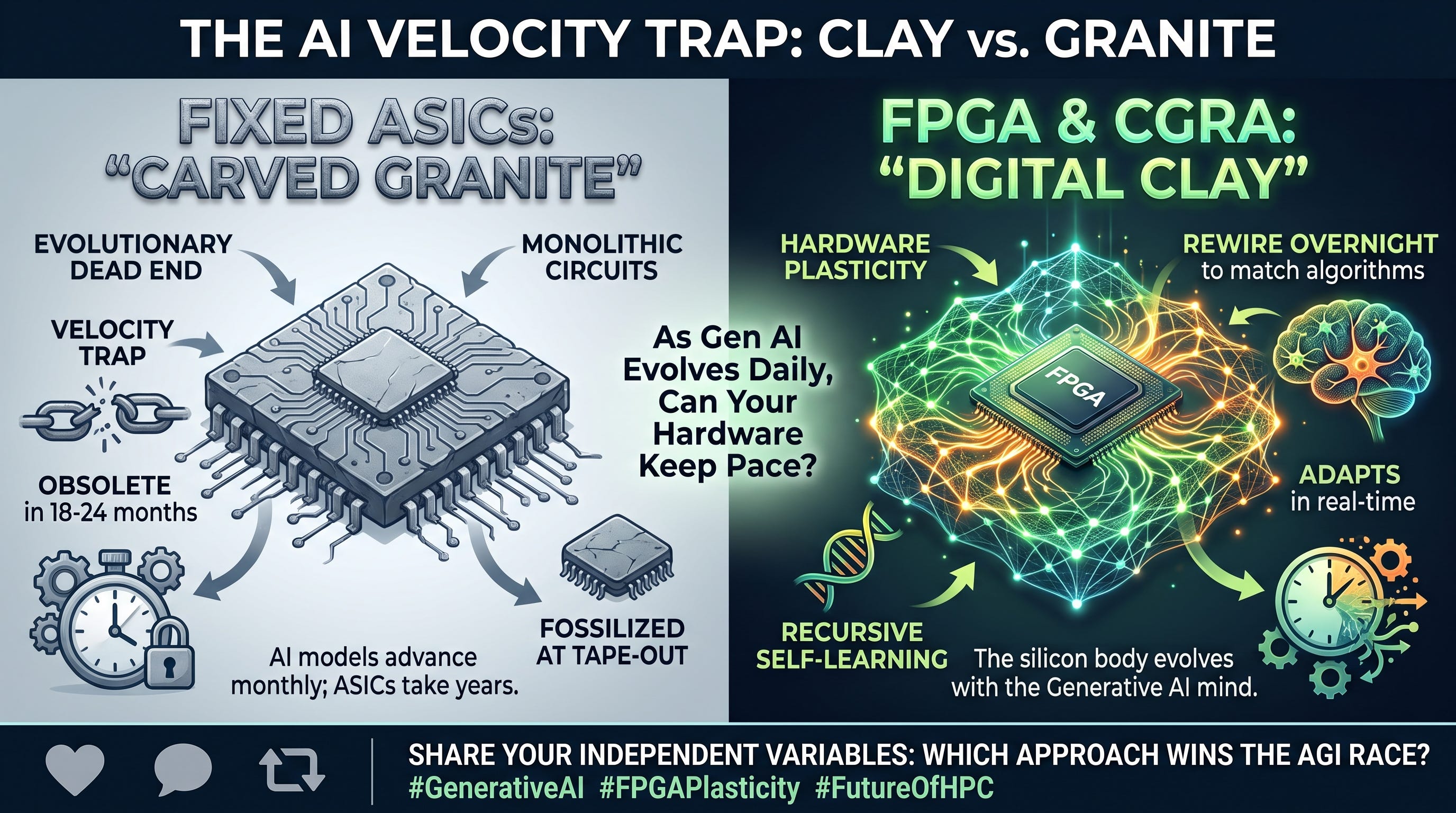
While popular media routinely compares generative AI to the human brain, conventional GPUs and custom ASICs emulate only synaptic plasticity—adjusting numerical weights across rigid, immutable circuits. This creates a severe "velocity trap," as two-year silicon fabrication cycles struggle to keep pace with algorithmic paradigms that mutate in months.
Reconfigurable silicon—spanning Field-Programmable Gate Arrays (FPGAs) and Coarse-Grained Reconfigurable Architectures (CGRAs)—introduces true structural plasticity to hardware. Acting as "digital clay" rather than carved granite, these spatial dataflow engines function like synthetic neocortical columns, physically rewiring their compute and memory topologies on the fly to run emerging mathematical models and drive recursive, self-adapting intelligence.
#GenerativeAI #FPGAPlasticity #FutureOfHPC #ComputerArchitecture #SpatialComputing