Scripture: Luke 3:1-6
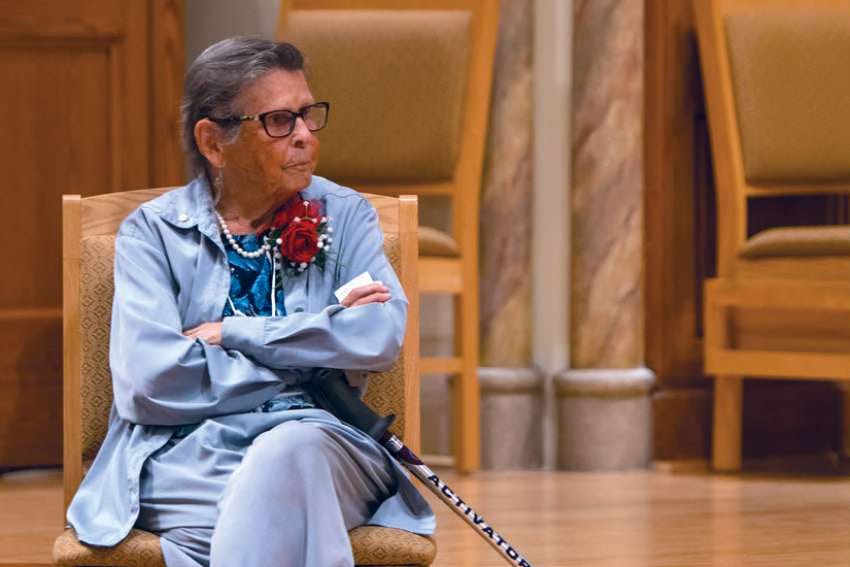
Photo of Lois Wilson by Michael Swan
On October 15 of this year, the church that I serve, Metropolitan United Church, hosted the funeral of The Very Reverend, The Honourable Doctor Lois Wilson. Lois was a Senator, a companion of the Order of Canada, an ecumenical bridge builder, the first female Moderator of the United Church of Canada, and a fierce and fierce-some advocate for the most vulnerable in our world.
She did not mince words or suffer fools, and I consider it a great honour that in the last years of her life, she chose to call our church her spiritual home.
She was deeply faithful, and those of us that knew her, or her writings on the church and society, carry gems of her prairie-fired wisdom with us like the pearl of great price.
I remember a number of years ago, she told me that she didn't really consider worship true Christian worship if the service didn't contain a prayer of confession.
"How am I supposed to worship God," she said,"if I am not first reconciled to my brother?"
She was paraphrasing Jesus's teaching in Matthew 5 when he says
"Therefore, if you are offering your gift at the altar and there remember that your brother or sister has something against you, leave your gift there. First go and be reconciled to them; then come and offer your gift."
Within the symbology of the scripture, the gift is our worship of God. But before we can truly and authentically offer ourselves to God, we must first offer ourselves to our brothers and sisters and siblings - for that which blocks us from each other, blocks us from God.
And this unblocking is the work of confession, which is the fruit of repentance, which is a necessary step towards forgiveness, which is a requirement for reconciliation. Lois was a very wise person, she understood this and that what we do in our churches, can play a role in healing that which is broken amongst us.
And it all sounds very good, doesn't it?
But there's also a pretty significant ask of us…. forgiveness, healing, peace amongst us come with a very real requirement of us. Did you catch it?
Here's that Matthew text again:
"If someone has something against you, first go and be reconciled to them."
"First go," like, actually go and talk to them. Hear their perspective, share yours, honour each other's pain, seek common ground, make and keep commitments, move forward together.
Reconciliation requires no less than pulling down the mountains that have risen up between us, and filling the valleys that have formed amongst us.
The first step in moving towards God is moving towards each other.
It is a hard step to take, really hard, and unfortunately, it is one, I believe, we are increasingly losing the capacity to take.
I read an article this week where the president of an ivy league university in the US was raising the alarm about the effect social media is having on young people and their ability, or rather, lack of ability, to deal with conflict.
As we likely all know, the tech platforms are set up as social eco-chambers. They are designed to connect us with people who essentially think like us - like the same things, dislike the same things - thus re-enforcing a worldview that fundamentally matches our own.
But as Professor Beilock at Dartmouth College says “learning to talk to people who are different from you is a muscle that you build with training.”
But now, she says: "we’re seeing that students aren’t practised at having conversations with people who disagree with them" “Now they communicate online" where "social media puts you towards people who agree with you."
Students used to debate issues in public, now Professor Beilock says "some are even scared to make a phone call."
Some are scared to make even a phone call, never-mind talking face-to-face, because without the technological filters that sort us into the boxes of our own making, many of us these days, of all ages and stages, don't have, or have lost the muscle memory needed to deal with opinions, perspectives, and pain that are not our own, or a worldview that we do not share.
This, combined with our current culture that rewards instant reaction - “like” / “don't like” - and penalizes reflection and nuance, never-mind confession and repentance - is causing in a shift in how we see each other.
It means that the people who think differently from us are no longer JUST PEOPLE like us who happen to think differently, they are JUST DIFFERENT - weird, backwards, leftist, neo-con - everyone else becomes a Nazi in eye of the beholder.
The one who has "something against you" is no longer a brother or sister or sibling, but... an enemy.
-----
When I was away on sabbatical these past months, I very intentionally touched technology less. If I was ever asked for my advice about how we could raise our collective mental health a hundred basis points, I would say we should all be prescribed "less tech and more trees.”
And nature certainly can be a place of healing for us, but also, for people of faith - whether they be Christian or Jewish or Muslim or Buddhist or those practising Indigenous spirituality - we also have the deep wisdom of our traditions to draw upon - our ceremonies, our songs, our ancient stories.
Over the past months of being away I would start each day by reading the Bible as a way to ground each day in the words and experiences of our spiritual ancestors. It is comforting, I believe, to know that even though there are unique particularities of our current context, there really is nothing new under the sun.
Since the beginning of us we have been navigating the cycles of conflict and peacemaking, exile and liberation, death and new life.
When you look at the stories of the Bible, it is essentially the human story played out again and again in different ways. But also, when you look at the Bible in it's entirety, you see that there is an overarching direction to it, a movement within it.
It has a beginning, a middle and an end.
Starting in the Book of Genesis, once we move through the beautiful creation myth of the first seven days, what is the first story of the Bible? It is Adam and Eve in the garden of Eden right?
Our sacred story starts in paradise - a garden filled flowers and fruits, streams and fountains - and the people living in right relationship with each other, and with God.
And then, because it is a human story, there comes the conflict - the lack of faith, the disobedience, the scape-goating, the sin that causes the separation from God and the exile from the Garden.
Now, if our story starts in the garden, how does it end? If you turn to the back of the Christian version of the Bible, it ends with the Book of Revelation, with the prophetic words of John, who sees not a garden, but a city.
“And I saw the holy city" he says "the new Jerusalem, coming down out of heaven from God, prepared as a bride adorned for her husband.
And I heard a loud voice from the throne saying, “See, the home of God is among mortals.
He will dwell with them; they will be his peoples, and God himself will be with them and be their God; he will wipe every tear from their eyes. Death will be no more; mourning and crying and pain will be no more.
And the one who was seated on the throne said, “See, I am making all things new."
At the end of our sacred story is a city. A city where its citizens live in harmony with one another - live in harmony with God - a place where there is no misery, no death, no separation between us and our creator.
But even as we hold hope in this promised future, it’s pretty obvious that we are not there yet.
We are still in the middle, somewhere between the garden and the city. And scripture has a name for that place. Between the garden and the city is the wilderness. The wilderness is the place of exile - and it is the place of preparation.
Consider the story of the Israelites who wandered for a generation after the sins of Mount Sinai. 40 years of testing and preparing and refining until they were ready to walk together into the promised land.
In our human story, the wilderness is not our true home - but it is where we go to work - to work on ourselves - to do the work of being human.
The wilderness is not the beginning or the end, it's the messy middle part where we bump into each other, and have to figure out how to deal with each other along the way.
The wilderness does not care if you are progressive or conservative, if you are on Twitter or Bluesky. We are ALL in the wilderness because NONE of us is perfect. We all make mistakes. And we all long for our true home where our mourning and crying and pain will be no more.
In his book The Wilderness of God, Andrew Louth, says that
"the wilderness is the place where the troubled, the hurting, the alienated, the angry, and the forlorn may hear a word of hope and renewal, and discover the possibility for change and rebirth."
Discover the possibility for change and rebirth. Remember those words “change and rebirth”… you will hear them again in a moment.
----
Each year on this, Second Sunday of Advent, we encounter the well-known story of the wild-one of the Jordan - John and his "baptism of repentance for the forgiveness of sin."
Now, I'm sure you are an expert in biblical Greek, but just in case you need a refresher... the Greek word for “repentance” is “metanoia” - from “meta”, meaning “change,” and “noia”, which is “mind.” So to repent, literally means to change one's mind. Repentance brings a shift in worldview - to turn and see the world from another perspective, which is so often a necessary step towards forgiveness.
And forgiveness in Greek is “aphesis” which is synonymous with our word “release”, as if to be released from a form of captivity or enslavement into a renewed life.
So the voice from the wilderness preaching a baptism of repentance for the forgiveness of sin, is also the one preaching the possibility for change and rebirth.
Repentance and forgiveness are change and rebirth.
This is the work of the wilderness, and even now there are voices crying out from amongst us reminding us that that which is broken amongst us does not need to stay broken - that healing is possible - that reconciliation is achievable - that the city without mourning or crying or pain is just over the next hill.
Can't you see it?
The voice in the wilderness cries out to pull down the mountains that have risen up between us - to fill the valleys that have formed amongst us. The city of God is at the other end of the path that we have allowed to become crooked.
Make it smooth!
Remember that if your brother or sister has something against you... first go and be reconciled to them, for that which blocks us from each other, blocks us from God.
-------
The Very Reverend, The Honourable Doctor Lois Wilson was one of the prophets of our church. For decades, she was that voice from the wilderness calling all people of goodwill towards change and rebirth.
She knew the way to the city that we all seek.
I remember a number of years ago, I was in a session with her where a congregation was looking to set up a group similar to the Peace and Social Justice Committee we have at Metropolitan.
And in that session, she said there is really only one way to ensure peace and to do the work of justice. That way is to build real and reciprocal relationships.
To build real, reciprocal relationships.
To get out of our eco-chambers, and actually go and talk to other people, even if they are different from us, even if they disagree with us. To hear their perspective, share ours, honour each other's pain, seek common ground, make and keep commitments, move forward together.
To see each person as a fellow child of the living God, our brother or sister or sibling, where each one of us has something to teach, and everyone has something to learn.
This is the worldview that we are called into, and Lois understood that when we as Christians live into it, the church can play a role in healing that which is broken amongst us.
-----
Taking a step towards someone who has "something against you" or you against them, is not easy, and there are times when not taking it is the right thing - if things are too raw, for you or them.
But there are other times, where the city we seek is just over the hill, and the only way to get there is to take a first step. And remember, taking that step is an act of worship, for that which blocks us from each other, blocks us from God.
So in this Advent season of preparation, in this wilderness place where the work of being human happens, I wonder if there is a relationship in your life, with a family member, a friend, a work colleague, a fellow church member, where something has come between you, and you might go to them, and offer yourself a gift - to listen, to share, to love, to gently, oh so gently, take a step together.
Take one step together towards that city of God where all things are made new.
I wonder what would happen if we all did that?
Thanks for reading The Pilgrim and the Pulpit! This post is public so feel free to share it.