skip to 14:06 if you only want poetry. the first chunk is me reflecting on the poems. poems are after the bibliography. maybe i should’ve done it the other way around? whatever!hey! more bad poetry for y’all, full-on raw!
a professor gave me some excellent advice: writers write. a dear friend gave me a challenge: write for five minutes at the start of every morning. that way you can say you wrote that day. even if it’s s**t, i’m writing.
the phrase “wrong world” has been swimming in my mind since i spotted it graffitied in a bar bathroom in east atlanta. this truly is the wrong world! i share an epiphany and a lament and a few glimpses of divinely feminine, intensely relational care in this wrong-ass world. i don’t say how we’re gonna usher in the next one, but i don’t have that kind of wisdom anyway.
This project was completed the day after bell hooks’ death. Along with millions of others of her students, I grieve her passing. The preface to her book all about love (2000) opens with a meditation on love, how we only come to know its importance in its absence. When hooks passes through her own lovelessness, she writes, “I awakened from my trance state and was stunned to find the world I was living in, the world of the present, was no longer a world open to love. And I noticed that all around me I heard testimony that lovelessness had become the order of the day.”[1] My project gestures at the lovelessness awaiting us when we wake up from our own heart-breakings. It takes courage to love fiercely in a world shaded in the blues. I see care at the root of lament and prophesy: the speaker cares enough about a given issue or event to transform caring disposition into caring action. Poems to Enheduanna, Inanna, and Ereškigal are attempts at professing a fierce love while confronting the psychological and ecological landscapes that make it difficult to do so. They are my depressive devotionals to feminine divine phantasmagoria.
I am fascinated by the apparent consensus among ANE scholars, Goddess worshippers, and secular feminists who agree that hymns, devotionals, and stories about Inanna carry tremendous implications for psychospiritual care.[2] To be clear, I draw largely from Inanna: Lady of Largest Heart, the English translation of Enheduanna’s poetry by Betty De Shong Meador, a Jungian psychoanalyst who opens her book with a report of her dream of a cuneiform symbol –– one of Inanna.[3] The story of Inanna’s descent also provided Gwenaël Salha balm during a tumultuous period in her marriage (2010). She imposes a literary archetype onto Inanna, deeming her a heroine among the “ecopsychological pantheon.”[4] I find archetypal demarcations troubling because the label ‘hero’s journey’ is a type of narrative structure that has been universalized in the Western literary cannon; labeling Inanna’s descent a hero’s journey strips it of its original context and compares Inanna against a masculinized definition of heroism. Even in Lady of Largest Heart, the chapter on Enheduanna as high priestess first attends to Sargon of Akkad. Enheduanna, the translator suggests, was appointed by Sargon to “help solidify his control over the restless and rebellious populations of southern Sumerian states.”[5] This is to say that applied psychospiritual analysis of goddess stories and their authors necessarily brush up against male power. As a literary scholar trained in sociohistorical criticism, I enter these translations curious about the “socio-economic power and self-esteem between her father [Sargon] and herself [Enheduanna].”[6]
Yet I use this opportunity to construct a poetic world bounded by femininity more so than tethered to patriarchy.
Taken together, these poems express the feminine dread of both epiphany and lament. This tonal approach to this collection is my take on the divine phantasmagoria presented by Enheduanna, priest and wife of Nanna, the Sumerian moon god, and devotee of Inanna. I trouble the construction of public-private, despite it being a dichotomy lifted by J. G. Westenholz[7], precisely because Western gender roles do not make clear sense of cultic functions for Inanna’s devotees.[8]Dread in the form of epiphany and lament are neither entirely public nor private. The speaker in “Hymn to Inanna: Flat Phantasmagoria” longs for visitors, animal and human. In “Elegy for Ereškigal,” the desolate speaker sabotages themselves, taking up spectral arms against potential company. And to address the spiritual dimension of companionship, Enheduanna and the speaker find solace in their mutual longing and belonging for a daughterhood that makes space for the blues. None of these speakers are fully alone, nor do they want to be.
My critique of the public-private dichotomy also comes from the queer desire I hear in Enheduanna’s love for Inanna: “O my Lady/ my Queen/ I unfold your splendor in all lands/ I extol your glory/ I will praise your course/ your sweeping grandeur/ forever.”[9] All the while shouting a far-reaching love of her heavenly queen, Enheduanna continued to serve her spouse dutifully from the gipāru.[10] Her living quarters and the storehouse, the gipāru kept the year’s harvest and was adorned with reed symbols for Inanna.[11] Inanna and Enheduanna’s centrality to the economic life of worshippers at Ur distorts gendered dichotomies of space and the worship within it. It also imagines that the two lived together, intimately connected, as if lovers entwined in their own kind of sacred marriage, at least a domestic partnership of some kind.
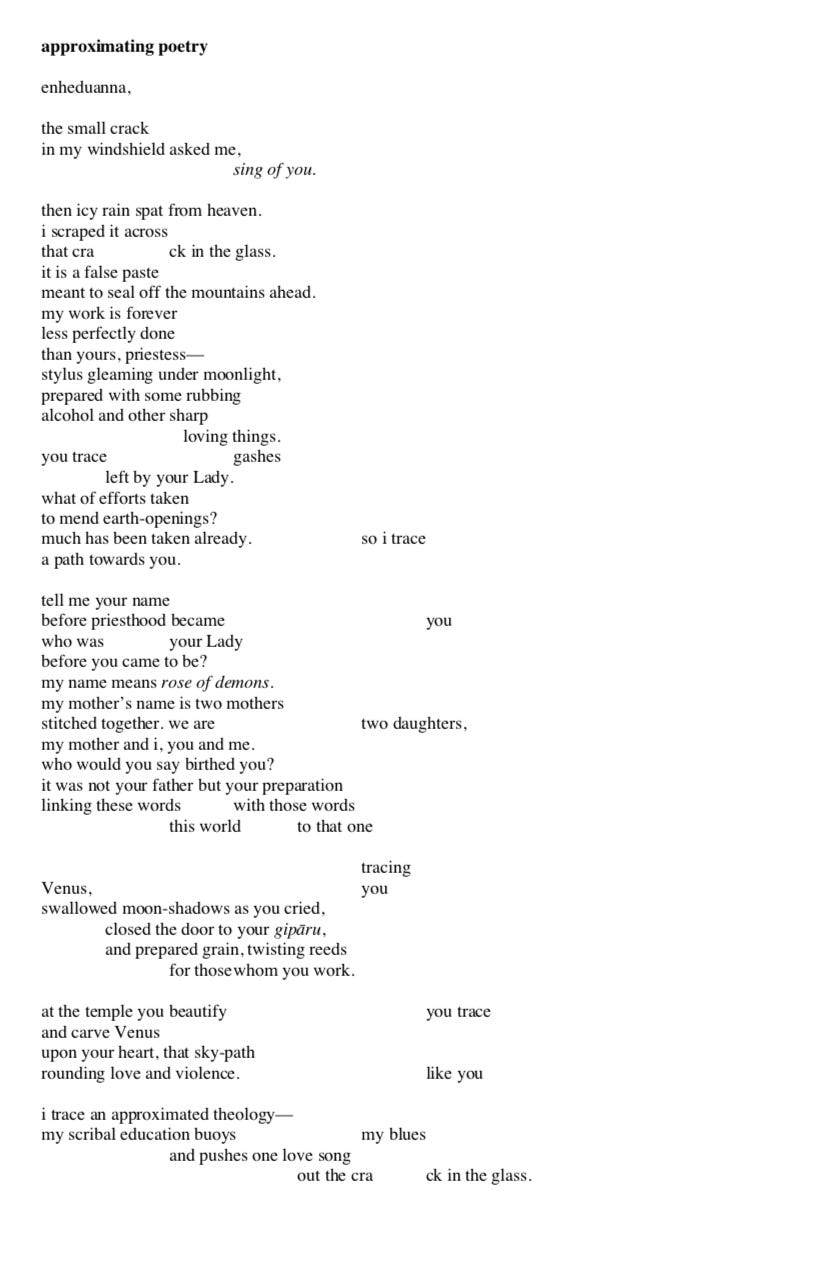
What makes dread feminine is its care. Although I do not believe that care is an exclusively feminine practice, care locates dread –– and love, and healing –– at the level of the interpersonal relationship. Notice how the speaker in “approximating poetry” assesses a situation, the crack in their windshield, and hears a request, “sing of you.” As the whirligig imagery within the “Hymn” stops spinning, the speaker prays for an inversion of Enheduanna’s lament after she is deposed from her position.[12] The “elegy” wonders what loving relationship is possible between person and earth in a world without much care. It is my hope that these poems insist in the dreadfulness of care. It is difficult to wash dishes, to name a self, to even recall a personal history when you need care. Many church communities refuse to acknowledge the types of psychic hurt in the pews –– a different type of dread emerges. Asking to receive care becomes even harder for femmes and feminine people, whose care becomes commodified and taken from them. When femmes care for femmes, however, care grows even more brilliant and dreadful to me: “The more I read about you,/ the more I sink into blue” (“Hymn to Inanna”). Despite the closeness of shared experiences, femmes and feminine caregivers experience moral injury, a devaluation of care labor, that is thrown right back in the face.
My poems enflesh three orientations towards psychospiritual caregiving. Taken together, these orientations anticipate the dreadfulness of care for femme care recipients and caregivers. Discussing lineages of gendered work, the first poem critiques pastoral theology that centers filiality. The characterization of Enheduanna suffers under the moon-shadows from her role as priest to Nanna. It also asks about the tools we have, whether we have honed them by choice, inheritance, or another circumstance, to survive breaks in human and divine filiality. Borrowing words from Westenholz, the speaker observes a connection to Enheduanna through their shared “scribal education”[13] –– that is, the power of language to lament and exalt love. Speaking to an indifferent, perhaps unavailable, Inanna, the speaker of the second poem recounts a manic episode in which she mistakenly realizes her ability to care for herself. She pleads to Inanna for company in her current depressive state using paired obverse-inverse[14] structures like those in De Shong Meador’s translation. Settling into the flattened, depressive state, the speaker glimpses a stripped Inanna in the netherworld to find a moment of shared humanity, even from her “soiled bed.” Care within this poem exists between self and other, blue and red, manic and depressive. It is a tension within the self and beyond the self.
The third poem, an elegy, relocates the care relationship to a meso-ecological level. Set outside a grocery store, the speaker refuses the reader “basic… psychological comfort”[15] that many hyper-individualistic feminists, be they Goddess devotees or care theorists, prioritize. The “hollow wind” of unmet care desires and needs fill up bellies, oxidizing the spilt blood from miscarriages. The tone originates in Ereškigal’s demands of the male gods to abide by the orders of the netherworld.[16] By setting this destruction and rage at a grocery store, I attempt to see Ereškigal’s cries as cries for everyday attention and care from the gods. My use of the collective first-person is not only between the speaker and Ereškigal but also the gatekeepers, seemingly her companions, and Ereškigal. Because she is recognized as (an odd) queen within[17] and outside of her family, spectral threats flow from Ereškigal, stewardess of lost creation, and her painful birth. Consequences of this lack of care can be seen in Foster’s translation of “Nergal and Ereškigal”: “I shall raise up the [dead to devour] the living,/ I shall make the dead [outnum]ber the living.”[18] If we turn our back on any kin, we will face much more death than we will life. We are responsible, too, for caring for our caregivers; Ereškigal maintains balance and cosmological order for the gods to enjoy their feast, yet no one cares to support Ereškigal’s maintenance of her realm.
There is much, much more to consider on images of care across these core texts and my companion poems. For now, I trust these devotionals contain a sufficient grasp of the interplay between care and violence that we see in prayers to Inanna, the fleshy warrior deity who crushes whole cities with her love. She wars and loves by fate[19]; yet, as hooks reminds us, an ethics of care practice cannot be left to mere chance. The first and third poems illustrate the roles of purposeful language and action in a divinely feminine care ethic. We may find that we need to lament our bonds to deities that do not love us back. We may also discover that through care-full relation with the feminine divine, we ecstatically scribe new names for ourselves through chance cracks in the glass. Brought to a psychospiritual context, these poems argue that poetic divination inches us closer to the maddening hurt of being alive –– while also singing the beautiful difficulty of syncretic care for self, spirit, and sister.
Bibliography
Assante, Julia. “Bad Girls and Kinky Boys? The Modern Prostituting of Ishtar, Her Clergy and Her Cults.” In Tempelprostitution im Altertum: Fakten und Fiktionen, edited by Tanja S. Scheer and Martin Lindner, 23–54. Verlag Antike, 2009.
Brands Gagne, Laurie. The Uses of Darkness: Women’s Underworld Journeys, Ancient and Modern. South Bend, IN:University of Notre Dame Press, 2000.
Enheduanna. Inanna: Lady of Largest Heart. Poems of the Sumerian High Priestess. Translated by Betty De Shong Meador. Austin, TX: University of Texas Press, 2000.
Foster, Benjamin R. Before the Muses: An Anthology of Akkadian Literature. CDL Press, 2005.
Gadotti, Alhena. “Never Truly Hers: Ereškigal’s Dowry and the Rulership of the Netherworld.” Journal of Ancient Near Eastern Religions 20, no. 1 (2020): 1–16. DOI: 10.1163/15692124-12341309
Gross, Rita M. “Is the (Hindu) Goddess a Feminist?” In A Garland of Feminist Reflection: Forty Years of Religious Exploration, 189–97.Berkeley: University of California Press, 2019.
Harris, Rivkah. “Inanna-Ishtar as Paradox and a Coincidence of Opposites.” History of Religions 30, no. 3 (1991): 261–78. DOI: 10.1086/463228
Heyward, Carter. Staying Power: Reflections on Gender, Justice, and Compassion. Cleveland, OH: Pilgrim Press, 1995.
hooks, bell. All about love. New York: Harper Collins Publishers, 2000.
Katz, Dina. The Image of the Nether World in the Sumerian Sources. Bethesda, MD: CDL Press, 2003.
Salha, Gwenaël. “The Heroine in the Underworld: An Ecopsychological Perspective on the Myth of Inanna.” Ecopsychology 2, no. 3 (September 2010): 165–9. DOI: 10.1089/eco.2010.0023
Westenholz, Joan Goodnick. “Enheduanna, En-Priestess, Hen of Nanna, Spouse of Nanna.” In Dumu-E2–Dub-Ba-A: Studies in Honor of Åke W. Sjöberg, edited by Hermann Behrens, Darlene Loding, and Martha T. Roth, 539–556. Philadelphia: Occasional Publication of the Samuel Noah Kramer Fund, 1989.
Wolkstein, Diane, and Samuel Noah Kramer. Inanna, Queen of Heaven and Earth: Her Stories and Hymns from Sumer. New York: Harper & Row Publishers, 1983.
[1] bell hooks, All about love (New York: Harper Collins Publishers, 2000), x.
[2] Laurie Brands Gagne. The Uses of Darkness: Women’s Underworld Journeys, Ancient and Modern (South Bend, IN: University of Notre Dame Press, 2000).
[3] Enheduanna, Inanna: Lady of Largest Heart. Poems of the Sumerian High Priestess, trans. by Betty De Shong Meador (Austin, TX: University of Texas Press, 2000), 3.
[4] Gwenaël Salha, “The Heroine in the Underworld: An Ecopsychological Perspective on the Myth of Inanna,” Ecopsychology 2, no. 3 (September 2010), 168.
[5] Enheduanna, Inanna, 49.
[6] Carter Heyward, Staying Power: Reflections on Gender, Justice, and Compassion (Cleveland, OH: Pilgrim Press, 1995), 91.
[7] Joan Goodnick Westenholz, “Enheduanna, En-Priestess, Hen of Nanna, Spouse of Nanna,” in Dumu-E2–Dub-Ba-A: Studies in Honor of Åke W. Sjöberg, ed. by Hermann Behrens, Darlene Loding, and Martha T. Roth (Philadelphia: Occasional Publication of the Samuel Noah Kramer Fund, 1989), 539–556.
[8] Julia Assante, “Bad Girls and Kinky Boys? The Modern Prostituting of Ishtar, Her Clergy and Her Cults,” in Tempelprostitution im Altertum: Fakten und Fiktionen, ed. Tanja S. Scheer and Martin Lindner (Verlag Antike, 2009), 23–54.
[9] Enheduanna, Inanna, 134–5.
[10] Westenholz, “Enheduanna.”
[11] Ibid.
[12] Enheduanna, Inanna, 178.
[13] Westernholz, “Enheduanna,” 549.
[14] Rivkah Harris, “Inanna-Ishtar as Paradox and a Coincidence of Opposites” History of Religions 30, no. 3 (1991): 261–78.
[15] Rita M. Gross, “Is the (Hindu) Goddess a Feminist?” in A Garland of Feminist Reflection: Forty Years of Religious Exploration (Berkeley: University of California Press, 2019), 192.
[16] Alhena Gadotti, “Never Truly Hers: Ereškigal’s Dowry and the Rulership of the Netherworld,” Journal of Ancient Near Eastern Religions 20, no. 1 (2020): 1–16.
[17] The sisters are interpreted as rivals, according to Dina Katz (CDL Press, 2003). Inanna usurps Ereškigal’s throne after being stripped of her clothes and her me.
[18] Benjamin R. Foster, Before the Muses: An Anthology of Akkadian Literature (CDL Press, 2005), 521.
[19] Assante, “Bad Girls and Kinky Boys?”