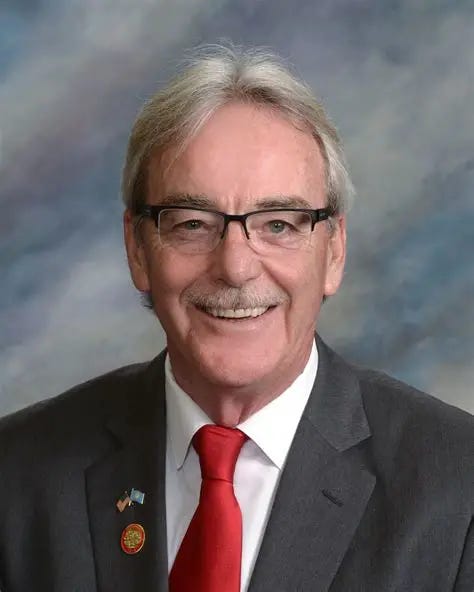
Representative Jack Kolbeck of South Dakota House District 13, a member of the Appropriations Committee, joins Dave Roetman to discuss campaigning, the state budget, the prison and possible legislation. Kolbeck recalls entering politics as a senator in 2016, serving eight years in the Senate, and returning to the Legislature when Governor Larry Rhoden picked Tony Venhuizen as lieutenant governor, opening a House seat. He says the state did not meet revenue projections for the fiscal year ending June 30 as sales taxes came in lower, and describes the appropriators’ summer work. On the prison, he outlines the $650 million, 1,500-bed plan in northeast Sioux Falls ahead of a September 23 special session. He also discusses adding money to the aeronautics fund, extending the nicotine tax to vaping products to support a victims fund, and differences between the House and Senate.
Topics: Appropriations Committee, state budget, sales tax revenue, prison construction, special session, women’s prison, aeronautics fund, vaping tax, homeschool scholarships, campaigning, House and Senate culture
Jack Kolbeck is a former Senator, current Representative and member of the Appropriations committee.
“In order for you to be a good legislator in the state of South Dakota, you gotta be connected to your constituents.” - Jack Kolbeck
Jack Kolbeck for District 13 (Facebook campaign site)
Contact Jack Kolbeck (link)
Jack Kolbeck named to District 13 House seat (link)
Full transcript
About this transcript: It was machine-transcribed in-house and then edited for readability. Filler words and false starts are removed, and the meaning is unchanged. Timestamps are approximate.
[00:00]
Dave Roetman: This is the Making Waves Podcast. My name is Dave Roetman. We’re here with Jack Kolbeck, Representative from District 13. Welcome, Jack.
Jack Kolbeck: Well, good morning, Dave. It’s been a while since you and I have gotten together. If you don’t mind me just going back a little bit in history here, I’ll just tell you that on January the 16th, I got a phone call in 2016 to be the senator in the District 13 in Sioux Falls and you know that wasn’t really on my bucket list but I went to my wife and my wife says well that is something that God wants you to do because you weren’t able to get into the service because I had flunked a physical And they kind of booted me out and I always wanted to kind of do something like that to serve the people because my dad did it, my grandfather, my uncles, I’ve been in the military.
I decided to do it and I should say we decided to do it and I won and I became a Senator in District 13 and Dave, you were one of the first people to reach out to me because I knew nothing about campaigning. And you and I met up at the old bakery way up in North Main Avenue and co-working space huh that was a co-working space yeah co-working space yeah I wasn’t you know we there’s other people in there in any way I mean you showed me some things that I needed to do.
I mean, you even helped me campaign back then. I mean, you knocked on doors for me. Door-to-door. Yep, door-to-door was a big thing and I still believe in door-to-door. I love meeting people and I think that’s a good way that any candidate can meet their constituents and actually find out what’s going on within their district. But anyway, that’s our history, Dave, and you know, in this room we’re meeting in today right here at this a little coffee shop on South Minnesota Avenue I think Wednesdays.
Wednesday mornings, had coffee for a number of years and I really met some great people. So that’s kind of the history of how I got to the Senate, okay.
Dave Roetman: So yeah, I remember that. You’re one of the best candidates because you had a lot of experience in marketing. And also, you had been a softball coach for 30 years. When I’m going down the streets, I recall, everybody knew who you were. I’d go down one side of the street, you’d go to the other side of the street, and I said, that’s Jack. I went, oh yeah, Jack.
And then everybody knew you by name. I was like, wow. He’s a really good campaigner. That was pretty awesome. Well...
Jack Kolbeck: The marketing thing, yes, because your eyes are always moving in marketing when you’re out in the trade like me and as you guys know everybody loves the beer guy and of course I was the beer guy. And everybody likes the beer guy one way or another, but my eyeballs would always keep moving. And as you said one time to me, I believe, you said, how did you get that sign location? That is absolutely great.
And I said, well, I drove by there a lot, and I just kept saying, there’s a lot of people turning this corner. And I said, that’s the sign location I would go after. It’s just like me putting up marketing signs for my business. I would always look for the best location within my establishments where I was selling or whatever it might be. That kind of marketing. And then the softball thing, yes, I’ve been the softball since 1975 here in Sioux Falls and a lot of people know me by that.
I formed a 50 and over softball league 12 years ago, where we had men and women over the age of 50. We play every Thursday night. In fact, we play tonight. And we have over 200 players, 14 teams, and we’re all getting ready to go to the state senior game tournament which will be held in Huron this year. So a lot of people know me by that and it’s been just a lot of great memories going back over the years.
From... Not only the political side of things but this great city of Sioux Falls.
Dave Roetman: It really does show how important it is to be involved, be part of some community group or be engaged with your community at large that makes for a better campaign skill set. For camp people who want to run for office. So that’s something to keep in mind if anybody’s interested in running. Be involved in your community, join some community organization, do some sport and that way you get to know people and you build up your connections to the community.
Jack Kolbeck: Correct, you know the first day of my job in 1975 my boss And I did, I joined the Lions Club and I’ve been a member of the Downtown Lions Club ever since. And we get involved with the Lions Club, Pancake Days and McCrossan Boys Ranch, all kinds of things. And yeah, just like with the club you belong to. And I met hundreds of people, great people, through that kind of involvement.
And so you’re 100% correct. And I’m not afraid to talk and you will know. You’re probably talking too much now. And I like coffee and I’m drinking a cup of coffee as we’re doing this. But I just think that You know, anybody that’s thinking about politics, there’s a couple things that I’ve always believed in. One is... Get to know the person you’re talking to. Be honest with that person.
[05:00]
Follow through with what you have told them. If they email you or call you or something like that, if you don’t agree with them, if you don’t agree with what their side is, but in order for you to be a good legislator in the state of South Dakota is you gotta be connected to your constituents. No matter, like I said, whether you believe in their philosophy or they don’t believe in your philosophy or if there’s issues with a bill or issues with anything going on, I get calls on things that happen within the city.
Mopeds are going up and down the street a hundred miles an hour. I mean I get phone calls on that type of thing You know and talk through it, you know So yeah, I mean if anybody Dave you get people that may want to run for an office somewhere Have them give me a call and I can give them a few pointers. I’m not saying I’m perfect by any means But it’s a lot of work, and I enjoyed it.
I mean, really, the door-to-door was absolutely, to me, my first year, for example, my wife, I always say I’ll be home at dark because nobody wants their door knocked on after dark, right? You were there with me. Is that right? Well, I’m telling you what, the Sunday night before the election on Tuesday, the general election, on that Tuesday in 2016. I had so much fun walking and knocking on doors people had made up their minds pretty much who they were going to vote for from the presidential election all the way down and so they were relaxed they talked and we didn’t talk politics a lot of times it was you know how you doing and you know yeah hey you see my new boat whatever it might be right i got home at 8 30 that night and so if you can imagine in november how dark it is at 8 30 yeah and i even my last knock on the door i the guy said you got a sign with him i said yeah i got one in my car put it up so i mean it was it’s things like that that you can You never want to forget.
I mean those are those were great times But you know sometimes door-knocking can be a little bit treacherous. You might be in a neighborhood that Sorry, but you talk to them and I never When we were walking on doors and you know as well as I do we didn’t walk on just one party doors We walked and knocked on everybody’s door. Yeah, it was quite an experience.
Dave Roetman: Moving on more to policy and what’s happening in the Legislature. Now you were on the Appropriations Committee, correct?
Jack Kolbeck: That is correct. I’ll be going on my eighth year this coming January. As people may not know, but it was turned down the Senate. Put in my eight years, had decided, my wife and I, maybe it was time to get out of it. Well, being in District 13 and the governor was picked to go to Washington, D.C., which put Governor Larry Rhoden now in his position and he picked Tony Venhuizen from my district to be his lieutenant governor that opened that house seat up and It was quite a story behind all that but anyway My wife and I, we’d talked a little bit about it if Tony got picked, but we really hadn’t made any decisions.
Well anyway, the day that Tony was picked, it happened at 10 o’clock in the morning and it was on TV. My wife looked at me and she says, you’re going to apply for that little spot, aren’t you? And I said, well, honey, we really haven’t talked about it. And she says, well, you darn well better. OK. OK. So. I mean, she says, What do you need for paperwork to get it done?
We got it done. I get a call from the governor. The governor calls me and says, When can you be out here? I said, Are you going to be out there in four hours? He said, no, no. Not quite that quick. I said, I’ll be out there tomorrow. And I was. I went out there on February the 6th and got sworn in by Speaker Hanson. Got put back on appropriations, and went right to work on that.
Dave Roetman: They could use your experience.
Jack Kolbeck: Well, thank you for doing that. Well, experience means a lot, even in your own personal business. Experience, you can’t give experience away. It is something that stays with you. And yeah, I was glad I went back. It was good.
Dave Roetman: Being on appropriations there’s a lot to do with the budget going on could you fill us in what’s going on with the budget and yeah i know you’re having discussions now right we are discussing the budget of course.
Jack Kolbeck: People should know that on June 30th, that’s our end of the year. We did not end up as good as what we would like to have ended up at the end of June 30th. We did not quite meet our projections. Sales taxes were down. Yeah, sales taxes numbers were down. Other items were down. During the COVID construction taxes were way up because there was a lot of all of a sudden you know our town boomed and a lot of towns boomed shortly after that and so construction taxes were down a little bit so our budget was down a little bit so going into next year’s session we’re not going to have quite as much money you know we were dealing a lot of times with a couple hundred million dollars of One-time money to spend and we’re not going to have that this year.
[10:00]
We’ll probably be somewhere in the vicinity I believe the number 67 million dollars is probably where we’re at And so June 30th, that’s kind of where we’re at, where we ended up at. And then this last month has been a good month, the first month of our new fiscal year, June 30th through the end of July. Our sales tax are above projections, construction taxes above projections. So things are looking pretty good, even with the way that the economy, I feel, is going where people are not really spending any more money than what they really need to spend, but I think our tourism has been doing.
Quite well again you know and of course we’re just coming off of the 85th Sturgis rally 85th annual and that was huge out there yeah and that that revenue will start showing up in August so it’s going to be a lot tougher year there’s going to be there’s going to be no’s you know, in appropriations, where there’s going to be asks for money and there’s going to be no’s. And I mean, that’s my constitution.
We have to have a balanced budget. So as appropriators, we work hard on it. I mean, we try to, do the best we can for the people in the state. And sometimes there’s tough decisions to make, but you got to make them.
Dave Roetman: Are there any summer work groups going on with the budget?
Jack Kolbeck: Yes, our appropriators we meet about three times during the course of the summer, of course, then we look at letters of intent, which are letters - letters of intent are our letters that we put together as appropriators and ask a department to bring back information on how they spent the money or where they spent the money. And we do that every year and those are - they’re all online, everybody can look at them.
One work group that we put together the last time we met was our work group on what they call zero-based budgeting. And that met this morning, in fact I just got off the Zoom call here at about 12:30 before I came over here. And the members of the work group, what they want is a little bit more accountability from the departments of BFM, which is the Bureau of Finance and Management.
Okay, because when we get a budget, and when you hear the governor’s budget in December, he’ll talk about $20 million dollars for the Department of Education. Okay, well that $20 million comes down as a $20 million dollar deal. Okay, so then we work through it and what departments. As appropriators is we want a little bit more of accountability as to how that money is spent so if they get a certain amount of money and they spent this for or...
. The And the Department of Ed, if they did it, somewhere within a school district or somewhere within their own department for better teacher training or whatever it might be, we want to know what those are. So we’re going to get a little bit better lineup and nothing that’s going to, we don’t have to take this to the legislature, but nothing that’s going to interfere with the operation of the Bureau of Finance and Management or the LRC or even the departments really because technology nowadays has come to a point that you can pinpoint things down pretty good.
So the general public, the legislators, everybody will get a little better view of what the budget, what we call the G bill. That’s the big one, the big G bill at the end of the year. And everybody waits for that to come down so they can vote on it and then go home, right? Now, not this [inaudible], but the following year they’ll be able to, hopefully if we get everything worked out, through this work group, which I think did a great job this morning by the way, I think that they’ll You’ll see some really exciting things into that, too.
So, just make the state better. I mean, really, we do a great job, when we have 10 million dollars, we’re below forecast or 10 million, we got a reserve fund that that we can help that out and keep our balance, the budget. Keep in line with the Constitution. South Dakota is lucky that we have a balanced budget and you’re doing a lot of hard work. I recall hearing lots of stories from the legislators about how the last day, just before the G bill, they’re working 24 hours.
[inaudible] every day, I said to come up to appropriations. You know we start at seven thirty in the seven thirty in the morning. Some of the committees in them don’t meet till ten o’clock or some don’t meet till eleven. I keep saying you guys come up to the appropriations room in 362 and come up and sit and listen. The different departments present their budgets to us and how they want us to appropriate money and spend it.
[15:00]
So that when you get down to the G bill, you know what we talked about. I encourage that, I keep telling that, and I’ll encourage anybody that’s listening today that’s a legislator, come up to 362, because we could... Handful over the whole year, it’s disappointing to me because I really like to be able to go down on the floor and talk about the G bill and know that, 105 legislators said, yep, I was up there that day.
I know exactly how that works and stuff like that. But they’re busy too. I understand that. But that’s how the Appropriations Committee works. In person. We got work cut out for us when the bill hits the floor. Interviewer-.
Dave Roetman: Tell us a little bit about what’s going on with the prison. I know it’s been an ongoing thing. Maybe people are a little tired of hearing about it, but I believe there’s some movement.
Jack Kolbeck: Yeah, I’ve been on the work group. In fact, I’ve been involved with the prison funding I’ve been here for about three and a half years. We started putting money away in an incarceration fund, is what we call it. And that incarceration fund was to help build and pay for in cash the women’s prison in Rapid City, which will be opening up here at the end of 26, December of 26. So we’re going to be able to move that operation out of the Pierre area into Rapid City, which is something very [inaudible] Pierre is overcrowded, it’s dilapidated, and those people deserve better as well as the people that work there.
So that’s pretty much And we’re on budget. In fact, we’re running a little under budget on that on an $80 million project. We’re running under budget on that. And how many beds is that? I think it’s somewhere in the vicinity of about 400 because I think our capacity in pierre is like 250 and we’re at like about 350 so I mean and there’s always you know give or take Oh. That number, but that’s probably about where we’re at with that.
And that’ll change something because we also are going to keep the in pier, we’re going to keep the maximum security there in pier as well because that was built not too many years ago and we’ll keep and this is strictly all women. So there’ll be, a couple of different locations, but all in all, it was a good deal. And then on the men’s prison situation, the land has been decided upon. It hasn’t been voted on yet.
We’ve got a special session on September 23rd, but the A bid has been put on the land and agreed upon up in northeast Sioux Falls up here. If you guys know where the Gage Brothers new cement plant is, if you go up into that area just look to your north and a little bit to your west and you’ll see the area there. You really can’t see it much from any road going around it.
We got 148 acres, 147 acres there that we’ve got a purchase agreement on with that. We’re waiting on right now the final bid on the prison as most people if they’ve been following it know that we kind of set 650 million as has the budget to build a 1,500 bed facility, which includes 1,200 beds of security and then a 300 minimum security bed. So that’ll bid 1,500, and that would help eliminate, we’d close the Hill.
Keep Jameson open, that’s maximum security. Close the Hill, which right now today has got like 735 prisoners in it, and it’s only built for 450. So those prisoners moved over to that new location. Plus we’re about 200 over in Springfield, and some of those minimum security guys would come here into the minimum security part as well. So hopefully that all works out. Kind of all been agreed upon but I’m not sure exactly how it’ll work.
We have to vote on if we want to have one bill. And you can call it the big beautiful bill or whatever you want to call it. Everybody’s a second to that rattle. Here we go again. We got the one great big beautiful bill. But the bill would include the purchase of the land. The ground. End. And also the amount of money to spend on the prison. It’d all be one. It would take a two-thirds vote, both in the Senate and in the House.
And in the process of the land, we traded the Lincoln County land to the people that owned the land that we’re purchasing, because we already owned that land, and we had... The number of millions of dollars already invested in that, so we traded that down, traded that to them, so that took the cost of this project down somewhat, too. Overall, it’s probably not what everybody had envisioned two years ago, or two and a half years ago.
I don’t foresee it really having any problem going through on the special session, but everybody’s got their own ideas.
[20:00]
It’s not a done deal yet. It’s not a done deal yet, but we’ll see what happens hopefully. But for the safety, of the. Thank you. Just for public safety, number one. For the CO officers that work in the Hill, it’s got to happen. And I don’t see delaying it anymore or spending any more taxpayer money on something any different than what we probably have proposed. Okay. Yep.
Dave Roetman: What do you think is going to happen next year at the legislative session? What topics are likely to be the big deal? As an appropriator I don’t bring a lot of bills. That’s right. Let’s explain that to our listeners because a lot of people don’t seem to understand the Appropriations Committee are so busy doing appropriations they oftentimes don’t get involved in policy bills?
Jack Kolbeck: Yeah, policy bills I brought a few. I don’t necessarily get involved in a policy bill that takes a lot of time and you know where you got to be out. Talking to people all day long, because I don’t have that liberty to do that. I’m kind of stuck in 362, but not that I don’t know about the bills, the policy bills, because as everybody knows, it’s a three and a half hour drive to Pierre, and it’s a three and a half hour drive back, and I love driving through South Dakota.
And I also love listening to committee hearings. And that’s what I do. I listen to if there’s a bill that I feel is very important and controversial or whatever it might be on the way out and on the way back, I’ll listen to those committee hearings. So at least I understand the pros that I don’t have the liberty of going in and sitting in the committee hearing to do that or getting to talk to a lot of people that.
Are interested in that bill or not interested. So that’s how I get a lot of my information. And if I need to make a phone call or two, I will. And so I try not to be uninformed. I may not be 100% informed, but I try not to be informed on the bills. Works really great for me because I you know something me in the hallway said hey you heard about Senate bill 63 Yeah, I just listened to that on the committee hearing you know and I said I’m good with the bills Don’t worry about it, and that won’t bother me anymore, or I might say I got some questions I got a couple for you, so you know and I’ll bring those up, so that’s what happens is an appropriator Especially on my side okay, but coming up next year one of the biggest I’ve worked on for a couple of years is the airport funding.
A lot of people out there know that our airport here in Sioux Falls, we need to expand it. In fact, we’re having a groundbreaking for new expansion in September. But the groundbreaking isn’t 100 percent- what we need to So we’ve been trying to get money put into our Aeronautics Fund, which is run by the Department of Transportation. The Aeronautics Fund is. An avenue for our federal airports in the state of South Dakota, which we got 57 of them.
They can take. That’s a lot. You can figure them out. Yep. And they get inspected, the runways, all that. But they get, every year out of that aeronautics fund, each airport gets $150,000 to use whatever they want to on their airport. The Sioux Falls, Rapid City, the five major ones get a little more than that, but they get that. But they can also, if they got cash... Money on hand where they can go to the federal government and apply for a grant to build an airport or build onto their airport.
Under certain things the federal government will allow done, the federal government would match up to 90% of it. So if you’ve got a $100 million project... Like, Sioux Falls has got a $135 million project going, and they had the money in the bank, 10%, 15%, 20%, 25%. The federal government said, yeah, we’ll match that with 75% of it. You get it done. So what I’ve been trying to do is get more money, put in that aeronautics fund, and the only funding in the aeronautics fund, the way it gets its money is from jet fuel, airplane licensing, and stuff like that there.
That’s the only way they get their funding into that. So I’ve been working on that real hard. We’re going to break ground on the first. Stage of the new addition of more terminal gates at the airport because we can’t handle any more planes here. That’s a big problem for a city growing like we are. And everybody knows that, and I know people in the middle of the state, if you’re listening to me, you probably won’t like this, but when Sioux Falls grows and Sioux Falls gets bigger like that, It’s just better for everybody all the way around it because people do come to fly into Sioux Falls and go to Chamberlain or Winter or wherever they may go.
And they do business. A lot of business people fly in and do that.
[25:00]
But we’ve got to be able to accommodate them. And this is one way to do it. So that’s one I’m really working on hard. Another one that... That I’m working on and hopefully we can remedy this too. And for your listeners, Dave, and some of them don’t like what we call new taxes, okay? Nobody likes new taxes. Nobody. I don’t like new taxes. But we have a situation in the industry around South Dakota is vaping.
There’s a lot of vaping going on. People are not smoking the cigarettes that we tax because they have nicotine in them. Chewing tobacco, which we tax, that’s got nicotine in them. But we do not tax vaping. And vaping has become very big, it’s become very unpopular amongst the districts, the school districts with the superintendents and that because a lot of the younger adults are vaping. And so anyway, we don’t tax that other than sales tax.
So one thing we thought about doing was Just extending the nicotine tax is what we got right now. Extending that to vaping. Okay, take that money and put that into a special fund. Like for VOCA, for example, victims against child abuse. The federal government’s been cutting our funding on that all the time, like Children’s Home Society and all that. They’ve been cutting our money, and we’ve been taking money out of the general fund to supplement that.
But if we could do that, and I say it’s not a new tax, I call it an extension of a tax, because I don’t know why we don’t, a lot of states, I think 38 states, tax it. And why we don’t tax it and put that money into that kind of a fund where VOCA would never have to worry about meeting their needs for our children. And then we could use it for something else, however it works.
And I think we’ve got a lot of the people that are involved with the manufacturing of that would like to even see that, because then there’d be a little bit more control of. Of the vaping and I don’t know if you’ve heard anything about it Dave or any of your listeners. No almost nothing about it. Yeah but I’m saying that is something that that has been talked about last year we had a bill that we almost had it but this wasn’t quite there like I found out in my avenue of being in the legislature that sometimes it takes three years to get something done you.
Dave Roetman: Things just don’t happen the first year which is exactly actually the point of legislators and legislation is that you have to think about things for a while and sometimes it takes a while for legislation to pass through because you have to contemplate it you have to get support from constituents and your voters citizens who are voting it’s one of those things where do you want to spend some time contemplating things before you pass, especially new tax?
Jack Kolbeck: And that’s okay. My second year there I had a bill for homeschool kids to balance the scholarship program. Between homeschoolers and the public schools. The public schools, the kids only needed like a 24 ACT score in order to qualify for $1,250 to go on to college with. Homeschoolers needed a 27 ACT score. It just didn’t make sense to me. Did I get it through the first year? Yeah, I got it to the floor, got it passed, got it vetoed, went to the veto day and lost my two votes, okay?
So the next year we had a new governor and we had some new legislators and everything like that and presented pretty much the same bill, had no problem with it. And did it cost the state of South Dakota any money? Very little, if anything. I mean very little, because, but it got a lot of our homeschool kids, got them into our unit, they had to go to a state university to get the money, just like the public kids.
That seems fair. Well, that’s legislation. Crying when I walked out of the Capitol that day, yeah, I’m going, what did I do wrong? Was I happy the next year? Yeah, I was high-fiving everybody all the way out. Politics is a long game. It’s a long game. It’s not an overnight deal.
Dave Roetman: Let’s talk just a little bit about, well, you were in the Senate for eight years. Correct. What do you feel is the difference between being in the Senate and being in the House? You were in the House, of course, for one session, but is there a difference in the culture, the timbre of the Houses, Senate versus House?
Jack Kolbeck: For your listeners, I was appointed by the governor and I went on February the 6th, so I missed a couple two or three weeks going into the House. I never sat in the House other than on the opening couple of days when the House and Senate would meet there.
[30:00]
The first thing is, right away, I look up and I’m looking at 69 other representatives, which is double what I look at in the Senate. In the Senate, I knew everybody by their first name, their last name, I probably knew their wife, I probably knew a couple of their kids. So that part of it, just a smaller group of people. So when it came to bills and all of that there, you got a little bit more camaraderie going, because you knew everybody and you could get up and walk over to their seat because they’re only right across the thing from you.
Going into the house, of course you got 70 people there, and you’re getting appointed when I did, and I think there was like 30 some new. Legislators this year, I don’t know the exact number. It was a large changeover. It was a large changeover and there was a lot of new people there that I had no idea who they were. And so the first couple of days, I walk into caucus. Where am I going to sit?
I don’t really, I mean, I know this guy or gal or whatever, but I just decided I’m just going to go sit by myself and I sat right in the front row so I could look at all the people and everybody could, well, there’s the new guy? And so anyway, but it really worked out great. I mean, I got to meet a lot of people, got to know who they were. But the atmosphere, I think, is different than it was in the past, I think, because of the number of new people that were there.
I came in, eight years and I could talk about bills and issues that had happened in the past. Where that type of information wasn’t available from other people, the new people and all that. And I felt a little bit uncomfortable. I’m going to be honest with you, I just didn’t know how to approach. And then there’s different groups. As a Senate, when I left the Senate, we had one group. We had 35 senators and we all caucused together and at night we’d go out to the different events and we’d probably maybe sit with some representatives as well as some senators sitting in there.
I didn’t find that kind of camaraderie the first year I was there. I mean, it just didn’t seem like, we all caucused, or most of them, together, but not everybody. And that was a little bit different for me. It was hard for me to accept that to the point that I felt comfortable enough to get up and voice my opinion on something. But after a while, I worked it out, got to know everybody.
I got to know this person’s views and that person’s views and stuff like that. And I can honestly say that I don’t really think there’s any one legislator out there in the house right now today that we cannot sit down and talk to each other you know side by side on issues whether they agree with me or not or I agree with them or not you know and I’m the kind of legislator that I kind of look at both sides I’m not you know a legislator that comes up with one issue that says okay I want 85 miles an hour on the interstate and that’s the way it’s gonna be I don’t care if you’re going through spearfish or Sioux Falls or whatever you know I’m not that the one that you guys yeah I’m not that type but I’m not that type of legislator so I mean and so I’m looking forward to next year I really It’s going to be different again.
I mean, it’s not going to be the same. But at least now that I’ve got a little history behind, how the House operates versus how the Senate operates is different. But I’m looking forward to going back. So, I mean, we’ll see what happens next year. We can talk next year when I come back. So, final thoughts. Well, my final thought is this, I’ve got the opportunity to run in 26. I can run for the house.
I could even run for the Senate, because now that I’ve been out two years, I mean, I was appointed, that doesn’t go against the regulation of running. So, being I was appointed, I’ve got open territory. I could do one or the other, or I could just stay with the House. And because I’ve been there now two years, I could fulfill that. But I would have eight years of eligibility, no matter which direction I decided to go or if I decide to go.
A couple of things that I’m not going to make a decision yet. I know a lot of people are asking me, and I’m not making a decision yet because there’s a couple of things. One, I want to find out who the governor races how that’s all who’s all going to be in the governor’s race and then the second thing is I want to I want to put this prison thing to bed just in my own heart I want to I want to make sure that that that’s done correctly and gets put to bed the way...
[35:00]
I’m hoping it does you know for the good of the people and then the governor’s race you know we’ve got what three four people running and possibly a fifth maybe a sixth you know I don’t know that but I want to wait before I make any announcement on that just to make sure that I’ve got all my ducks in a row and then the last thing at least you know we’re real close to getting we talked earlier about airport funding and I may have that you know, that maybe put to bed too before I go back out there.
And that would be nice to know too. Accomplishments. Accomplishments by a lot of people, not just me, but a lot of people that benefit the state of South Dakota. But I just want to say that I’m glad people had the confidence in me again to, number one, Governor Rhoden, to ask me to come back. The acceptance that I received when I got back into PEER from the representatives, from the senators that had been there and that I had served with, the constitutional officers, their people in their offices.
It was just absolutely amazing, Dave, and I was very humbled by it, and I’m glad I went back, and I hope I can continue to serve the people next year’s best of my ability.
Dave Roetman: Well, thanks, Jack. Thank you for your service.
Jack Kolbeck: Well, thanks, Dave, for asking me, and hopefully I get to come back sometime. Absolutely. And thanks for the coffee and the donut. You’re welcome.
Dave Roetman: This has been the Making Waves Podcast. My name is Dave Roetman, and we’ve been here with Representative Jack Kolbeck in District 13.